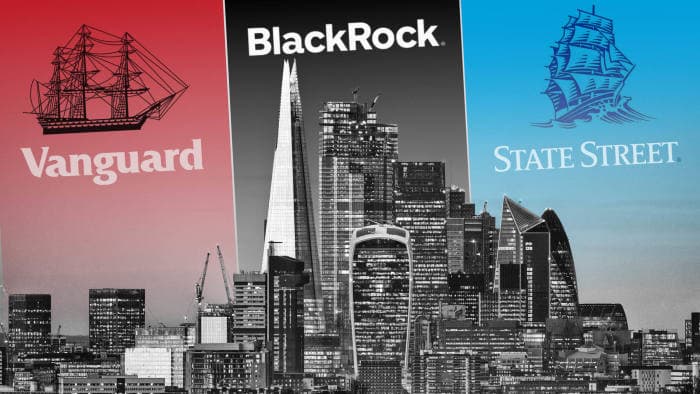
Academic research confirms BlackRock and/or Vanguard are among the top-3 institutional investors in all 505 S&P 500 companies (100%), and the single largest investor in 422 of them (84%). Together, the 'Big Three' control over $11 trillion in assets — more than all sovereign wealth funds combined — and own approximately 25% of voting shares in corporate America. Economists warn this unprecedented concentration could undermine competition across entire industries.
“BlackRock and Vanguard secretly own and control everything — every major corporation, every media company, every industry.”
What they said vs. what the evidence shows
“We manage assets on behalf of our clients, who are the true owners. Index fund ownership does not translate to corporate control.”
— BlackRock spokesperson · Jan 2020
SourceFrom “crazy” to confirmed
The Claim Is Made
This is the moment they called it crazy.
When you own a piece of Apple, chances are you're not alone. Three investment firms—BlackRock, Vanguard, and State Street—likely own pieces of it too. In fact, they probably own pieces of virtually every major company you've ever heard of, and collectively, they wield more financial power than any entity in human history.
For years, critics and independent researchers raised alarms about this concentration of corporate ownership. They pointed out that a handful of mega-funds held controlling stakes across entire industries, from technology to pharmaceuticals to energy. The establishment largely dismissed these concerns as conspiracy-minded, suggesting that institutional ownership was simply how modern markets functioned and that it posed no real threat to competition or democracy.
But the research has caught up. Academic studies now confirm what seemed paranoid to many just a few years ago. The data shows that BlackRock and/or Vanguard rank among the top three shareholders in all 505 companies in the S&P 500. In 422 of those companies—that's 84 percent—one of these three firms is the single largest shareholder. Together, they control more than $11 trillion in assets, exceeding the combined value of every sovereign wealth fund on the planet.
The scope of this ownership is difficult to overstate. These three firms don't just dabble in corporate America; they are woven into its very fabric. They own roughly 25 percent of all voting shares across the entire corporate landscape. An investor buying index funds—arguably the most common retirement investment today—is inevitably channeling money through these gatekeepers.
Get the 5 biggest receipts every week, straight to your inbox — plus an exclusive PDF: The Top 10 Conspiracy Theories Proven True in 2025-2026. No spam. No agenda. Just the papers they couldn't hide.
You just read "BlackRock, Vanguard, and State Street collectively own domin…". We send ones like this every week.
No one's said anything yet. Be the first to drop your take.
Confirmed: They Were Right
The truth comes out. Officially documented.
Confirmed: They Were Right
The truth comes out. Officially documented.
Academic researchers at Cambridge and contributors to The Conversation have documented this systematically. Their work reveals not a shadowy conspiracy but a structural reality that emerged gradually through decades of consolidation in the asset management industry. Index funds exploded in popularity because they were cheaper and more passive than actively managed funds. This growth naturally funneled trillions toward the largest index fund providers.
Yet this convenience came with a hidden cost. When three firms own major stakes in every competitor within an industry, traditional market competition begins to break down in subtle but significant ways. Economists point out that these firms have little incentive to aggressively compete on behalf of individual shareholders—there's no winner when BlackRock's holding in Company A competes too fiercely against Vanguard's holding in Company B. The real clients are the pension funds and retirement plans that feed capital into these giants.
What makes this claim particularly significant is not that it's false, but that it was so thoroughly dismissed when first raised. The architecture of modern finance quietly concentrated power in ways that most Americans didn't notice and couldn't easily name. By the time academic institutions formally documented the reality, the concentration was already entrenched.
The implications extend beyond markets. If three entities effectively control the largest companies in America, who actually holds power? Not consumers, certainly. Not workers negotiating wages. And arguably not even the theoretical shareholders whose votes these firms cast in boardrooms. The question becomes whether this level of concentration in the hands of unelected financial institutions is compatible with competitive markets or democratic accountability. The research confirms the claim was true. Now we must grapple with what that actually means.
See also: [How the 'Big Three' Control the S&P 500](/blog/big-three-shareholders-sp500-blackrock-vanguard-state-street) — our deeper breakdown of this topic.
Beat the odds
This had a 0.2% chance of leaking — someone talked anyway.
Conspirators
~100Network
Secret kept
5.6 years
Time to 95% exposure
500+ years