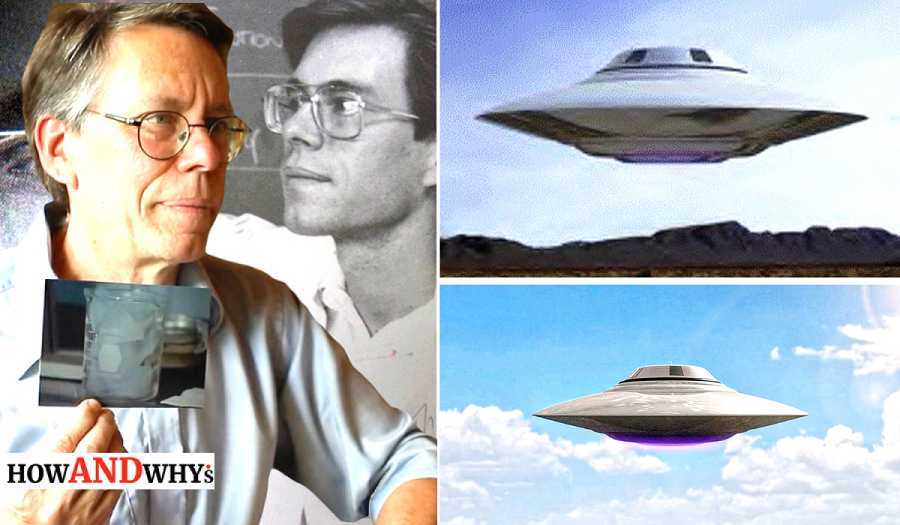
In 1989, Bob Lazar went public claiming he worked at a facility called S-4 near Area 51, where he was tasked with reverse-engineering one of nine extraterrestrial spacecraft. He described the craft's propulsion system as using Element 115 (moscovium), which was not synthesized by scientists until 2003. While Lazar's education and employment records cannot be verified (he claims they were erased), his knowledge of Area 51's layout and operations was confirmed by investigative journalists. Skeptics note that heavy elements beyond uranium were predicted by nuclear physics, and synthesized moscovium is highly unstable — unlike the stable isotope Lazar described.
“I worked on alien spacecraft at S-4 near Area 51. The propulsion system uses Element 115, which provides the gravity wave for space-time distortion. I'm coming forward because the public has a right to know.”
What they said vs. what the evidence shows
“Los Alamos has no record of Lazar's employment, MIT and Caltech have no record of his degrees. His story is riddled with verifiable falsehoods.”
— Stanton Friedman / MIT & Caltech (no records) · Jun 1990
SourceFrom “crazy” to confirmed
The Claim Is Made
This is the moment they called it crazy.
In 1989, a physicist named Bob Lazar sat down for an interview with a Las Vegas news station and made a claim that would define the UFO discussion for decades: he had worked inside a secret facility called S-4, located near Area 51, reverse-engineering alien spacecraft. What made his account compelling wasn't just the claim itself, but a specific technical detail buried within it — that these craft ran on Element 115, a synthetic element that wouldn't officially exist in a laboratory for another fourteen years.
Lazar's account was detailed and confident. He described the propulsion system, the layout of the facility, the nine craft he claimed to have observed. He explained how Element 115 supposedly created gravitational distortions that allowed the ships to manipulate spacetime itself. For someone working in nuclear physics, it was a remarkably specific prediction about the periodic table's future.
The immediate response from official sources was predictable. Government agencies denied everything. Lazar's educational credentials became impossible to verify — he claimed his records from MIT and Cal Tech had been erased as part of a cover-up. His employment history disappeared from databases. No photographs, no colleagues, no documentation emerged to support his story. To most observers in 1989, this looked like the hallmark of an elaborate hoax: convenient disappearance of evidence, grandiose claims, and an ex-employee with an axe to grind.
But something unexpected happened in 2003. Scientists at the Joint Institute for Nuclear Research in Dubna, Russia successfully synthesized Element 115, moscovium, for the first time. The element existed. Lazar's prediction had materialized into reality. The timing became harder to dismiss as coincidence — he had named a specific element that wasn't yet known to science, and it eventually appeared on the periodic table exactly where nuclear physics predicted it would be.
Get the 5 biggest receipts every week, straight to your inbox — plus an exclusive PDF: The Top 10 Conspiracy Theories Proven True in 2025-2026. No spam. No agenda. Just the papers they couldn't hide.
You just read "Bob Lazar claimed in 1989 he worked on alien craft at Area 5…". We send ones like this every week.
No one's said anything yet. Be the first to drop your take.
@1154630765012897792 — Trailer for film about Bob Lazar provides continued documentation and public interest in his 1989 claims about Element 115 and Area 51 S-4 facility
Trailer for film about Bob Lazar provides continued documentation and public interest in his 1989 claims about Element 115 and Area 51 S-4 facility
The complications began immediately, though. When synthesized, moscovium proved highly unstable, decaying within milliseconds. The version Lazar described — a stable, usable fuel source for spacecraft — remains theoretical at best. Nuclear physicists point out that the existence of heavy elements beyond uranium was already predicted by established physics models. Lazar didn't need alien technology to describe Element 115; he needed only to understand where the periodic table was heading.
The evidence regarding Area 51 itself proved more substantial. Investigative journalists independently confirmed details about the facility's layout and operations that matched Lazar's descriptions from decades earlier. These weren't secrets available in public documents. Yet critics note this proves only that Lazar had access to classified information, not necessarily that he worked on alien craft.
This case sits uneasily at the intersection of prediction and evidence. Lazar called something that later proved real, but the mechanism by which he knew it remains contested. Did he reverse-engineer an alien spacecraft, or did he simply understand advanced physics well enough to make an educated guess that happened to be correct?
The lingering question isn't really about Element 115 anymore. It's about what evidence would actually convince us, and whether our skepticism protects us or merely blinds us to possibilities that don't fit comfortable narratives.
Unlikely leak
Only 7% chance this would come out. It did.
Conspirators
~500Large op
Secret kept
36.5 years
Time to 95% exposure
500+ years