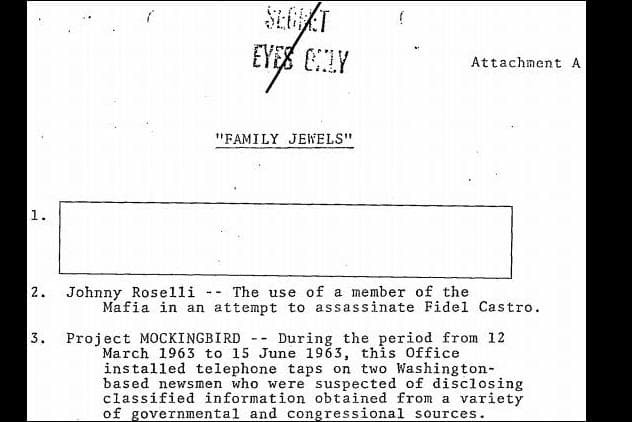
In 1973, CIA Director James Schlesinger ordered CIA employees to report any activities that might have been illegal or exceeded the agency's charter. The resulting 693-page document, known as 'The Family Jewels,' cataloged domestic wiretapping, surveillance of journalists, assassination plots, human experiments, and mail opening. The document was classified until June 2007 when it was finally released under FOIA after 34 years of secrecy.
“I want every single one of these skeletons. I want them all out of the closet.”
From “crazy” to confirmed
The Claim Is Made
This is the moment they called it crazy.
When CIA Director James Schlesinger took office in February 1973, he inherited an agency with a serious credibility problem. The Watergate scandal was unraveling, revelations about FBI abuses were mounting, and whispers about CIA misconduct were growing louder in Congress and the press.
Rather than wait for outside investigators to expose wrongdoing, Schlesinger made an unusual decision. He ordered every CIA employee to submit written reports about any activities that might have violated the law or exceeded the agency's legal authority. He wanted the violations documented internally, in one place, so leadership could understand the full scope of the problem.
What Schlesinger got back was a 693-page bombshell that the agency would spend the next three decades trying to bury.
The resulting document, informally titled "The Family Jewels," read like a confession written in bureaucratic language. It laid out domestic wiretapping operations targeting American citizens. It documented surveillance of journalists and news organizations. It detailed assassination plots against foreign leaders. It described illegal mail opening programs. It cataloged human experimentation involving LSD and other drugs, some conducted on unwitting American subjects. Each entry was methodically documented with dates, names, and operational details.
For years, the CIA simply denied the document's existence or claimed it was too sensitive to release. When pressed by Congress in the late 1970s, the agency acknowledged conducting some questionable activities but insisted most had been discontinued and were not worth discussing publicly. Officials suggested that exposing these details would compromise sources, methods, and ongoing intelligence operations.
Get the 5 biggest receipts every week, straight to your inbox — plus an exclusive PDF: The Top 10 Conspiracy Theories Proven True in 2025-2026. No spam. No agenda. Just the papers they couldn't hide.
You just read "The CIA compiled a 693-page internal report of its own crime…". We send ones like this every week.
No one's said anything yet. Be the first to drop your take.
Confirmed: They Were Right
The truth comes out. Officially documented.
Confirmed: They Were Right
The truth comes out. Officially documented.
The agency maintained this position for 34 years.
Then, in June 2007, the CIA released the full text of the Family Jewels under pressure from FOIA requests and Freedom of Information Act litigation. The document was declassified not because the agency suddenly became transparent, but because secrecy could no longer be legally justified. Researchers and journalists who had been requesting the document for decades finally held it in their hands.
What they read confirmed what critics had long suspected: the CIA had systematically violated American law and constitutional rights, often with the knowledge and approval of senior leadership. The violations weren't aberrations or rogue operations. They were programs. They were deliberate. And they were extensive.
The Family Jewels mattered for a simple reason: it proved that official denials had been false. When CIA officials testified to Congress in the 1970s that certain programs had ended or were minor in scope, they were lying. When they claimed the agency operated within legal boundaries, they were not being truthful. The declassified document provided documentary evidence of their dishonesty.
Three and a half decades of secrecy hadn't made the crimes disappear—it had only hidden them from the people those crimes had harmed and from the citizens whose taxes funded the agency. Once released, the Family Jewels became a permanent record that intelligence agencies cannot be trusted to police themselves, and that transparency, however delayed, eventually matters.
The document stands as evidence that what governments classify as secrets are often just inconvenient truths.
Beat the odds
This had a 2.7% chance of leaking — someone talked anyway.
Conspirators
~200Network
Secret kept
34.1 years
Time to 95% exposure
500+ years