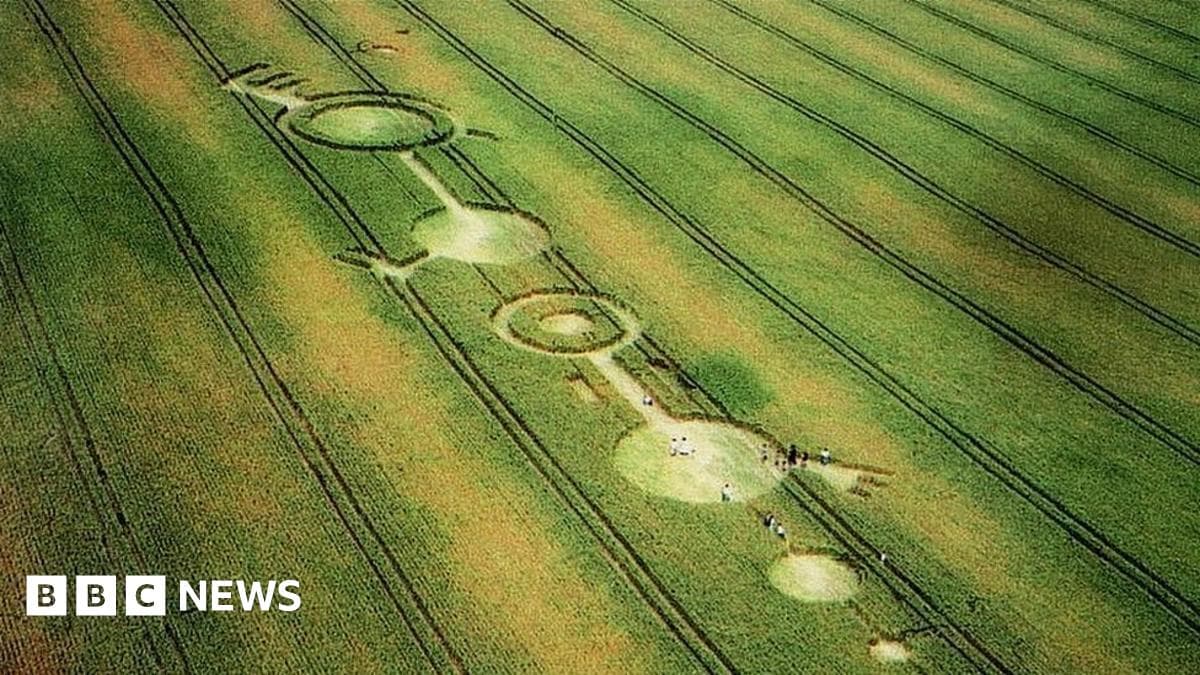
After Doug Bower and Dave Chorley admitted in 1991 to creating over 200 crop circles with ropes and boards, the phenomenon was widely dismissed. However, researchers note that some formations exhibit anomalies: bent (not broken) plant stalks, expulsion cavities in plant nodes suggesting rapid heating from inside, changes in soil crystalline structure, and electromagnetic anomalies. Complex formations incorporating advanced mathematical concepts like fractal geometry appeared overnight in areas with no tracks or evidence of human activity. Physicist Haselhoff published peer-reviewed research suggesting some circles show radiation patterns consistent with an overhead energy source. Mainstream science attributes all crop circles to human creation, noting that GPS and lasers easily explain increasing complexity.
“Some crop circles display physical anomalies in the plants and soil that cannot be replicated by mechanical flattening. These formations deserve serious scientific investigation.”
What they said vs. what the evidence shows
“We made over 200 of them. All you need is a plank, some rope, and a clear night. It's remarkable how easy it is to fool people into thinking these are supernatural.”
— Doug Bower & Dave Chorley / Matt Ridley (Scientific American) · Sep 1991
SourceFrom “crazy” to confirmed
The Claim Is Made
This is the moment they called it crazy.
When Doug Bower and Dave Chorley stepped forward in 1991 to claim responsibility for over 200 crop circles, the case seemed closed. Two middle-aged men with ropes and boards had apparently fooled the world for nearly a decade. The Smithsonian's documentation of their hoax became the definitive explanation, and mainstream science moved on. But moving on meant ignoring something inconvenient: not all crop circles matched the admitted hoaxers' methods or capabilities.
The dismissal was understandable. Once the human element was established, skepticism became the rational default position. Why investigate further when the mystery was already solved? Mainstream science pointed to increasingly sophisticated GPS and laser technology as explanations for complex formations appearing in later years. The narrative was tidy, conclusive, and required no additional research.
Yet researchers continued documenting anomalies that conventional explanations struggled to address. Some crop circle formations displayed plant stalks that were cleanly bent rather than broken—a detail that matters because human hoaxers using boards tend to snap plants, not flex them. More puzzling were the expulsion cavities found in plant nodes, microscopic structures that suggest rapid, intense heating from inside the plants themselves. Soil samples collected from multiple sites showed crystalline structure changes inconsistent with mechanical pressure from boards or trampling.
The complexity argument is where the case becomes harder to dismiss. Certain formations incorporated advanced mathematical concepts, including fractal geometry patterns that would require either sophisticated training or extensive overnight planning. Yet investigators found no tracks leading to these sites, no evidence of equipment, and no witnesses despite occurring in areas where human activity should leave traces. The speed of creation—overnight appearances in monitored fields—presents a practical challenge for the rope-and-board theory.
Get the 5 biggest receipts every week, straight to your inbox — plus an exclusive PDF: The Top 10 Conspiracy Theories Proven True in 2025-2026. No spam. No agenda. Just the papers they couldn't hide.
You just read "While many crop circles are proven hoaxes, some formations e…". We send ones like this every week.
No one's said anything yet. Be the first to drop your take.
Confirmed: They Were Right
The truth comes out. Officially documented.
Confirmed: They Were Right
The truth comes out. Officially documented.
Physicist Eltjo Haselhoff published peer-reviewed research suggesting that some crop circles display radiation patterns consistent with an overhead energy source, not ground-level human activity. While his work remains controversial within mainstream science, its publication in peer-reviewed journals indicates that some serious investigators believe the phenomenon warrants continued examination rather than categorical dismissal.
This is where the story matters beyond the novelty of unexplained circles in wheat fields. The crop circle case demonstrates how an established narrative can calcify into accepted fact even when evidence remains incomplete. Bower and Chorley's admission didn't prove they created all crop circles—it proved they created some. That distinction matters, but it's been largely lost in the rush to close the file.
The real issue isn't whether crop circles are real or hoaxes. It's that documented anomalies exist that don't fit the standard explanations, yet those anomalies receive minimal scientific attention. When we dismiss evidence because it contradicts our preferred conclusion, we're not practicing skepticism—we're practicing faith.
What gets lost in this approach is the opportunity to understand genuinely unexplained phenomena. Whether crop circles result from unknown natural forces, human technology we don't fully understand, or something else entirely, that knowledge has value. The public's instinct to question official explanations isn't irrational when those explanations demonstrably leave gaps.
The crop circle case suggests that sometimes being right about most of something doesn't mean we can ignore the parts that don't fit.