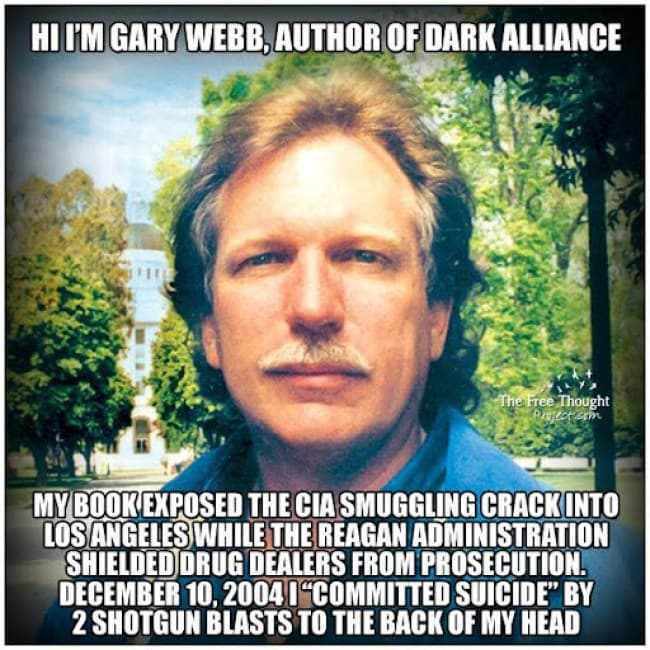
San Jose Mercury News series revealed CIA-connected Nicaraguan dealers flooded LA with crack to fund Contra war. Webb documented how profits supported CIA-backed rebels while devastating Black communities, leading to his professional ostracism and later suicide.
“The CIA has never been involved in drug trafficking or had any connections to cocaine dealers”
From “crazy” to confirmed
The Claim Is Made
This is the moment they called it crazy.
When investigative journalist Gary Webb published "Dark Alliance" in the San Jose Mercury News in August 1996, he documented something the U.S. government had spent years denying: a direct connection between CIA-backed Nicaraguan rebels and the crack cocaine flooding Los Angeles in the 1980s. The three-part series alleged that agents with ties to the CIA's Contra operation had systematically supplied cocaine to major dealers in South Central LA, with profits funneling back to fund the anti-Sandinista war effort.
The claim was straightforward but explosive. Webb showed that while the Reagan administration publicly fought the War on Drugs with increasing intensity, covert operatives were facilitating the very drug trade that devastated Black communities across America. He named specific dealers, traced specific transactions, and documented how these operations were coordinated with U.S. intelligence agencies. The series ran for months and generated immediate international attention.
The response from official channels was swift and coordinated. The CIA, DEA, and various government officials dismissed Webb's reporting as conspiracy theory nonsense. The Washington Post and New York Times—institutions that could have amplified the story nationally—instead assigned reporters to debunk it. Webb was portrayed as a sensationalist chasing shadows. Intelligence officials testified before Congress that the allegations were unsubstantiated. His own editor at the Mercury News eventually distanced the paper from his work. Within three years, Webb was forced out of journalism entirely. In 2004, he died by gunshot wound in what authorities ruled a suicide.
Get the 5 biggest receipts every week, straight to your inbox — plus an exclusive PDF: The Top 10 Conspiracy Theories Proven True in 2025-2026. No spam. No agenda. Just the papers they couldn't hide.
You just read "Gary Webb exposed CIA connections to crack cocaine epidemic …". We send ones like this every week.
No one's said anything yet. Be the first to drop your take.
Yet the documentary record eventually vindicated Webb's core claims. The 1998 CIA Inspector General report—which the agency initially tried to keep secret—confirmed that CIA-connected Contra operatives had indeed trafficked cocaine, and that the agency had not adequately investigated these connections while the drug war was raging. The report acknowledged what officials had vehemently denied: that some CIA assets had drug trafficking relationships, that agency officials knew about these relationships, and that they were not always reported to the DEA.
Documents released under FOIA requests showed that federal investigators had compiled evidence about these connections as early as the mid-1980s but chose not to pursue major cases. Law enforcement officers working street-level narcotics cases filed reports up the chain describing exactly what Webb later documented—organized networks moving cocaine in suspicious patterns with apparent government knowledge. Those reports were filed away.
None of this exonerated the systems that crushed Webb professionally. No major news organization that debunked him later issued formal corrections. Webb never saw his vindication before his death. The damage to his reputation and career remained intact.
What matters about this case is not whether every detail of Webb's reporting was perfectly accurate—investigative journalism rarely is. What matters is that he documented something true and substantial: that government agencies had knowingly failed to interdict drug trafficking by their own assets, and that this failure had catastrophic consequences for entire American communities. When institutions coordinate to discredit inconvenient truth-telling, and when that coordinated response succeeds in silencing a journalist and his work, we should ask what else we're not hearing about.
The Gary Webb story teaches us that official denial is not the same as fact, and that institutions protecting themselves can weaponize media and professional ostracism against those who threaten their narratives.
Unlikely leak
Only 5.8% chance this would come out. It did.
Conspirators
~500Large op
Secret kept
29.7 years
Time to 95% exposure
500+ years