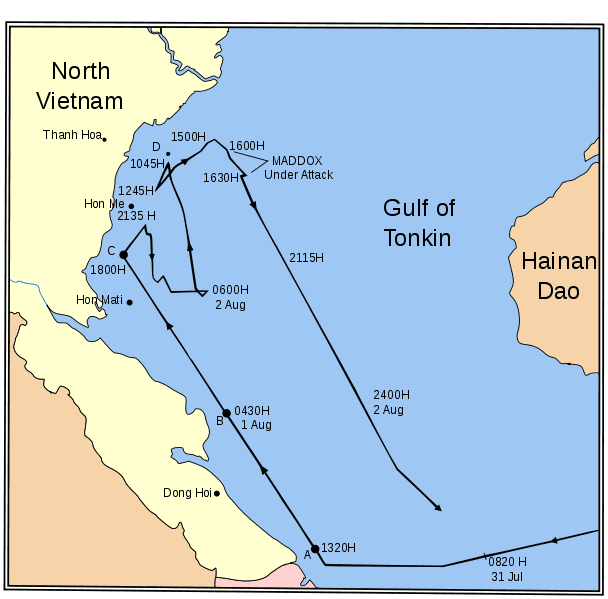
On August 4, 1964, the USS Maddox reportedly came under a second attack by North Vietnamese torpedo boats. President Johnson used this to push the Gulf of Tonkin Resolution through Congress, giving him unlimited military authority. NSA documents declassified in 2005 confirmed the agency deliberately manipulated signals intelligence to fabricate the second attack. Secretary McNamara later admitted the August 4th incident did not occur. The resolution led to the deaths of 58,000 Americans and millions of Vietnamese.
“The Gulf of Tonkin incident... involved deliberate distortion of intelligence reports. The second attack never happened.”
What they said vs. what the evidence shows
“The initial attack on the destroyer Maddox, on August 2, was repeated today by a number of hostile vessels attacking two U.S. destroyers with torpedoes.”
— President Lyndon B. Johnson · Aug 1964
SourceFrom “crazy” to confirmed
The Claim Is Made
This is the moment they called it crazy.
On August 4, 1964, President Lyndon B. Johnson told the American people that the USS Maddox had been attacked twice by North Vietnamese torpedo boats in the Gulf of Tonkin. The second attack, he claimed, was an unprovoked act of aggression that demanded a military response. Congress believed him, and within days, the Gulf of Tonkin Resolution passed with overwhelming support, giving Johnson essentially unlimited authority to wage war in Southeast Asia.
What followed was the Vietnam War—a conflict that would kill 58,000 Americans and millions of Vietnamese over the next decade. The war divided the nation, sparked massive protests, and fundamentally altered American foreign policy. But it was all built on an attack that never happened.
The first attack on August 2 was real. The Maddox genuinely encountered North Vietnamese torpedo boats in international waters and returned fire. But the second attack, the one used to justify the war resolution, existed only in misinterpreted radar signals and the deliberate manipulation of intelligence reports.
At the time, military and government officials presented the August 4th incident as established fact. Secretary of Defense Robert McNamara testified before Congress that the attack had occurred. The Joint Chiefs of Staff treated it as confirmed. Newspapers ran with the story. Skeptics who questioned the account were dismissed as naive or unpatriotic. The narrative was locked in place before anyone could seriously investigate whether it was true.
For decades, the official story held. Doubts emerged in the 1960s and 1970s among historians and investigative journalists, but the government maintained the attacks had happened. The cold war made such questions seem almost treasonous. Vietnam veterans were told they had fought because America had been attacked. Families who lost loved ones believed their sacrifice was in response to enemy aggression.
Get the 5 biggest receipts every week, straight to your inbox — plus an exclusive PDF: The Top 10 Conspiracy Theories Proven True in 2025-2026. No spam. No agenda. Just the papers they couldn't hide.
You just read "The second Gulf of Tonkin attack that triggered the Vietnam …". We send ones like this every week.
No one's said anything yet. Be the first to drop your take.
Confirmed: They Were Right
The truth comes out. Officially documented.
Confirmed: They Were Right
The truth comes out. Officially documented.
The truth only emerged when the National Security Agency declassified its internal documents in 2005. The files revealed what NSA analysts had discovered even at the time: there was no second attack. The radar signals that operators thought showed enemy boats were actually weather phenomena and false readings. More damning still, the documents showed that NSA officials had deliberately altered and manipulated the signals intelligence presented to policymakers. They knew what they were reporting was unreliable, and they reported it anyway.
Robert McNamara, the architect of the war, acknowledged years later that the August 4th attack did not occur. He confirmed what the NSA documents had proven: intelligence had been deliberately shaped to support a decision that had already been made. The question of whether to escalate in Vietnam was political, not military. The attack was the justification they needed.
This case matters beyond history. It demonstrates how easily democratic societies can be led into war through intelligence manipulation. It shows that even the most powerful institutions—the Pentagon, the NSA, the presidency—can deliberately deceive the public. And it reveals that official denials, congressional testimony, and media reports can all be fabrications layered so thickly that truth becomes difficult to reach.
The Gulf of Tonkin incident did not prove that skepticism of government was justified. It proved that institutional skepticism is necessary. Americans died because their leaders lied, and the machinery of power was built to protect those lies until declassification made them impossible to deny.
Unlikely leak
Only 15.2% chance this would come out. It did.
Conspirators
~1,000Large op
Secret kept
41.2 years
Time to 95% exposure
500+ years