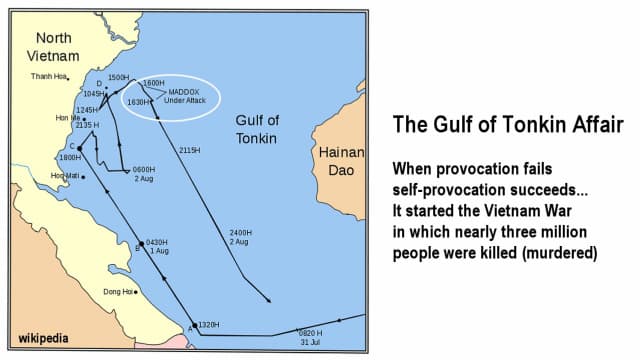
The second alleged attack on August 4, 1964, never actually occurred. Declassified NSA documents in 2005 confirmed that signals intelligence was manipulated to support the claim of a North Vietnamese attack.
“The August 4th attack in the Gulf of Tonkin did not happen as reported. The intelligence was manipulated.”
From “crazy” to confirmed
The Claim Is Made
This is the moment they called it crazy.
On August 2, 1964, American destroyers reported being attacked by North Vietnamese torpedo boats in the Gulf of Tonkin. Two days later, another attack was allegedly reported. These incidents gave President Lyndon B. Johnson the political cover he needed to push the Gulf of Tonkin Resolution through Congress, which authorized an unprecedented expansion of military operations in Vietnam. Within months, Operation Rolling Thunder began—a sustained bombing campaign that would last three years and kill an estimated 52,000 American servicemen and over a million Vietnamese civilians.
For decades, the second attack existed in a murky space between fact and assumption. Military officials insisted it happened. Congressional leaders voted to approve the resolution based on briefings claiming it had occurred. Textbooks taught it as history. But serious questions persisted among researchers and former military personnel who had been there that night. The waters were rough. The radar signals were unclear. Some officers at the time expressed doubts about whether North Vietnamese boats had actually fired on the American destroyer USS Turner Joy.
Those skeptics were dismissed as second-guessers or Vietnam War opponents with an axe to grind. The official position from the Department of Defense remained firm: both attacks happened, and the military response was justified. Critics were told they lacked access to classified information. The government had signals intelligence—intercepted North Vietnamese communications—that proved the attack occurred. That was enough to end most public debate.
Then, in 2005, forty years after the incident, the National Security Agency its internal report on the affair. 's own analysis revealed what many suspected but could never prove: the second attack on August 4 never happened. More damaging still, the showed that signals intelligence had been manipulated and presented selectively to support a predetermined conclusion.
Get the 5 biggest receipts every week, straight to your inbox — plus an exclusive PDF: The Top 10 Conspiracy Theories Proven True in 2025-2026. No spam. No agenda. Just the papers they couldn't hide.
You just read "The Gulf of Tonkin incident that justified US escalation in …". We send ones like this every week.
No one's said anything yet. Be the first to drop your take.
Confirmed: They Were Right
The truth comes out. Officially documented.
Confirmed: They Were Right
The truth comes out. Officially documented.
The NSA report found that radar operators had misinterpreted weather signals as enemy vessels. Sonar operators had been confused by acoustic anomalies in the water. But the most striking discovery involved the supposed intercepted communications. The NSA had actually altered and misrepresented the signals intelligence it presented to policymakers. Specific intelligence assessments showing doubt about an attack were buried or reworded to support the narrative that an attack had occurred.
This wasn't a case of honest misinterpretation or the fog of war. The declassified documents show deliberate manipulation of classified information by officials who wanted justification for a military escalation they had already decided to pursue. The intelligence didn't drive the policy—the policy drove the intelligence.
The Gulf of Tonkin deception matters because it revealed something fundamental about how governments can use classified information as a tool to control public debate. Americans voted, Congress voted, and soldiers fought and died—all based on signals intelligence that officials knew was misrepresented. It established a troubling precedent: classified information can be weaponized against democratic accountability, and it takes decades of declassification to expose the truth.
The lesson isn't that all government claims are lies. It's that when officials invoke classified intelligence to justify major decisions, skepticism isn't unpatriotic—it's essential.
Unlikely leak
Only 15.2% chance this would come out. It did.
Conspirators
~1,000Large op
Secret kept
41.2 years
Time to 95% exposure
500+ years