Declassified NSA documents revealed the second Gulf of Tonkin attack likely never occurred, while military officials presented exaggerated and misleading reports to Congress to justify major Vietnam War escalation.
“North Vietnamese forces conducted unprovoked attacks on US naval vessels in international waters, requiring immediate military response”
From “crazy” to confirmed
The Claim Is Made
This is the moment they called it crazy.
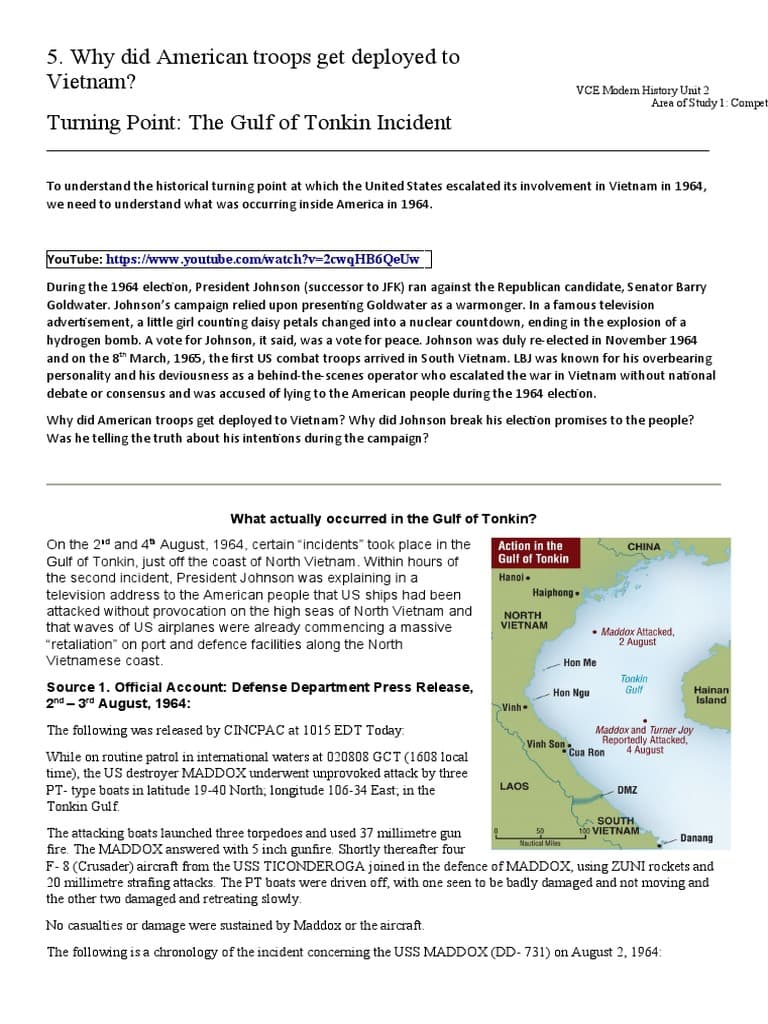
On August 2, 1964, American destroyers reported being attacked by North Vietnamese patrol boats in the Gulf of Tonkin. Three days later, military officials claimed it happened again. Congress believed them. Within days, lawmakers passed the Gulf of Tonkin Resolution, effectively handing President Lyndon B. Johnson a blank check to wage full-scale war in Vietnam without a formal declaration.
The incidents seemed straightforward at the time. The USS Maddox was supposedly attacked first in broad daylight—that part appears to have actually happened. But the second attack, allegedly occurring on August 4 during a dark, stormy night, became the justification for one of America's most controversial wars. Military commanders reported radar contacts, sonar signals, and enemy fire. Pentagon officials presented these reports to Congress as indisputable fact.
For years, the official story held. Veterans who served in the Gulf of Tonkin knew something felt off about the accounts, but they lacked proof. Skeptics questioned the narrative, but they were often dismissed as unpatriotic or anti-military. The Johnson administration insisted the evidence was solid. Military brass stood by their reports. The war escalated, eventually costing 58,000 American lives and over a million Vietnamese lives.
Then declassified documents surfaced. In 2005, the National Security Agency released previously hidden intelligence records related to the incident. These documents revealed what skeptics had long suspected: the second attack almost certainly never happened.
Get the 5 biggest receipts every week, straight to your inbox — plus an exclusive PDF: The Top 10 Conspiracy Theories Proven True in 2025-2026. No spam. No agenda. Just the papers they couldn't hide.
You just read "Gulf of Tonkin Incident Reports Were Deliberately Exaggerate…". We send ones like this every week.
No one's said anything yet. Be the first to drop your take.
The declassified NSA files showed that radar operators had misinterpreted weather patterns as enemy ships. Sonar operators mistook acoustic anomalies for torpedo launches. In the darkness and confusion, military personnel convinced themselves they were under attack—and then reported what they expected to find rather than what they actually detected. The incident became a case study in perception bias and the fog of war.
But there was more to the story than simple confusion. Declassified materials also revealed that military officials, particularly in the Pentagon, had presented exaggerated and misleading interpretations of the evidence to political leadership. They shaped the narrative to support decisions that had already been made. The war planners wanted escalation, and the Gulf of Tonkin incident provided the political cover they needed.
Congressional leaders received sanitized briefings. Key details about the questionable nature of the second attack were omitted or downplayed. President Johnson later admitted privately that he wasn't even sure an attack had occurred, yet he used it publicly to justify the war. The information asymmetry was stark: the public and Congress operated on incomplete, slanted intelligence while military strategists knew the situation was murkier than they were letting on.
The Gulf of Tonkin incident stands as a watershed moment in American history. It demonstrates how institutions can manufacture consent for major decisions when the public and elected representatives lack access to complete information. The incident showed that even senior government officials operate on what they're told, not necessarily what's true.
Decades later, when documents finally emerged, most Americans had moved on. The war had already ended. The damage was done. What remains is a crucial lesson: the burden of proof for military escalation must rest with the institution proposing it, not with skeptics questioning its claims. When officials control both the information and the narrative, accountability becomes nearly impossible until it's too late.
Beat the odds
This had a 2.2% chance of leaking — someone talked anyway.
Conspirators
~100Network
Secret kept
54.9 years
Time to 95% exposure
500+ years