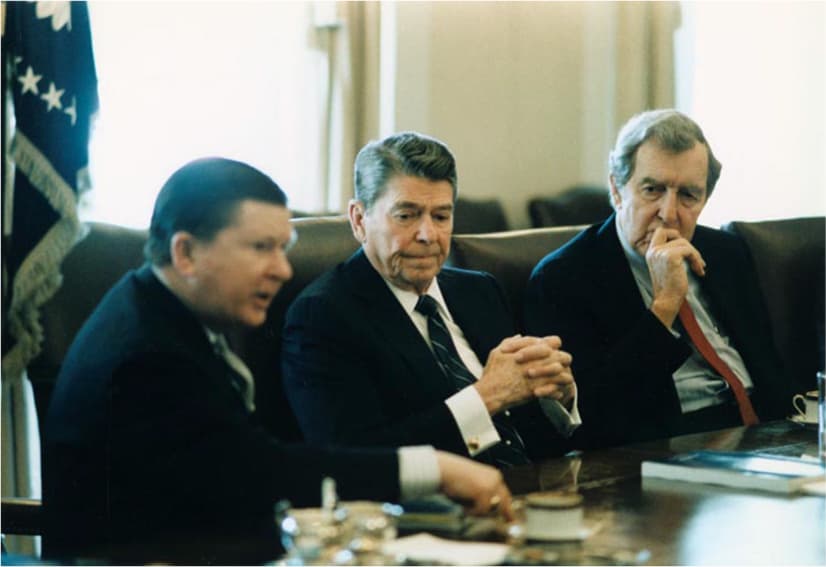
Senior Reagan administration officials secretly facilitated arms sales to embargoed Iran and used the proceeds to fund the Contras in Nicaragua, violating the Boland Amendment. Confirmed through the Tower Commission and congressional investigations.
“The US government is secretly selling weapons to Iran and using the money to fund rebel groups in Central America in violation of federal law.”
From “crazy” to confirmed
The Claim Is Made
This is the moment they called it crazy.
When a leaked national security advisor's memo surfaced in 1986, it revealed something that seemed impossible: the Reagan administration had been secretly selling weapons to Iran—the very country American diplomats had publicly called a state sponsor of terrorism. Worse, officials had allegedly funneled the profits into a covert war in Central America that Congress had explicitly forbidden.
At the time, the White House dismissed the allegations as fabrications. President Reagan's team maintained that no such arms sales had occurred and that even if they had, every action taken was within legal bounds. Critics were portrayed as naive about the complexities of foreign policy or, worse, as opponents of American anti-communist efforts. The administration's message was consistent and forceful: this was politically motivated fiction designed to undermine their Central American strategy.
The Iran-Contra affair, as it came to be known, unraveled over months of congressional testimony and document releases. The Tower Commission, established by Reagan himself to investigate the matter, published its findings in 1987. What the commission documented was damning: senior administration officials, including National Security Advisor John Poindexter and Oliver North of the National Security Council staff, had indeed orchestrated covert arms shipments to Iran. The proceeds—millions of dollars—were then diverted to support the Contras, right-wing rebels fighting Nicaragua's leftist government.
The timing was particularly damaging to the administration's credibility. Congress had passed the Boland Amendment in 1984 specifically to prevent funding the Contras. The Reagan administration's response wasn't to challenge this legal restriction through proper channels. Instead, they circumvented it entirely through a secret network of operatives and intermediaries. When questioned, they lied about their actions to Congress and the American public.
Get the 5 biggest receipts every week, straight to your inbox — plus an exclusive PDF: The Top 10 Conspiracy Theories Proven True in 2025-2026. No spam. No agenda. Just the papers they couldn't hide.
You just read "The Reagan administration secretly sold arms to Iran and ill…". We send ones like this every week.
No one's said anything yet. Be the first to drop your take.
Confirmed: They Were Right
The truth comes out. Officially documented.
Confirmed: They Were Right
The truth comes out. Officially documented.
The evidence was overwhelming because it came from government's own investigative machinery. The Tower Commission wasn't a media investigation or partisan witch hunt—it was a formal inquiry led by respected figures appointed by the president himself. Congressional committees reviewed classified documents, interviewed witnesses under oath, and published extensive reports detailing the operation. This wasn't conspiracy theory territory. It was conspiracy fact, documented in official government records.
What makes this case particularly instructive is how thoroughly dismissed it was before verification. Skepticism about the initial claims was reasonable—extraordinary allegations do require extraordinary evidence. But the systematic denials, the dismissal of reporters following the story, and the ridicule of those raising questions reflected something deeper: an institutional resistance to accountability. Only when the evidence became impossible to ignore did the administration shift from denying the facts to debating their interpretation.
The Iran-Contra affair matters today because it demonstrates how government institutions can be used to subvert their own stated rules. It also reveals how public trust erodes not from a single acknowledged mistake, but from the gap between what officials claim and what documents later prove. Citizens who were told their government would never do such things watched as evidence showed it had done exactly that.
The lesson isn't that governments always lie. It's that when officials make blanket denials about matters of significant public concern, skepticism grounded in document review and investigation serves an essential function. Sometimes, the rejected claim turns out to be the documented truth.
Beat the odds
This had a 0.4% chance of leaking — someone talked anyway.
Conspirators
~500Large op
Secret kept
2.2 years
Time to 95% exposure
500+ years