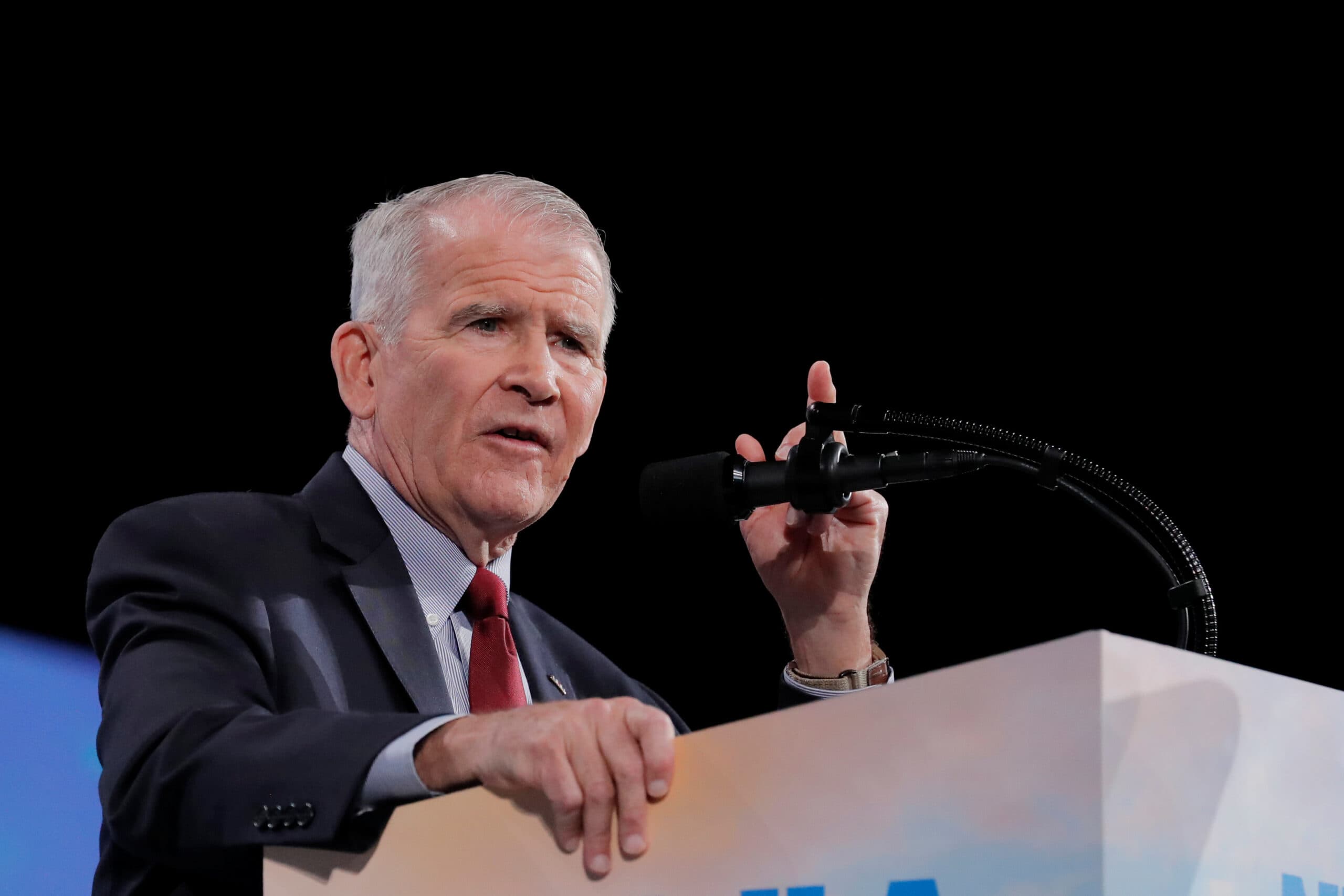
The Iran-Contra affair revealed that NSC staff member Lt. Col. Oliver North operated a shadow foreign policy from the White House basement, secretly selling weapons to Iran (which Congress had embargoed) and using the profits to fund Nicaraguan Contras (which Congress had explicitly banned). North maintained a secret Swiss bank account and shredded evidence. Fourteen officials were indicted; President Reagan claimed no knowledge.
“I participated in the preparation of documents for the President of the United States that I knew to be false and misleading.”
From “crazy” to confirmed
The Claim Is Made
This is the moment they called it crazy.
When Lieutenant Colonel Oliver North began work at the National Security Council in 1981, few Americans knew his name. By 1987, he had become the public face of one of the most consequential government scandals in modern history—and evidence showed that much of what critics had alleged about his secret operations was exactly true.
The claim was straightforward but almost too extraordinary to believe: a mid-level Pentagon officer had essentially created a parallel government inside the White House basement. While Congress had explicitly forbidden aid to Nicaragua's Contra rebels and imposed a strict embargo on selling weapons to Iran, North was doing both—simultaneously. He wasn't acting alone, but he was the operational hub, the person who made the machinery work.
The official response, when the story first broke in 1986, was dismissal bordering on ridicule. The Reagan administration initially claimed ignorance. When pressed, officials suggested that if anything unauthorized had occurred, it was the work of overzealous subordinates acting without higher approval. President Reagan himself would later state he had no knowledge of the arms sales to Iran. The suggestion that a Lieutenant Colonel could orchestrate foreign policy decisions of this magnitude without presidential knowledge struck many observers as either impossible or a convenient fiction.
What made the claim impossible to dismiss was the paper trail. The Iran-Contra affair, as it became known, was exposed through multiple investigative channels throughout 1986 and 1987. Congressional investigators and the Department of Justice Office of Inspector General discovered that North had maintained a secret Swiss bank account funneling money from Iranian arms sales directly to the Contra forces in Central America. He had operated with such confidence in his position that he kept detailed notes and records—until the moment he realized the investigation was closing in, at which point he systematically shredded the evidence.
Get the 5 biggest receipts every week, straight to your inbox — plus an exclusive PDF: The Top 10 Conspiracy Theories Proven True in 2025-2026. No spam. No agenda. Just the papers they couldn't hide.
You just read "Oliver North ran a secret parallel government from the White…". We send ones like this every week.
No one's said anything yet. Be the first to drop your take.
Confirmed: They Were Right
The truth comes out. Officially documented.
Confirmed: They Were Right
The truth comes out. Officially documented.
The numbers were staggering. Between 1985 and 1987, the United States secretly transferred over $30 million in weapons to Iran, a nation openly hostile to American interests and explicitly subject to a congressional arms embargo. The proceeds—millions of dollars—were diverted to support the Contras, despite Congress having voted to cut off military aid to the rebel group. North's operation existed in plain sight within the Executive Office of the President, yet remained hidden from Congress and the public for years.
Fourteen government officials were ultimately indicted in connection with the scandal. Convictions were secured, though many were later pardoned. The damage to public trust, however, could not be undone with a pardon. The Iran-Contra affair demonstrated that the assumption of oversight—that Congress could restrict executive action through legislation—was only as strong as the administration's willingness to comply.
This case matters because it revealed something uncomfortable about American governance: executive power, combined with secrecy and ideological commitment, could override statutory law. North wasn't operating in some theoretical gray zone. Congress had voted. Laws had been passed. And yet, for years, those laws were simply ignored through the creation of an extra-legal apparatus. The question wasn't whether someone could run a secret government from the basement. The question was why nobody had been able to stop it until it was too late.
Beat the odds
This had a 0.1% chance of leaking — someone talked anyway.
Conspirators
~500Large op
Secret kept
0.7 years
Time to 95% exposure
500+ years