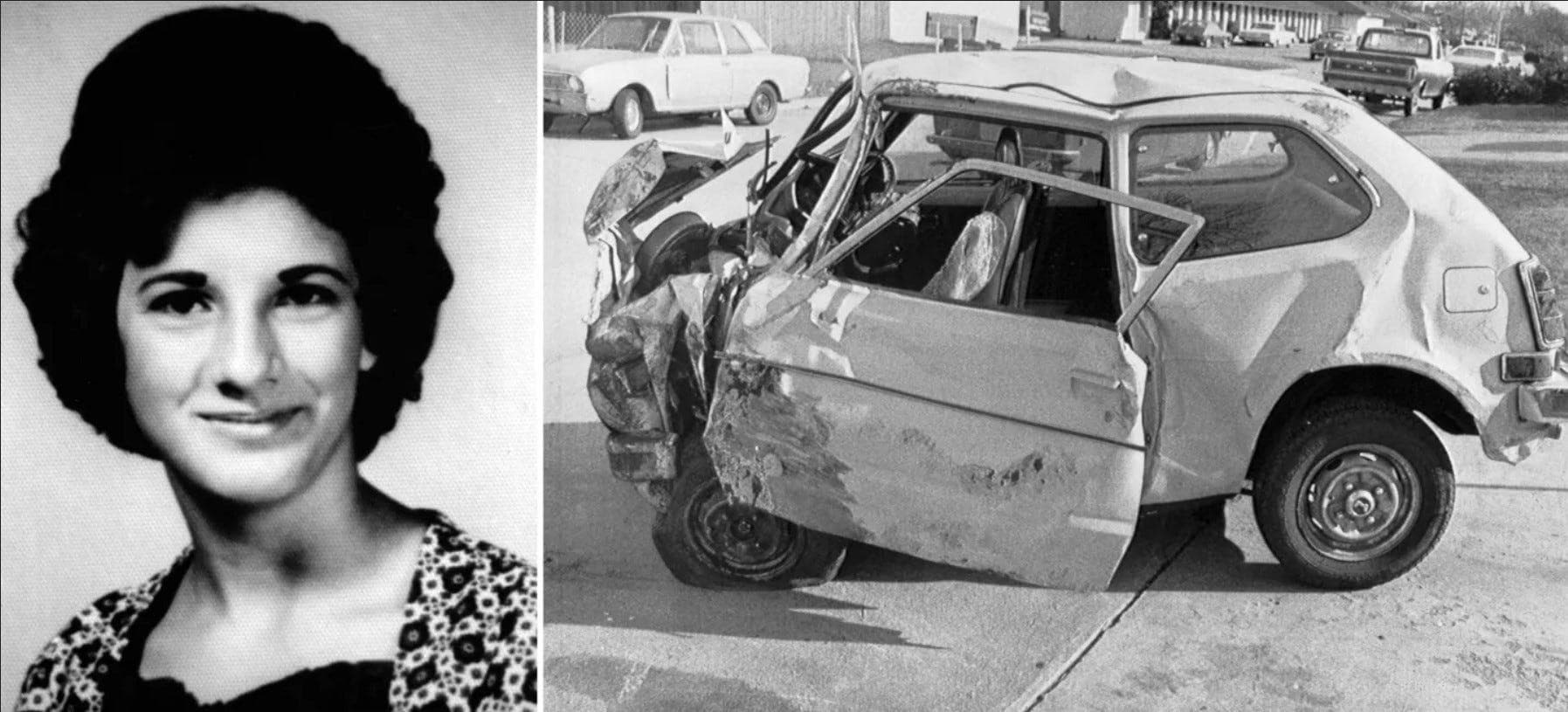
Plutonium plant worker died in suspicious car crash in 1974 while en route to meet reporter with evidence of safety violations. Family lawsuit revealed extensive contamination cover-ups.
“Silkwood's death was an unfortunate accident unrelated to her employment”
From “crazy” to confirmed
The Claim Is Made
This is the moment they called it crazy.
On November 13, 1974, Karen Silkwood never made it to her meeting. The 28-year-old plutonium processing worker was driving through the dark Oklahoma night, carrying documents about safety violations at the Kerr-McGee nuclear facility where she worked. Her car was found wrapped around a concrete culvert the next morning. She had been dead for hours.
For decades, the official story was simple: it was an accident. A tired worker on a late shift, perhaps distracted, simply lost control on a curve. The Kerr-McGee Corporation, one of America's major nuclear contractors, expressed regret. The authorities filed their reports. The case seemed closed.
But Karen Silkwood's family and the workers who knew her refused to accept that narrative. She had been actively raising alarms about contamination levels at the facility—both to coworkers and to journalists. In the weeks before her death, she had documented evidence of quality control problems, falsified safety records, and plutonium contamination that company officials were allegedly downplaying. These weren't vague concerns whispered in hallways. They were specific allegations backed by her own observations as someone working directly with the material.
What emerged through the family's civil lawsuit against Kerr-McGee was far more damaging to the company's reputation than any accident theory. The legal discovery process revealed that the plutonium plant had indeed experienced extensive contamination—not just of the facility, but of workers themselves. Silkwood's own body showed elevated plutonium levels when she was tested after her death. The company's safety protocols, it turned out, were far less rigorous than publicly stated.
The lawsuit also established that Silkwood had been intentionally contaminated at some point before her death, though the exact circumstances remained murky. What was clear: her concerns about safety were legitimate. The violations she wanted to expose were real.
Get the 5 biggest receipts every week, straight to your inbox — plus an exclusive PDF: The Top 10 Conspiracy Theories Proven True in 2025-2026. No spam. No agenda. Just the papers they couldn't hide.
You just read "Karen Silkwood Case - Nuclear Worker Killed After Exposing S…". We send ones like this every week.
No one's said anything yet. Be the first to drop your take.
In 1986, twelve years after her death, a jury found Kerr-McGee liable for her contamination in a landmark decision. The company was ordered to pay damages. Yet crucial questions about that fatal car crash itself were never definitively answered. Was it truly an accident? Some investigators noted that her car had been struck from behind, though the official investigation dismissed this. No autopsy was performed. No toxicology tests were conducted. The wreck was never thoroughly examined for evidence of tampering.
The case occupies an unusual space in the documentary record. The safety violations Silkwood exposed were vindicated through court proceedings. Her contamination was proven real. But the circumstances of her death remain officially unexplained in a way that has fueled speculation for fifty years.
What the Silkwood case ultimately demonstrates is how institutional power operates in the shadows of official channels. Even when a whistleblower is vindicated about safety failures, the mechanism of her silencing may never face scrutiny. The pattern itself—worker raises concerns, worker dies under suspicious circumstances, official investigators find nothing worth pursuing—becomes the story. Whether or not foul play occurred in that Oklahoma roadway, the system that allowed questions to go unanswered is the real problem.
Unlikely leak
Only 18.6% chance this would come out. It did.
Conspirators
~1,000Large op
Secret kept
51.5 years
Time to 95% exposure
500+ years