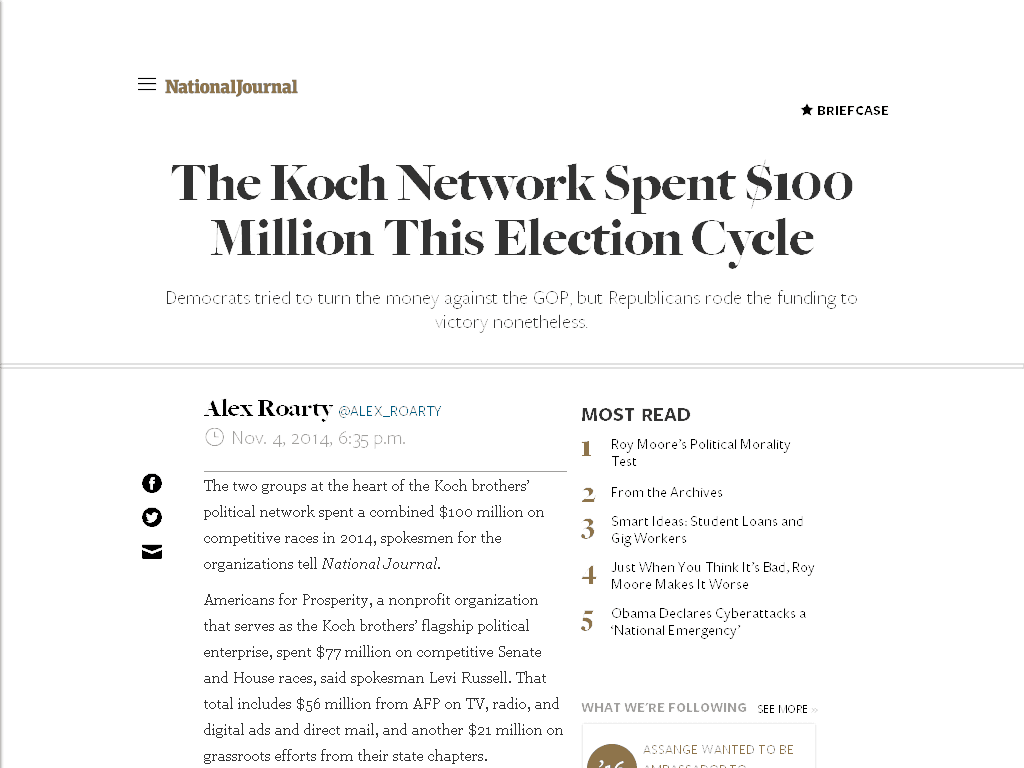
From 2004-2019, the Koch brothers built an 'integrated stealth network' of think tanks, media outlets, and academic programs to reshape public opinion. Political scientist Theda Skocpol identified 2007 as the 'turning point' when climate denial was deliberately and rapidly disseminated through conservative media, achieving 'saturation coverage' reaching 30-40% of the US population. Jane Mayer's 'Dark Money' documented how Koch-funded organizations manufactured doubt about climate science. The network accounted for about a quarter of all dark money spending in 2012. Charles Koch's own 1976 paper described plans to 'destroy the statist paradigm.'
“The Koch brothers have spent hundreds of millions building a shadow network of think tanks, media organizations, and academic programs specifically designed to manufacture doubt about climate change and block environmental regulation.”
What they said vs. what the evidence shows
“Charles Koch's philanthropic and civic activities are driven by his belief in free markets and individual liberty. The suggestion of a coordinated propaganda campaign is unfounded.”
— Koch Industries Spokesperson · Feb 2016
SourceFrom “crazy” to confirmed
The Claim Is Made
This is the moment they called it crazy.
When political scientist Theda Skocpol began studying climate policy networks in the mid-2000s, she expected to find something predictable: competing interest groups making their usual pitches. What she found instead was something far more systematic. A single family's network of organizations had orchestrated what she would later call the "turning point" in American climate discourse—the moment when doubt about climate science stopped being fringe and became mainstream Republican doctrine.
The claim was straightforward but audacious: Charles and David Koch, billionaire brothers who built their fortune in oil and petrochemicals, had spent hundreds of millions of dollars constructing what researchers described as an "integrated stealth network" of think tanks, media outlets, and academic programs specifically designed to manufacture doubt about climate change. This wasn't just political lobbying. This was infrastructure. And it worked.
For years, defenders of the Koch network dismissed such accusations as conspiracy thinking. They argued that the Kochs were simply exercising their right to fund causes they believed in, no different from any other wealthy donor. The network's representatives claimed their think tanks and media outlets operated with complete editorial independence. The suggestion that they were coordinating a deliberate disinformation campaign was treated as partisan paranoia.
Then came the documentation. Jane Mayer's 2016 book "Dark Money" meticulously traced how Koch-funded organizations had manufactured doubt about climate science using playbooks virtually identical to tobacco industry tactics from decades earlier. The evidence wasn't circumstantial. It came from the Kochs' own strategic documents and from researchers who had mapped the network's structure and messaging.
Skocpol's research pinpointed 2007 as the crucial inflection point. That year, conservative media outlets funded or influenced by the Koch network began achieving what she called "saturation coverage" of climate skepticism. Within a few years, roughly 30-40% of the American public had been exposed to organized messaging casting doubt on climate science. This wasn't organic. It was manufactured at scale.
Get the 5 biggest receipts every week, straight to your inbox — plus an exclusive PDF: The Top 10 Conspiracy Theories Proven True in 2025-2026. No spam. No agenda. Just the papers they couldn't hide.
You just read "The Koch network spent hundreds of millions building a media…". We send ones like this every week.
No one's said anything yet. Be the first to drop your take.
Confirmed: They Were Right
The truth comes out. Officially documented.
Confirmed: They Were Right
The truth comes out. Officially documented.
The reach was staggering. Between 2004 and 2019, the Koch network distributed hundreds of millions through organizations bearing respectable names—policy centers, research institutes, grassroots groups—that presented doubt as legitimate debate. By 2012, Koch-affiliated organizations accounted for roughly a quarter of all dark money spending in American politics. Even Charles Koch's own 1976 memo revealed his long-term vision: he would systematically work to "destroy the statist paradigm" and reshape American ideology.
What makes this case significant isn't that wealthy people fund political causes. That's routine. What matters is the deliberateness and scale of the operation, combined with how effectively it distorted public understanding of a scientific consensus backed by virtually every major scientific institution on Earth.
The implications extend well beyond climate policy. If a determined, well-funded network can reshape what millions of Americans believe about established science, what does that mean for public trust in expertise? What does it reveal about how easily manufactured doubt can compete with evidence? And perhaps most pressingly: how many other contentious public debates have been similarly shaped by coordinated campaigns rather than genuine grassroots disagreement?
The claim wasn't paranoia. It was documented fact.
Beat the odds
This had a 0% chance of leaking — someone talked anyway.
Conspirators
~100Network
Secret kept
0.5 years
Time to 95% exposure
500+ years