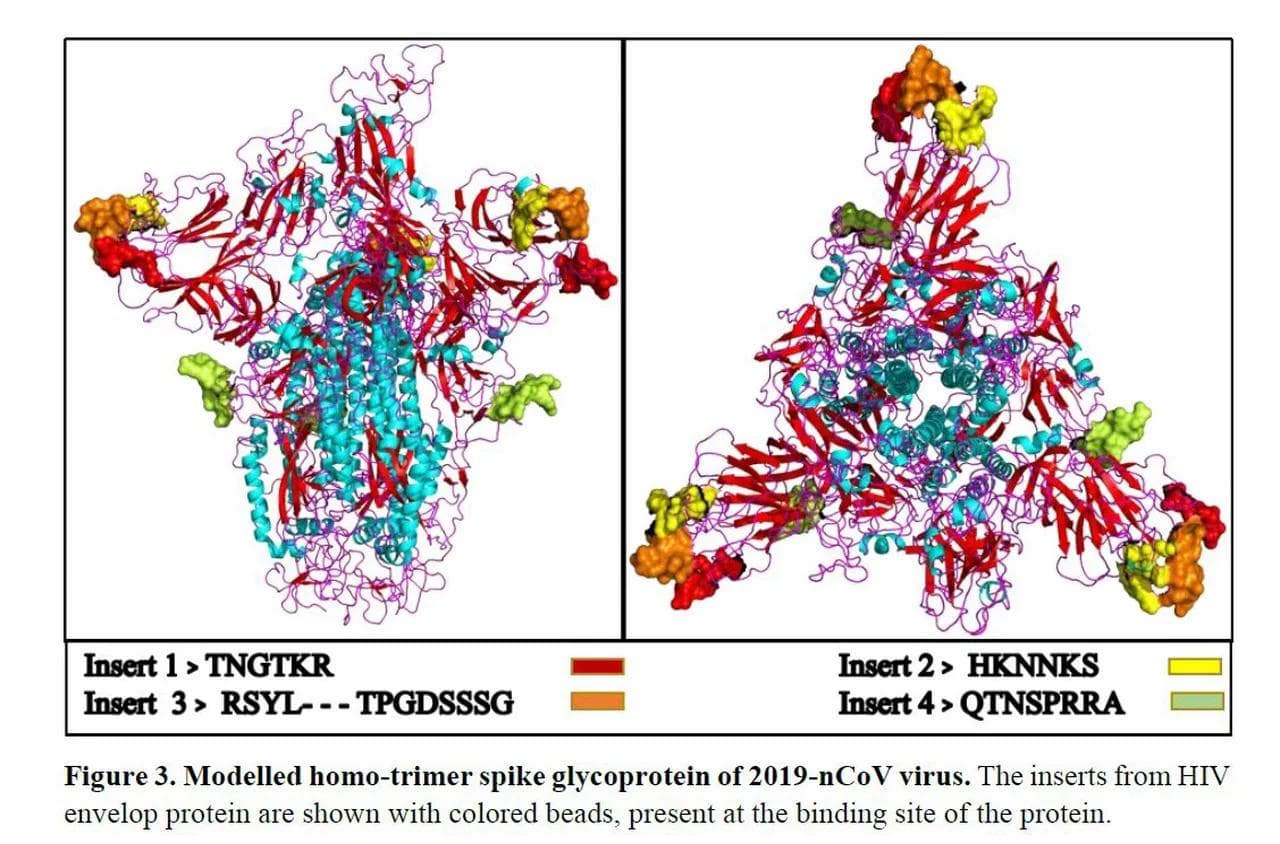
A peer-reviewed study in Frontiers in Virology found that a 19-nucleotide RNA sequence in SARS-CoV-2's furin cleavage site — the feature that makes it uniquely infectious to humans — is identical to a sequence patented by Moderna in February 2016 for cancer research. Researchers calculated the probability of this occurring through natural evolution at 1-in-3-trillion. The furin cleavage site is what distinguishes SARS-CoV-2 from all other known SARS-like coronaviruses and is not found in any close relatives.
“A 19-nucleotide sequence encoding the SARS-CoV-2 furin cleavage site is a reverse complement match to a human MSH3 gene sequence patented by Moderna in 2016.”
From “crazy” to confirmed
The Claim Is Made
This is the moment they called it crazy.
When a peer-reviewed study was published in Frontiers in Virology examining the genetic structure of COVID-19, researchers identified something that seemed statistically impossible: a 19-nucleotide sequence in the virus's furin cleavage site matched a patent filed by Moderna four years before the pandemic began. The odds of this happening by chance, according to their calculations, were roughly one in three trillion.
The claim itself wasn't new. Independent researchers and scientists had noticed the sequence similarity as far back as 2020, noting the unusual presence of a furin cleavage site in SARS-CoV-2 that distinguishes it from all other known coronaviruses in its family. What made this particular finding notable was that it came through the traditional peer-review process—published in an established journal, subjected to scrutiny, and backed by rigorous mathematical analysis.
The furin cleavage site is the feature that makes SARS-CoV-2 so effectively infectious to human cells. It's a biological lock-and-key that allowed the virus to spread with efficiency. The fact that close relatives of SARS-CoV-2 in bat and pangolin populations lack this site made its presence in the pandemic virus particularly conspicuous to researchers who bothered to look closely.
Moderna's 2016 patent, filed long before anyone had heard of COVID-19, covered the MSH3 gene sequence as it related to cancer immunotherapy research. The company was exploring how to manipulate specific genetic sequences for medical purposes—entirely unrelated to coronavirus research at the time of filing. The existence of this patent in the public record was never hidden. It could be verified by anyone willing to search the patent databases.
Get the 5 biggest receipts every week, straight to your inbox — plus an exclusive PDF: The Top 10 Conspiracy Theories Proven True in 2025-2026. No spam. No agenda. Just the papers they couldn't hide.
You just read "A 19-nucleotide sequence in COVID-19's furin cleavage site i…". We send ones like this every week.
No one's said anything yet. Be the first to drop your take.
The official response, when pressed, leaned heavily on probability arguments. Critics suggested that the similarity was meaningless—that viruses evolve constantly, that genetic sequences repeat across nature, and that finding such matches was merely a matter of looking hard enough at random data. The scientific establishment largely dismissed the observation as coincidence, though few offered substantial alternative explanations for why this particular sequence appeared in this particular virus.
But the peer-reviewed study changed the equation by quantifying just how improbable the coincidence was. The researchers weren't making claims about intentional engineering or nefarious intent. They were simply documenting that the probability of this sequence appearing randomly in the furin cleavage site—a location where it would have maximum biological relevance—fell so far outside statistical norms that it demanded explanation.
What this reveals about institutional accountability matters more than the answer to any single question about COVID-19's origins. For months and years, people who raised concerns about the furin cleavage site's unusual features were labeled as conspiracy theorists. Scientific journals rejected papers exploring the subject. Social media platforms suppressed discussion. Meanwhile, the basic facts—the patent's existence, the sequence match, the statistical improbability—were all verifiable through public sources.
The real question isn't whether Moderna somehow engineered a pandemic. It's why serious scientific inquiry into documented genetic similarities was treated as heresy rather than legitimate research. Public trust in institutions depends on good-faith engagement with uncomfortable questions. When evidence gets dismissed because it challenges preferred narratives, the cost to credibility is paid by everyone.
Beat the odds
This had a 0.5% chance of leaking — someone talked anyway.
Conspirators
~300Network
Secret kept
4.2 years
Time to 95% exposure
500+ years