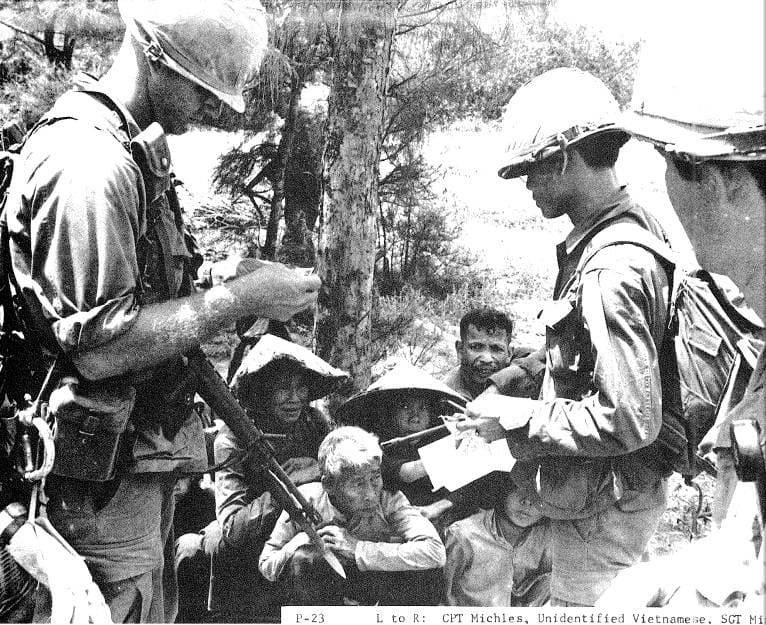
“Charlie Company conducted a successful search and destroy mission with no civilian casualties”
From “crazy” to confirmed
The Claim Is Made
This is the moment they called it crazy.
On March 16, 1968, soldiers from Charlie Company entered the village of My Lai in South Vietnam on what was supposed to be a routine search-and-destroy mission. By the end of the day, over 500 Vietnamese civilians—mostly women, children, and elderly—lay dead. What happened next might be more troubling than the massacre itself: the Army methodically buried the truth for over a year.
Official military channels initially reported the operation as a success. Command claimed that Charlie Company had engaged Viet Cong forces and killed 128 enemy combatants in a legitimate combat operation. After-action reports filed up the chain of command contained no mention of a massacre. Medal of Honor recommendations were submitted. The narrative was sealed and filed away as routine wartime business.
The cover-up held because military leadership had institutional incentives to keep it hidden. Officers involved in planning and oversight faced potential career-ending scrutiny if a systematic slaughter of civilians came to light. The officer corps as an institution stood to lose credibility at a moment when the Vietnam War was already drawing intense public scrutiny. Accountability was subordinated to reputation management.
The official story began to crack in April 1969—thirteen months after My Lai—when Ronald Ridenhour, a former soldier who had heard accounts from witnesses, wrote letters to military officials, the Pentagon, the State Department, and Congress. Ridenhour had not been present at the massacre but knew soldiers who had participated or witnessed the killings firsthand. His letters were detailed and specific, naming names and describing methods.
The Army, faced with Ridenhour's persistent documentation, initiated an investigation led by Lieutenant General William Peers. What Peers uncovered was systematic: not just the massacre itself, but a coordinated effort by officers to conceal it. Soldiers reported that a small number of direct participants faced charges or conviction. More significantly, the Peers Commission documented how command structure allowed the operation to proceed without proper oversight and then worked to suppress the evidence.
Photographs taken at the scene emerged, providing visual confirmation of the atrocity. Witness testimony from soldiers, some of whom were deeply troubled by what they had been ordered to do, corroborated the accounts. Medical evidence and survivor statements filled in further details. The massacre was undeniable once the cover-up eroded.
My Lai matters because it revealed how institutional interests can override accountability even within military hierarchies supposedly bound by codes of honor and discipline. The military didn't voluntarily disclose the massacre—it was forced to do so by a persistent whistleblower willing to work outside official channels. Had Ridenhour remained silent, the event likely would have stayed buried in classified files for decades.
The case demonstrated that senior officers had prioritized the reputation of the officer corps over justice for victims and honest accounting to the American public. It showed that official narratives can be completely fabricated and maintained if the right institutional incentives align. My Lai became a flashpoint in Vietnam War opposition not because Americans suddenly learned war was brutal, but because they learned their military had systematically lied about it.
For public trust in institutions, the lesson is stark: verification requires external accountability mechanisms. Whistleblowers matter precisely because institutions left to police themselves often choose self-preservation.
Get the 5 biggest receipts every week, straight to your inbox — plus an exclusive PDF: The Top 10 Conspiracy Theories Proven True in 2025-2026. No spam. No agenda. Just the papers they couldn't hide.
You just read "My Lai Massacre Cover-up Protected Officer Corps Reputation". We send ones like this every week.
No one's said anything yet. Be the first to drop your take.