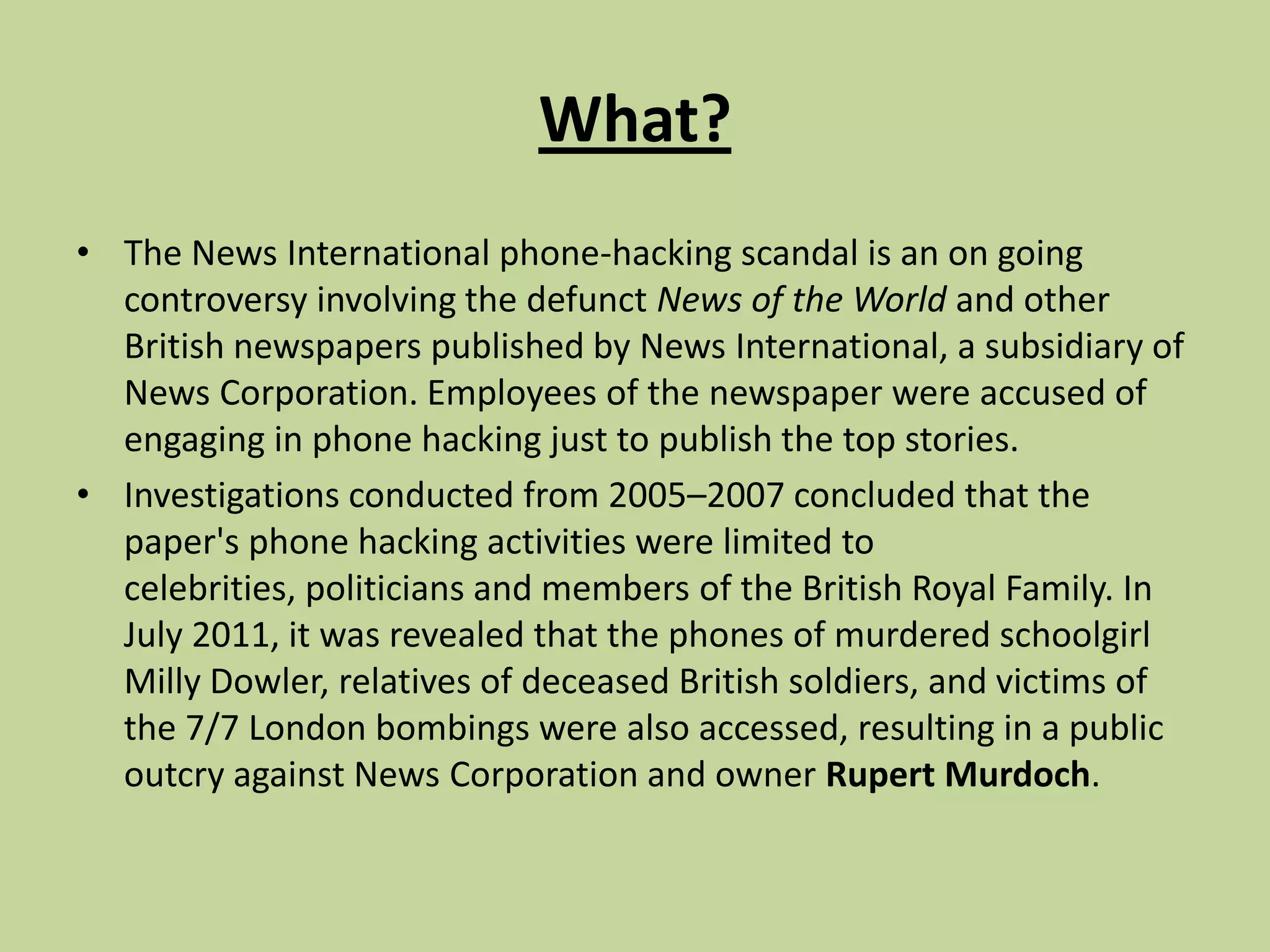
Police investigations revealed News of the World journalists routinely hacked phones of celebrities, politicians, and crime victims. The scandal exposed widespread illegal surveillance practices across Murdoch's media empire.
“Our journalists follow all legal and ethical guidelines in their news gathering activities”
From “crazy” to confirmed
The Claim Is Made
This is the moment they called it crazy.
When journalists started asking questions about how the News of the World obtained private details about celebrities and crime victims, the response from Rupert Murdoch's media empire was swift and dismissive. A few rogue reporters, they said. Isolated incidents. Nothing systematic, nothing that reached up the chain of command.
It turned out to be one of the most consequential lies a media company could tell.
Between the mid-1990s and 2011, journalists employed by News Corporation's British tabloid News of the World engaged in widespread phone hacking. They targeted mobile phones belonging to celebrities, politicians, and victims of crime—including families of soldiers killed in combat. The operation wasn't the work of a handful of bad actors. It was embedded into the newsroom culture, from reporters chasing stories to editors who knew what was happening and did nothing to stop it.
The initial claims about hacking emerged gradually. Private investigators and victims' lawyers had long suspected something was wrong, but the company's legal team and executives pushed back hard. They settled lawsuits quietly. They denied culpability. They maintained that hacking was against their editorial standards and that anyone doing it would face consequences.
In 2010 and 2011, investigations by the Guardian and the Metropolitan Police transformed suspicion into documented fact. Police found evidence that News of the World journalists had hacked the voicemails of hundreds of people. They uncovered internal documents showing editors knew about the practice. They identified payments to private investigators who conducted the hacking on behalf of the newspaper.
One particularly damaging discovery involved Milly Dowler, a 13-year-old girl who disappeared in 2002. News of the World reporters had hacked her phone, and according to reports, had deleted voicemails—potentially destroying evidence that might have helped police investigations. When the details of this case became public in 2011, public outrage forced Murdoch to shut down the 168-year-old publication entirely.
Get the 5 biggest receipts every week, straight to your inbox — plus an exclusive PDF: The Top 10 Conspiracy Theories Proven True in 2025-2026. No spam. No agenda. Just the papers they couldn't hide.
You just read "News Corporation Phone Hacking Scandal Involved Systematic P…". We send ones like this every week.
No one's said anything yet. Be the first to drop your take.
Further investigations revealed the problem extended far beyond News of the World. Other papers in Murdoch's empire, including the Sun, were implicated in similar practices. The scope of the hacking was staggering: hundreds of victims, possibly thousands, had their privacy violated systematically by one of the world's most powerful media companies.
This scandal mattered because it exposed the dangers of unchecked corporate power in the media industry. When one company controls dozens of outlets and operates with minimal regulatory oversight, the temptation and capability to break laws for profit and competitive advantage becomes nearly irresistible. The initial denials and cover-up attempts showed how institutional power could be weaponized to protect wrongdoing.
The fallout included criminal convictions of executives and journalists, billions in settlements, and a public inquiry that fundamentally questioned how media regulation worked in Britain. Yet the broader lesson extended globally: institutions with power will often deny the undeniable until the evidence becomes impossible to ignore.
The News Corporation phone hacking scandal reminds us why tracking these claims matters. It wasn't a conspiracy theory or a wild accusation. It was a documented campaign of illegal surveillance carried out by a major corporation and systematically denied until evidence forced accountability.
Beat the odds
This had a 0.6% chance of leaking — someone talked anyway.
Conspirators
~100Network
Secret kept
14.9 years
Time to 95% exposure
500+ years