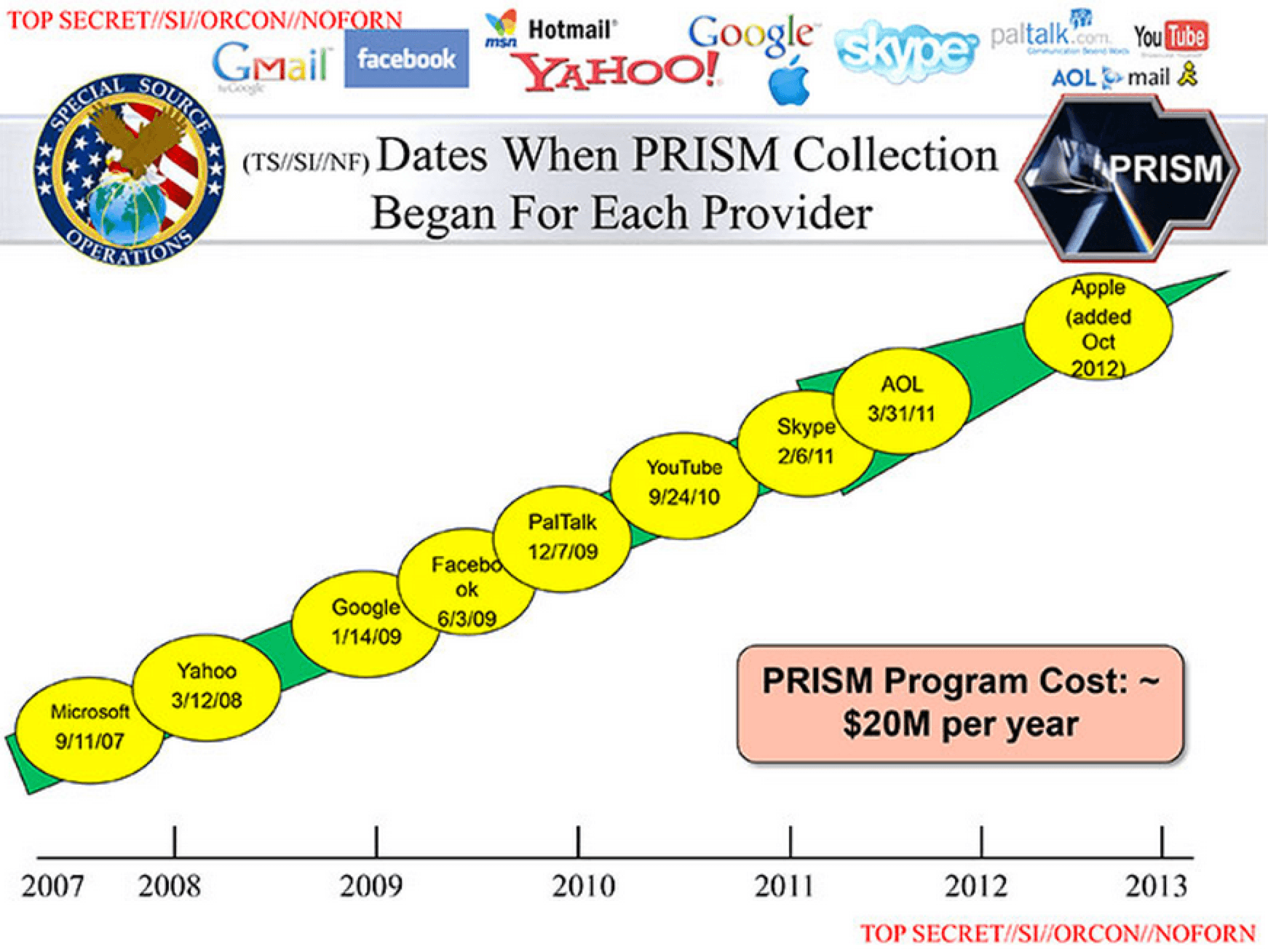
Edward Snowden's 2013 leak revealed PRISM, a secret NSA program operational since 2007 under the Protect America Act. PRISM granted the NSA direct access to the servers of nine major tech companies — Google, Facebook, Apple, Microsoft, Yahoo, Skype, YouTube, AOL, and PalTalk — allowing the agency to collect emails, chats, photos, and stored data without users' knowledge. Intelligence chief James Clapper had told Congress the NSA was 'not wittingly' collecting data on Americans, a statement proven false.
“The government has secret backdoor access to all major tech companies' servers and is collecting everything — your emails, your photos, your chats.”
From “crazy” to confirmed
The Claim Is Made
This is the moment they called it crazy.
In June 2013, a 29-year-old NSA contractor named Edward Snowden handed journalists at The Guardian thousands of classified documents that would fundamentally challenge what the American government had told its citizens about digital privacy. What he revealed was PRISM, a classified surveillance program that had been operating in secret since 2007, giving the National Security Agency direct access to the servers of nine major technology companies including Google, Facebook, Apple, and Microsoft.
The scope was staggering. Through PRISM, the NSA could collect emails, instant messages, video chats, photographs, and stored files from millions of Americans—all without their knowledge or consent. The program operated under legal authorities granted by the Protect America Act, which had been quietly passed in 2007. For six years, the infrastructure was in place, the access was active, and the public had no idea.
Just months before Snowden's leak, James Clapper, the Director of National Intelligence, had testified before Congress about NSA surveillance practices. When asked directly whether the agency collected data on millions of Americans, Clapper said no—the NSA was "not wittingly" collecting such information. This statement would later be revealed as deliberately misleading, if not outright false.
The official response from government officials and the tech companies themselves was swift and emphatic. They denied direct NSA access to their servers. Some claimed they knew nothing about PRISM. Others suggested that if data was being shared, it was only through lawful processes like court orders. The Defense Department and NSA issued carefully worded statements that technically denied the most dramatic interpretations while avoiding confirmation of the actual program's existence.
Get the 5 biggest receipts every week, straight to your inbox — plus an exclusive PDF: The Top 10 Conspiracy Theories Proven True in 2025-2026. No spam. No agenda. Just the papers they couldn't hide.
You just read "NSA's PRISM program gave backdoor access to Google, Facebook…". We send ones like this every week.
No one's said anything yet. Be the first to drop your take.
Confirmed: They Were Right
The truth comes out. Officially documented.
Confirmed: They Were Right
The truth comes out. Officially documented.
But Snowden's documents—classified slides, legal memos, and program descriptions—left little room for interpretation. They showed that PRISM participants had given the NSA engineers direct access to their servers. The documents listed specific collection capabilities for each company and showed the program had been expanding, not shrinking. Internal NSA presentations described PRISM as one of the agency's "most prolific" sources of intelligence.
Subsequent investigations by The Washington Post, The New York Times, and international media outlets confirmed and expanded upon the initial revelations. Journalists obtained additional classified materials and conducted extensive interviews with current and former government officials. The evidence accumulated: PRISM was real, it was vast, and the American public had been kept entirely in the dark about it.
The verification of these claims mattered because it exposed a fundamental credibility gap between government assurances and reality. Citizens had been told their digital communications were protected by law and oversight. They had been assured that surveillance was targeted and limited. None of that was entirely true. An entire infrastructure for mass data collection had been built in secret, approved in secret, and kept secret from the people it affected.
What followed was a global reckoning. Investigations were launched. Legislation was debated. Tech companies, facing public outcry, began pushing back against government demands and implementing stronger encryption. But the core lesson remained: what institutions claim and what actually happens can be separated by vast distances. The PRISM documents proved that sometimes, the most important claims about power and privacy are the ones that are loudly denied until they're undeniably exposed.
Beat the odds
This had a 0% chance of leaking — someone talked anyway.
Conspirators
~150Network
Secret kept
0.5 years
Time to 95% exposure
500+ years