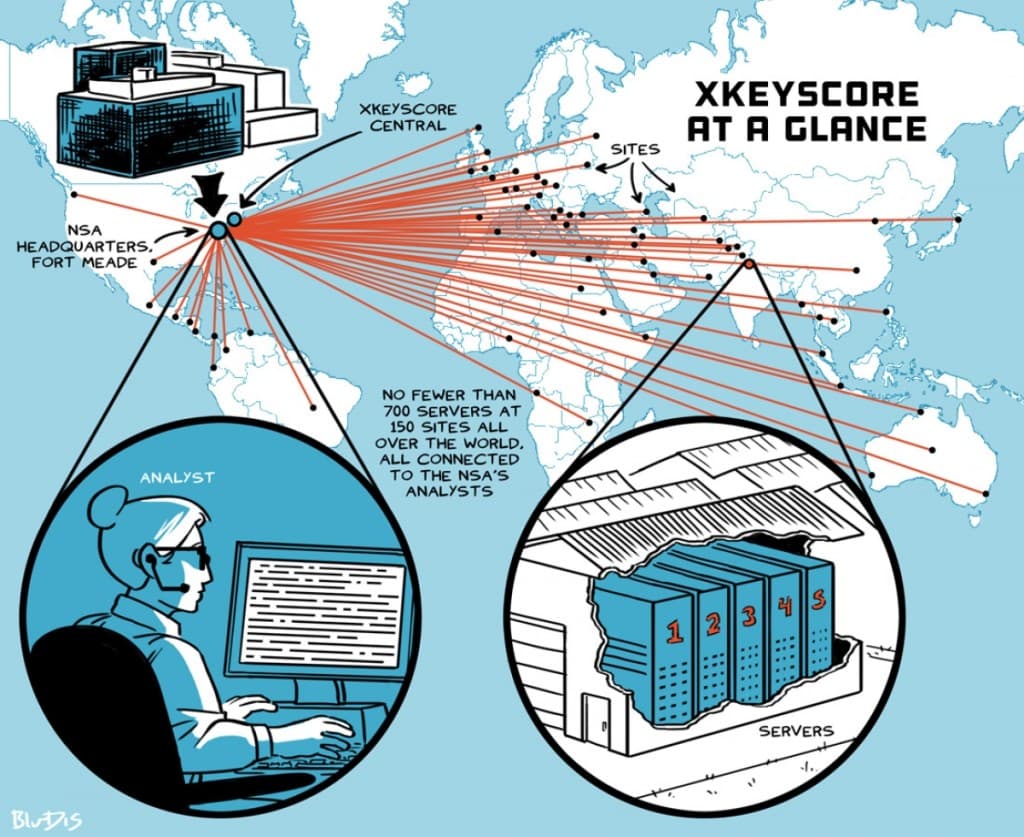
XKeyscore is an NSA system that allows analysts to search through vast databases of emails, online chats, and browsing histories of millions of individuals without prior authorization or a warrant. Training materials showed analysts needed only fill out a simple on-screen form giving a broad justification. The system was shared with intelligence agencies from Australia, Canada, New Zealand, Britain, Japan, Germany, and Denmark.
“I, sitting at my desk, certainly had the authorities to wiretap anyone, from you or your accountant to a federal judge, to even the president if I had a personal email.”
From “crazy” to confirmed
The Claim Is Made
This is the moment they called it crazy.
When Edward Snowden walked out of a Hawaii server farm in 2013 with classified NSA documents, he carried with him evidence of a surveillance capability that most Americans didn't know existed. XKeyscore was the name of the system—a tool that allowed intelligence analysts to search through the digital lives of millions of people without a warrant, without court approval, and often without any meaningful oversight. What Snowden revealed would fundamentally challenge the government's claims about how it monitored its own citizens.
For years, intelligence officials had maintained a careful public position: surveillance was targeted, legal, and bound by strict protocols. NSA directors testified before Congress that analysts couldn't simply rummage through Americans' private communications. They suggested robust safeguards prevented the kind of mass surveillance that civil libertarians feared. The intelligence community's message was consistent: trust us, the system works as intended, and constitutional protections are in place.
The reality, according to Snowden's leaked documents, was starkly different. XKeyscore gave analysts the ability to search vast databases containing emails, instant messages, browsing histories, and metadata from millions of individuals. What's particularly striking is how low the barrier to entry was. Training materials disclosed by The Guardian showed that analysts needed only to complete a simple on-screen form, providing a broad justification for their search. There was no requirement to name a specific target, no warrant requirement, no evidence of wrongdoing. The system essentially operated on an honor system backed by minimal technical controls.
The scope of XKeyscore's reach extended far beyond American borders—or American surveillance law. shared access to this system with from Australia, Canada, New Zealand, Britain, Japan, Germany, and Denmark. This meant that foreign intelligence services could conduct similar searches on communications that might include American citizens, raising questions about whether the U.S. was circumventing its own legal restrictions by outsourcing surveillance to allied nations.
Get the 5 biggest receipts every week, straight to your inbox — plus an exclusive PDF: The Top 10 Conspiracy Theories Proven True in 2025-2026. No spam. No agenda. Just the papers they couldn't hide.
You just read "NSA analysts could search anyone's emails, chats, and browsi…". We send ones like this every week.
No one's said anything yet. Be the first to drop your take.
Confirmed: They Were Right
The truth comes out. Officially documented.
Confirmed: They Were Right
The truth comes out. Officially documented.
When the Snowden revelations became public, the NSA initially denied the most troubling implications. Officials suggested that safeguards prevented abuse and that the system required proper justification. But internal documents told a different story. They revealed that the justification requirement was largely performative—a box to check rather than a genuine constraint on access.
The significance of XKeyscore extends beyond the technical capability itself. It exposed a fundamental gap between what the government told the public about surveillance and what was actually happening. Americans had been assured that their privacy was protected by law and oversight. Instead, a single analyst making a judgment call could access intimate details of someone's life—their medical searches, their financial transactions, their private conversations—without anyone knowing or approving it.
This matters because it struck at the heart of public trust in institutions. The government had been dishonest, whether through deliberate deception or careful omission. Citizens couldn't meaningfully consent to or challenge surveillance they didn't know existed. The revelation forced a reckoning: either the laws governing surveillance were inadequate, or the agencies entrusted with power had abused it, or both.
Nearly a decade later, the implications continue to resonate. XKeyscore demonstrated that surveillance capabilities had evolved far beyond what the legal framework contemplated, and that the safeguards citizens believed protected them were weaker than the public had been led to believe.
Beat the odds
This had a 0% chance of leaking — someone talked anyway.
Conspirators
~200Network
Secret kept
0.5 years
Time to 95% exposure
500+ years