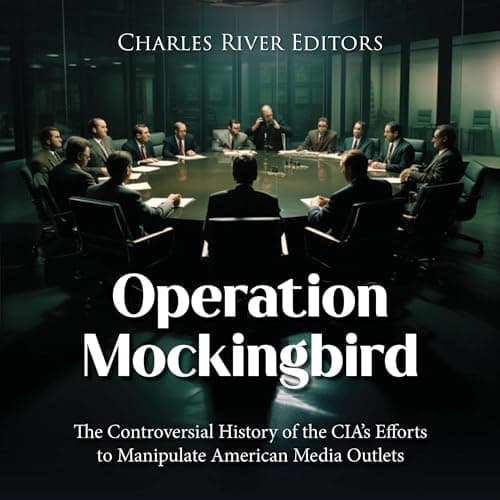
The CIA recruited journalists and editors at major newspapers, magazines, and TV networks to plant stories and suppress news. Church Committee investigations in 1975 revealed the program's extensive reach into American media.
“The CIA does not engage in domestic propaganda operations or manipulate American news media”
From “crazy” to confirmed
The Claim Is Made
This is the moment they called it crazy.
For decades, Americans trusted their newspapers and evening news broadcasts as independent sources of information. What they didn't know was that many of those journalists and editors were actively working for the Central Intelligence Agency. Operation Mockingbird wasn't a fringe theory whispered in dark corners—it was a documented, systematic program that gave a government agency direct control over some of the country's most influential news organizations.
The seeds of the program were planted in the 1950s, growing out of the CIA's broader belief that controlling public narrative was essential to national security. Agency officials reasoned that if they could shape what Americans read and watched, they could shape what Americans believed. They set about recruiting reporters, editors, and network executives, offering them money, access, and prestige in exchange for their cooperation. Some knew exactly what they were doing. Others operated in gray areas, unclear about their true employers.
When journalists and researchers began asking questions in the 1970s, the CIA's standard response was denial. Officials claimed the agency had minimal involvement in domestic media and that any cooperation was limited and consensual. They suggested that critics were paranoid, that independent journalism was thriving, and that the entire premise was exaggerated. The mainstream media itself—the very institutions allegedly compromised—largely echoed these assurances. There was no scandal here, they insisted. Just conspiracy thinking.
Get the 5 biggest receipts every week, straight to your inbox — plus an exclusive PDF: The Top 10 Conspiracy Theories Proven True in 2025-2026. No spam. No agenda. Just the papers they couldn't hide.
You just read "Operation Mockingbird: CIA Secretly Controlled Major News Or…". We send ones like this every week.
No one's said anything yet. Be the first to drop your take.
Then came the Church Committee.
In 1975, the Senate Select Committee to Study Governmental Operations with Respect to Intelligence Activities, chaired by Senator Frank Church, launched the most comprehensive investigation into intelligence abuses in American history. What they found wasn't speculation or hearsay. They uncovered documented evidence of Operation Mockingbird's scope and methods. The CIA had indeed recruited journalists and editors at major newspapers, magazines, and television networks. They had planted stories, suppressed inconvenient news, and shaped coverage of major events. The program wasn't marginal—it was systematic and widespread.
The Committee's final report confirmed what skeptics had claimed: the CIA maintained relationships with more journalists than anyone outside the agency realized. Some were paid assets. Others simply cooperated because they believed in the cause. Either way, they were functioning as intelligence operatives while maintaining their public role as independent journalists. The conflict of interest was total.
The evidence was there in cables, memos, and testimony. It wasn't ambiguous or circumstantial. It was institutional admission—the CIA acknowledging what it had done and how long it had been doing it.
What makes Operation Mockingbird historically significant isn't just the program itself, but what its exposure revealed about how power actually works. Intelligence agencies didn't need to own newspapers to control them. They just needed to cultivate relationships with influential people within those institutions. When the Church Committee pulled back the curtain, it raised a question that remains relevant today: how many of the stories we trust, the narratives we believe, are shaped by hidden agendas we'll never fully know about?
The verification of Operation Mockingbird didn't restore public trust in media. If anything, it made trust harder. Once you know that corruption was this systematic and this hidden, skepticism becomes rational.
Beat the odds
This had a 2% chance of leaking — someone talked anyway.
Conspirators
~100Network
Secret kept
50.7 years
Time to 95% exposure
500+ years