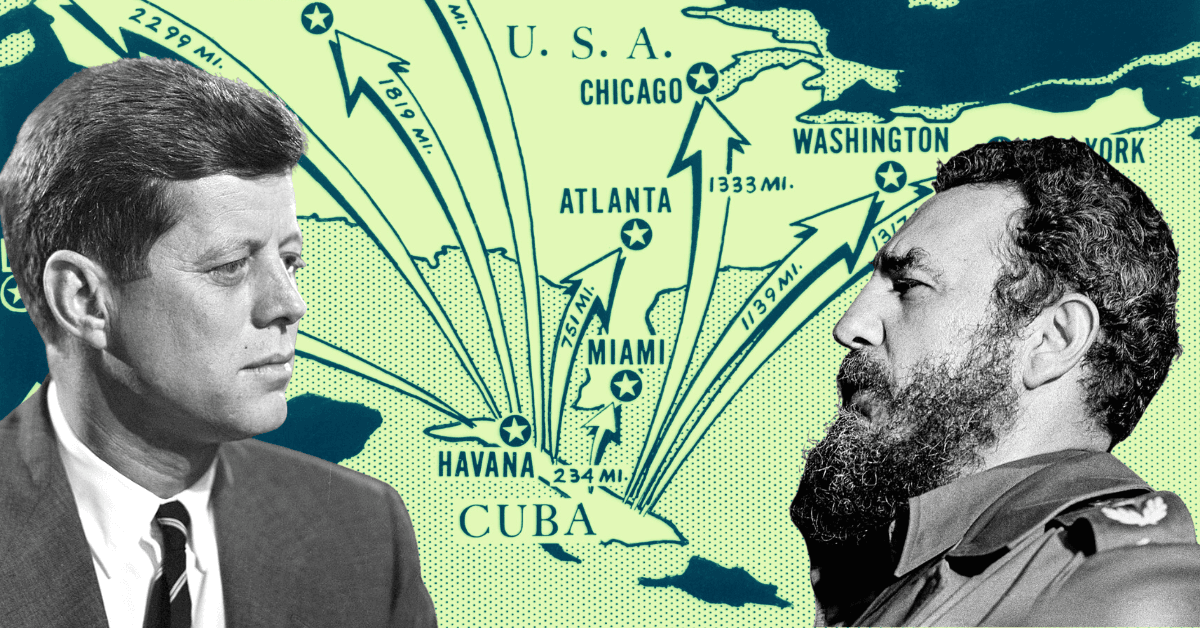
Joint Chiefs of Staff approved plans for CIA operatives to conduct terrorist attacks on U.S. soil and blame Cuba to justify invasion. Plans included bombing American cities and shooting down civilian aircraft with fake Cuban involvement.
“No such plans for operations against American civilians have ever been considered”
From “crazy” to confirmed
The Claim Is Made
This is the moment they called it crazy.
In 1962, the Joint Chiefs of Staff drafted a proposal so extreme that even Cold War hawks would eventually reject it. The plan, code-named Operation Northwoods, called for the U.S. military and CIA to stage false flag terrorist attacks on American soil, then blame Cuba to manufacture public support for an invasion.
For decades, this wasn't a fringe theory whispered in dark corners of the internet. It was a documented proposal that sat in classified files, dismissed by most observers as either fabricated or misunderstood. The very suggestion that American military leadership would consider bombing their own cities seemed too outrageous to take seriously.
The proposal emerged from genuine Cold War anxiety. The failed Bay of Pigs invasion in 1961 had embarrassed the Kennedy administration. Military planners wanted another shot at removing Fidel Castro, but they needed something to convince the American public that military action was necessary and justified. Instead of manufacturing a legitimate casus belli, they decided to manufacture the threat itself.
The specific ideas documented in these proposals were staggering in their scope. Plans included bombing American cities, sinking U.S. Navy ships and blaming Cuba for the attacks, shooting down civilian aircraft and making it appear that Cuba was responsible, and staging false flag operations designed to provoke a military response. One proposal even suggested creating an incident at the U.S. naval base at Guantanamo Bay itself, using American military personnel to stage the attack.
Get the 5 biggest receipts every week, straight to your inbox — plus an exclusive PDF: The Top 10 Conspiracy Theories Proven True in 2025-2026. No spam. No agenda. Just the papers they couldn't hide.
You just read "Operation Northwoods proposed false flag attacks against Ame…". We send ones like this every week.
No one's said anything yet. Be the first to drop your take.
When word of these plans circulated, the official response was predictable: denial and dismissal. Military and government sources claimed the documents were either taken out of context, misinterpreted, or exaggerated by critics. The idea that respectable military officers would propose mass casualty attacks on American civilians was simply too uncomfortable to acknowledge as genuine policy discussion.
The critical moment came in 1997 and 1998, when the National Security Archive, a nonprofit research institute at George Washington University, obtained the actual declassified documents through Freedom of Information Act requests. These weren't rumors or secondhand accounts. They were the actual memoranda, complete with official letterhead, signatures, and dated communications between the Joint Chiefs of Staff and Department of Defense officials.
The documentation proved several things. First, the proposals were real, not fabricated or distorted. Second, they were seriously considered at the highest levels of military planning. Third, they were ultimately rejected—not by Congress or the public, but by Secretary of Defense Robert McNamara and President Kennedy himself, who found them unacceptable.
What makes Operation Northwoods matter isn't just that it was proposed. It matters because it represents a concrete historical moment when American leadership contemplated deliberately killing American civilians to advance a geopolitical agenda. The fact that the plan was rejected doesn't erase that it was drafted, circulated, and seriously discussed.
This case should fundamentally reshape how we evaluate government credibility. When institutions insist that certain claims are impossible or too extreme to be true, we should remember that one of those "impossible" claims turned out to be completely real. It suggests that healthy skepticism about official narratives isn't paranoia—it's the basic intellectual rigor that a free society requires.
Unlikely leak
Only 12% chance this would come out. It did.
Conspirators
~500Large op
Secret kept
64.2 years
Time to 95% exposure
500+ years