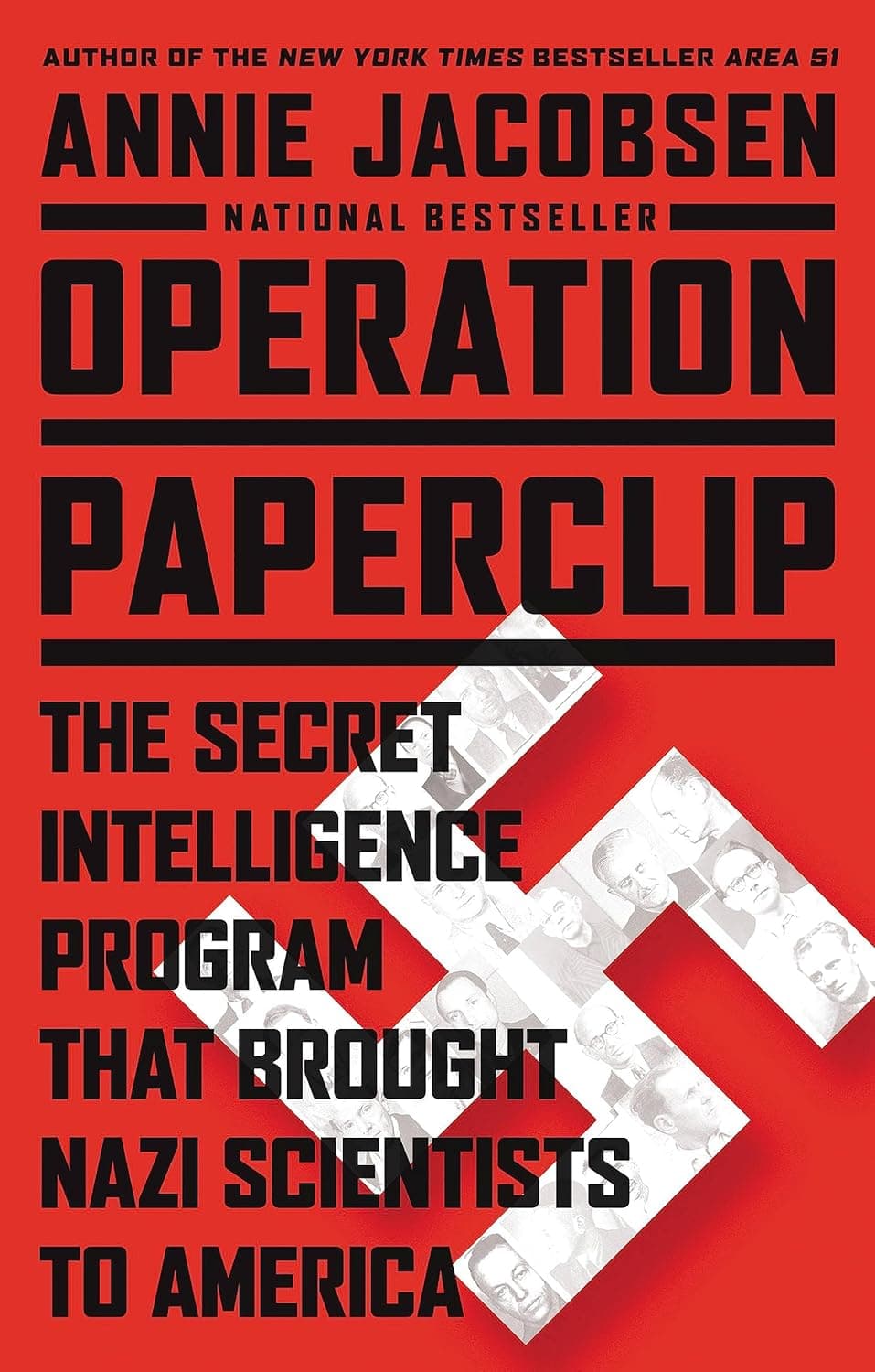
US military recruited over 1,600 Nazi scientists and engineers while publicly denying harboring war criminals. Declassified documents revealed many had participated in slave labor and human experiments, but were given new identities and government positions.
“The United States does not employ former Nazi party members or war criminals in any capacity”
From “crazy” to confirmed
The Claim Is Made
This is the moment they called it crazy.
The story of Operation Paperclip reveals one of the most uncomfortable truths about post-World War II America: the U.S. government systematically recruited Nazi scientists while the public was told no such arrangement existed. What began as whispered suspicions in the 1950s became documented fact only decades later, when declassified records forced a reckoning with historical denial.
In the immediate aftermath of World War II, the United States faced a strategic calculation. The Soviet Union was rapidly consolidating power in Eastern Europe, and American military and intelligence officials worried about falling behind in technological advancement. Rather than allow German scientific expertise to benefit the Soviets, the U.S. decided to claim it for itself. Between 1945 and the early 1970s, over 1,600 German scientists, engineers, and technicians were brought to America under a covert program that would later be called Operation Paperclip.
The official government position was unambiguous: America was not harboring Nazi scientists or collaborators. State Department officials and military brass consistently denied the program's scope and nature. When critics raised concerns about specific individuals with troubling records, they were dismissed as alarmists or, in some cases, silenced entirely. The public largely accepted this reassurance, having little reason to distrust their government on matters of national security.
What declassified documents revealed, however, told a far different story. The scientists brought into the program included individuals directly implicated in some of the Nazi regime's worst crimes. Many had overseen or participated in research involving slave labor from concentration camps. Some had conducted or authorized human experiments on prisoners. Their backgrounds were cleaned up through a process that involved destroying or altering records, creating new identities, and strategic omissions in official biographies.
One particularly striking aspect of the documentation was how thoroughness varied depending on an individual's scientific value. Those deemed essential to American military or space programs received more aggressive protection and background sanitization. The more useful you were to Cold War ambitions, the more enthusiastically your past was obscured.
The evidence of Operation Paperclip's true scope came through multiple channels. Researchers working through Freedom of Information Act requests gradually pieced together the program's scale. Survivors and historians conducted their own investigations, cross-referencing Nazi records with American personnel files. By the 1980s and 1990s, the contradictions between official denials and documentary reality became impossible to ignore.
The lasting significance of Operation Paperclip extends beyond historical curiosity. It represents a calculated decision to prioritize strategic advantage over accountability for war crimes. It demonstrates how governments can maintain false narratives even when contradictory evidence exists in their own archives. And it raises uncomfortable questions about what nations will tolerate when framed as necessary for security.
For those tracking the gap between official narratives and documented reality, Operation Paperclip stands as a textbook example. The claim wasn't outlandish conspiracy thinking—it was careful documentation of what the government had actively hidden. Only when secrecy became technically impossible did the truth emerge, not because authorities suddenly became transparent, but because the paper trail eventually grew too large to suppress.
Get the 5 biggest receipts every week, straight to your inbox — plus an exclusive PDF: The Top 10 Conspiracy Theories Proven True in 2025-2026. No spam. No agenda. Just the papers they couldn't hide.
You just read "Operation Paperclip secretly brought Nazi scientists to Amer…". We send ones like this every week.
No one's said anything yet. Be the first to drop your take.