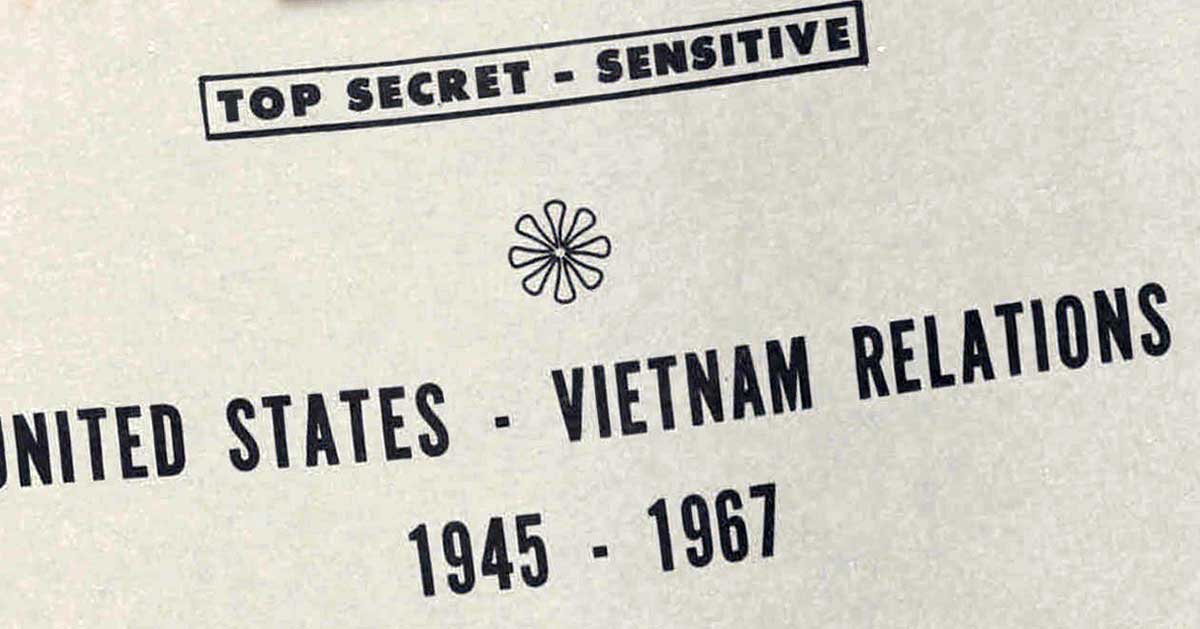
Classified documents showed the U.S. government knew the Vietnam War was unwinnable while publicly claiming progress. The papers revealed decades of lies to Congress and the American people about military strategy and casualty projections.
“The war effort is making steady progress and victory is achievable with continued commitment”
From “crazy” to confirmed
The Claim Is Made
This is the moment they called it crazy.
For over a decade, American soldiers died in Vietnam while their government systematically lied about how the war was going. The Pentagon Papers would eventually prove it, but not before the deception had reshaped an entire nation.
Throughout the 1960s, official statements from the Pentagon and White House painted an optimistic picture of the Vietnam conflict. Secretary of Defense Robert McNamara and military commanders assured Congress and the American public that progress was steady, enemy casualties were mounting, and victory was within reach. News conferences featured charts showing enemy body counts and territory gains. The message was consistent: patience would pay off.
Behind closed doors, however, a different story existed. Pentagon officials had prepared a massive classified study—eventually known as the Pentagon Papers—that documented decades of government decision-making about Vietnam. This study, commissioned in 1967, was meant to remain secret indefinitely.
In 1971, Daniel Ellsberg, a military analyst who had worked on the study, became convinced the public had a right to know what their government had hidden. He photocopied the entire 7,000-page document and provided it to The New York Times. When the newspaper began publishing excerpts that June, the documents revealed something stunning: U.S. military leaders had privately concluded the war was likely unwinnable, even as they publicly promised victory.
The Pentagon Papers showed that successive administrations—under Presidents Eisenhower, Kennedy, and Johnson—had all known far more about the war's true trajectory than they disclosed. The documents contained casualty projections, strategic assessments, and internal debates that directly contradicted public statements. Officials knew about the failure of bombing campaigns. They understood the limits of South Vietnamese military capability. They had evidence that enemy strength was not declining as claimed.
Get the 5 biggest receipts every week, straight to your inbox — plus an exclusive PDF: The Top 10 Conspiracy Theories Proven True in 2025-2026. No spam. No agenda. Just the papers they couldn't hide.
You just read "Pentagon Papers revealed systematic government deception abo…". We send ones like this every week.
No one's said anything yet. Be the first to drop your take.
The government's initial response was to demand that The New York Times stop publishing. When the newspaper refused, the Justice Department sought an injunction. The case reached the Supreme Court in a matter of weeks. In June 1971, the Court ruled 6-3 that the newspaper could continue publishing, establishing that the government could not suppress the press simply because documents were classified.
Other newspapers, including The Washington Post, quickly followed with their own reporting on the Pentagon Papers. Ellsberg was prosecuted under the Espionage Act, though the charges were eventually dismissed due to prosecutorial misconduct. Nonetheless, the damage to official credibility was done.
The Pentagon Papers proved that skeptics of the war had been right all along—not about the war's merits, but about the government's honesty. What had seemed like isolated doubts or radical criticism were actually grounded in facts the government possessed but withheld. Thousands more American soldiers, and countless Vietnamese civilians, died between the time officials knew the war was likely lost and when the public learned the truth.
This episode matters because it established a precedent and a principle: official optimism should not substitute for public knowledge. If government statements about military operations cannot be trusted without documentary verification, citizens cannot make informed decisions about sending their children to war. The Pentagon Papers didn't just reveal lies about one war. They raised a fundamental question about democratic accountability that remains relevant whenever officials ask the public to trust their judgment about distant conflicts.
Unlikely leak
Only 10.4% chance this would come out. It did.
Conspirators
~500Large op
Secret kept
54.9 years
Time to 95% exposure
500+ years