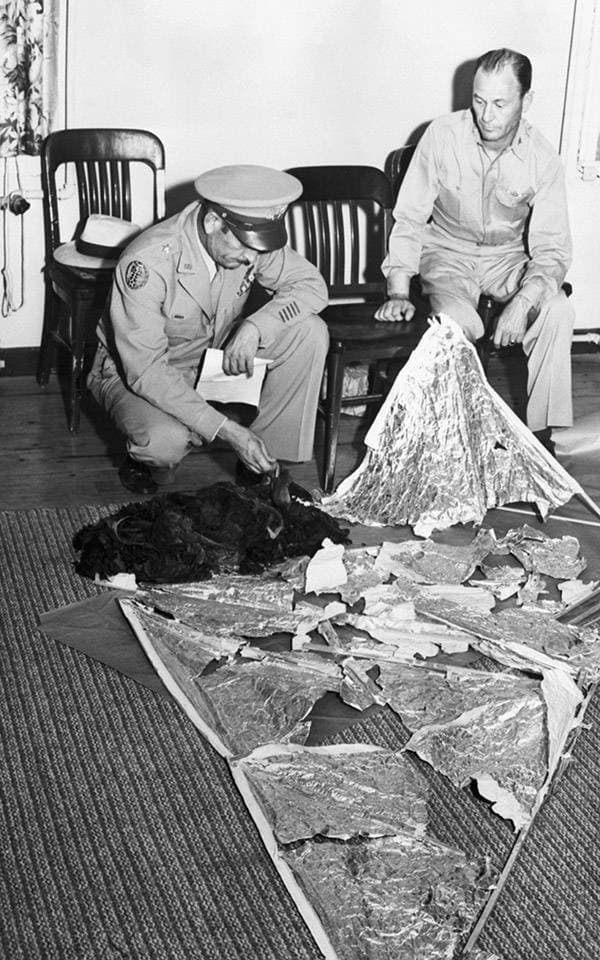
On July 8, 1947, the Roswell Army Air Field press officer issued a release stating they had recovered a 'flying disc.' Within hours, the story was retracted and replaced with the claim it was a weather balloon. Intelligence officer Major Jesse Marcel, who personally handled the debris, later stated the material was extraordinary — thin metallic sheets that couldn't be dented or burned, I-beams with hieroglyphic-like markings, and memory-metal that returned to shape. In 1994, the Air Force admitted the 'weather balloon' was actually a Project Mogul spy balloon, but Marcel and other witnesses insisted the material was unlike anything terrestrial. The case remains the foundational UFO incident.
“It was not a weather balloon. What I saw, I'd never seen before. There was all kinds of stuff — small beams with hieroglyphics that nobody could decipher. The metal was impossibly thin yet indestructible.”
What they said vs. what the evidence shows
“The material recovered near Roswell was consistent with a balloon device used in Project Mogul. There were no 'alien' bodies — those reports stem from misremembered crash test dummies dropped in the 1950s.”
— US Air Force (1994 & 1997 reports) · Sep 1994
SourceFrom “crazy” to confirmed
The Claim Is Made
This is the moment they called it crazy.
On July 8, 1947, the Roswell Army Air Field in New Mexico issued a press release that would define UFO discourse for generations. The facility's public information officer announced that the Army had recovered a "flying disc" from a nearby ranch. It was front-page news, broadcast on radio stations across the country.
By that evening, the story had fundamentally changed.
Within hours, the Army issued a retraction. The recovered object, they now claimed, was merely a weather balloon—mundane, unclassified, entirely terrestrial. The original announcement was quietly buried. Most newspapers ran the correction smaller than the initial story. For decades, this became the official account: a simple mistake, a misidentification, nothing more to see.
Yet the witnesses who had actually handled the debris told a different story.
Major Jesse Marcel was the intelligence officer who personally recovered and examined the wreckage. According to his later testimony, the material was extraordinary—nothing like a weather balloon. He described thin metallic sheets that could not be dented or burned, structural I-beams etched with what he characterized as "hieroglyphic-like markings," and material that exhibited what he called "memory-metal," capable of returning to its original shape after being bent or crumpled. Marcel was no ordinary witness; as an intelligence officer, he had professional training in identifying military hardware and foreign technology.
Other witnesses corroborated these descriptions. The accounts were remarkably consistent: unusual materials, strange construction, nothing matching known terrestrial aircraft or balloons of the era.
For nearly fifty years, the "weather balloon" explanation held. The incident became the subject of jokes and conspiracy theories, the very term "Roswell" synonymous with UFO mythology rather than credible documentation.
Get the 5 biggest receipts every week, straight to your inbox — plus an exclusive PDF: The Top 10 Conspiracy Theories Proven True in 2025-2026. No spam. No agenda. Just the papers they couldn't hide.
You just read "The Roswell crash was initially announced as a 'flying disc'…". We send ones like this every week.
No one's said anything yet. Be the first to drop your take.
@109065990 — Witness testimony about hieroglyphic writing on Roswell wreckage provides contemporary corroboration for the initial flying disc recovery claim and subsequent cover-up narrative.
Witness testimony about hieroglyphic writing on Roswell wreckage provides contemporary corroboration for the initial flying disc recovery claim and subsequent cover-up narrative.
Confirmed: They Were Right
The truth comes out. Officially documented.
Confirmed: They Were Right
The truth comes out. Officially documented.
Then, in 1994, the U.S. Air Force released its official report on the incident. They confirmed that the "weather balloon" explanation was, in fact, false. The recovered object was part of Project Mogul, a classified reconnaissance program designed to detect Soviet nuclear tests using high-altitude balloons with sensitive listening equipment. This was at least partially true—the object was human-made and military in origin, not extraterrestrial.
Yet this revelation only deepened the mystery rather than resolving it. The Air Force's own explanation raised uncomfortable questions: Why issue such a crude cover story in 1947? Why maintain it for decades? And perhaps most significantly, Major Marcel and other firsthand witnesses continued to insist that the material they had examined bore no resemblance to a Mogul balloon, either.
The Roswell case stands as a test case for official credibility. What matters here isn't whether something extraterrestrial crashed in the desert—the evidence for that remains contested. What matters is that the initial official story was demonstrably false, the cover story held for forty-seven years, and the explanation offered in 1994 failed to account for the testimony of trained observers.
When institutions lie about what happened, even on matters of national security, they create the conditions for the very conspiracy theories they later deplore. Roswell demonstrates why institutional transparency matters: not because every theory is true, but because credibility, once lost, is extraordinarily difficult to recover.
Unlikely leak
Only 9% chance this would come out. It did.
Conspirators
~500Large op
Secret kept
47.2 years
Time to 95% exposure
500+ years