A landmark 2022 umbrella review in Molecular Psychiatry by Dr. Joanna Moncrieff analyzed 17 major reviews and found 'no consistent evidence' linking low serotonin to depression. Drug trials showed antidepressants are 'barely distinguishable from placebo.' Yet the chemical imbalance narrative, heavily promoted by pharmaceutical companies, drove SSRI prescriptions to over 70 million Americans. The serotonin theory was marketing masquerading as science.
“There is no consistent evidence of there being an association between serotonin and depression, and no support for the hypothesis that depression is caused by lowered serotonin activity.”
From “crazy” to confirmed
The Claim Is Made
This is the moment they called it crazy.
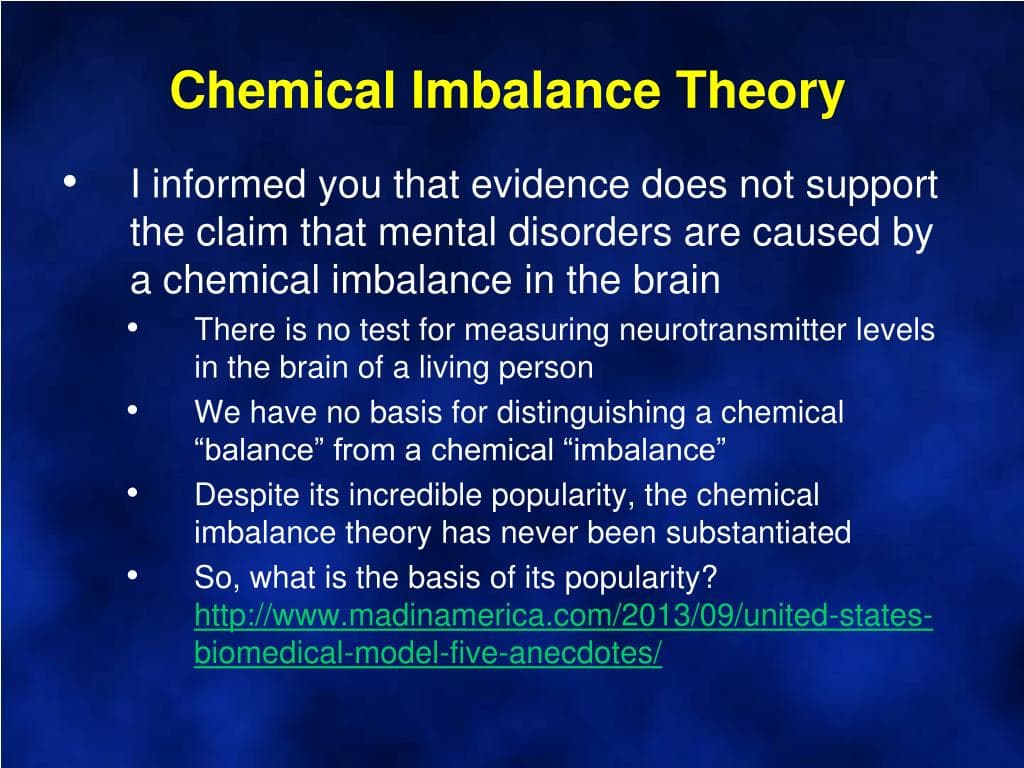
For three decades, millions of Americans took daily pills based on a theory that was never actually proven. The idea was simple and compelling: depression results from low serotonin in the brain, and selective serotonin reuptake inhibitors—SSRIs—could fix it. That narrative became so embedded in medical practice and popular culture that questioning it seemed almost heretical. Yet in 2022, a systematic review of the scientific evidence revealed a troubling reality: there was never solid proof that low serotonin caused depression in the first place.
The chemical imbalance theory emerged in the late 1980s and 1990s as pharmaceutical companies introduced a new class of antidepressants. Rather than waiting for robust evidence, the industry promoted a simplified explanation that resonated with doctors and patients alike. Depression wasn't a personal failing or a complex psychological condition—it was a biological defect, a neurotransmitter shortage that pills could correct. The narrative was elegant. It was also, as it turned out, unsubstantiated.
For years, when researchers and clinicians raised concerns, the official response was consistent: the science was settled. Psychiatrists pointed to the efficacy of SSRIs in clinical practice. Pharmaceutical representatives presented the serotonin theory as established fact. Patients were reassured that they had a medical condition with a medical solution. Dissenting voices were marginalized or ignored.
Then came the 2022 umbrella review in Molecular Psychiatry led by Dr. Joanna Moncrieff. Her team systematically analyzed 17 major reviews examining the relationship between serotonin and depression. The findings were unambiguous: there was no consistent evidence that depressed patients had lower serotonin levels than non-depressed individuals. More damning still, the drug trials themselves showed SSRIs performed barely better than placebo—a fact buried in technical literature rather than broadcast to the public.
Get the 5 biggest receipts every week, straight to your inbox — plus an exclusive PDF: The Top 10 Conspiracy Theories Proven True in 2025-2026. No spam. No agenda. Just the papers they couldn't hide.
You just read "The 'chemical imbalance' theory of depression was never prov…". We send ones like this every week.
No one's said anything yet. Be the first to drop your take.
Confirmed: They Were Right
The truth comes out. Officially documented.
Confirmed: They Were Right
The truth comes out. Officially documented.
This wasn't a fringe critique. Moncrieff's work represented the kind of rigorous meta-analysis that should have guided prescribing practices all along. Yet tens of millions had already been prescribed these drugs under false pretenses. Some patients benefited, certainly. But others experienced side effects without the promised explanation of why they were necessary. The informed consent that should have accompanied treatment was based on marketing, not science.
The implications extend beyond individual cases. When pharmaceutical companies shape the narrative around disease, when profit incentives align with simplified explanations, and when institutions accept convenient myths without demanding proof, public trust suffers. Patients have legitimate reasons to question whether they truly need their medications, or whether they were sold a story.
This doesn't mean SSRIs should be abandoned or that depression isn't real. But it does mean the foundation of their mass prescription was built on sand. The chemical imbalance theory became what Moncrieff herself has called "marketing masquerading as science"—a claim repeated so often that its lack of evidence went unexamined.
The lesson runs deeper than antidepressants. When institutions fail to challenge established narratives, when financial interests shape medical knowledge, and when complexity is flattened into simplicity, those who trust the system pay the price. What happened with SSRIs is a case study in how good intentions and institutional inertia can allow widespread treatment based on unproven theories. It's a reminder that even in medicine, the burden of proof should not be optional.
Beat the odds
This had a 2.1% chance of leaking — someone talked anyway.
Conspirators
~300Network
Secret kept
17.5 years
Time to 95% exposure
500+ years