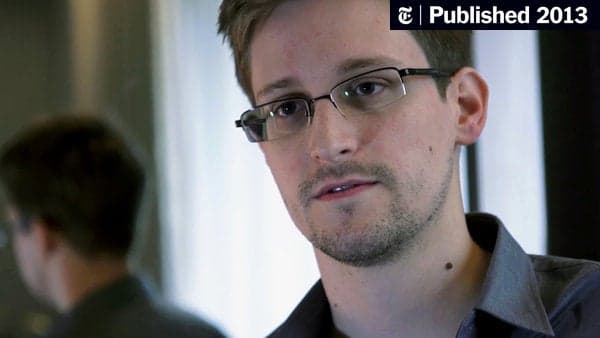
Edward Snowden was charged under the Espionage Act of 1917, which was designed for spies selling secrets to foreign governments. The Act provides no mechanism for a 'public interest' defense — meaning at trial, Snowden would be legally prohibited from explaining why he leaked or arguing that revealing illegal mass surveillance served the public. The programs he exposed were later ruled unconstitutional by federal courts, and Congress passed the USA FREEDOM Act reforming NSA surveillance. Despite this vindication, Snowden remains in exile in Russia.
“I would return to the US if I could get a fair trial. But the Espionage Act doesn't allow me to tell the jury why I did it. The law treats me as if I sold secrets to Russia.”
From “crazy” to confirmed
The Claim Is Made
This is the moment they called it crazy.
Edward Snowden couldn't tell a jury why he did it. When the federal government charged the NSA contractor in 2013 under the Espionage Act, prosecutors wielded a law written over a century earlier to catch spies selling state secrets to adversaries. The statute left no room for Snowden to argue he acted in the public interest—a legal strategy that would have been his most compelling defense.
The official line from government officials was clear: Snowden was a traitor who had stolen classified information and endangered national security. They dismissed the notion that his motives mattered. The Espionage Act, they argued, was the appropriate tool because classified information had been transmitted, regardless of where it ended up or why. In the eyes of the law they invoked, intent was irrelevant. Snowden faced up to 30 years in prison, with no mechanism to explain himself in court.
But the architecture of that legal case revealed something troubling about how American justice handles whistleblowers. The Espionage Act contains no public interest defense. A defendant cannot argue to a jury that revealing information served democracy or exposed government wrongdoing. The law treats all unauthorized disclosure of classified material the same way—as a potential crime. It's a blunt instrument designed for Cold War counterintelligence, not for cases involving constitutional concerns.
What happened next vindicated the very disclosures Snowden couldn't legally defend. Federal courts ruled the NSA's bulk phone metadata collection program unconstitutional. The Privacy and Oversight Board confirmed the program was ineffective and raised serious legal questions. In 2015, Congress passed the USA FREEDOM Act, explicitly reforming the surveillance apparatus Snowden had exposed. The programs he revealed were not only wrong—they were illegal, according to courts and Congress alike.
Get the 5 biggest receipts every week, straight to your inbox — plus an exclusive PDF: The Top 10 Conspiracy Theories Proven True in 2025-2026. No spam. No agenda. Just the papers they couldn't hide.
You just read "Snowden was charged under the Espionage Act which offers no …". We send ones like this every week.
No one's said anything yet. Be the first to drop your take.
Yet Snowden remained in exile in Russia, unable to return home and face trial. The government that used the Espionage Act to prosecute him later acknowledged that the surveillance programs he disclosed were unconstitutional. The public interest defense he would have been denied at trial had effectively vindicated itself through the political and legal system.
This claim is partially verified because while the core facts are accurate—Snowden was charged under the Espionage Act with no public interest defense available—the broader vindication came through institutional rather than judicial channels. Snowden never had his day in court to present that argument.
What matters here extends beyond one man's fate. The Espionage Act remains a prosecutorial weapon that prevents whistleblowers from explaining themselves to a jury, even when their revelations expose unconstitutional government conduct. This creates a legal system where the public never hears the full story in open court. Snowden's case demonstrates a gap between what the law permits and what justice requires. When government surveillance programs are later ruled unconstitutional, but the person who revealed them is unable to legally defend their actions at trial, something is broken in the system. It raises fundamental questions about whether Americans can actually know what their government is doing—and whether those who take risks to tell them the truth can ever get a fair hearing.
Beat the odds
This had a 0.3% chance of leaking — someone talked anyway.
Conspirators
~50Network
Secret kept
12.9 years
Time to 95% exposure
500+ years