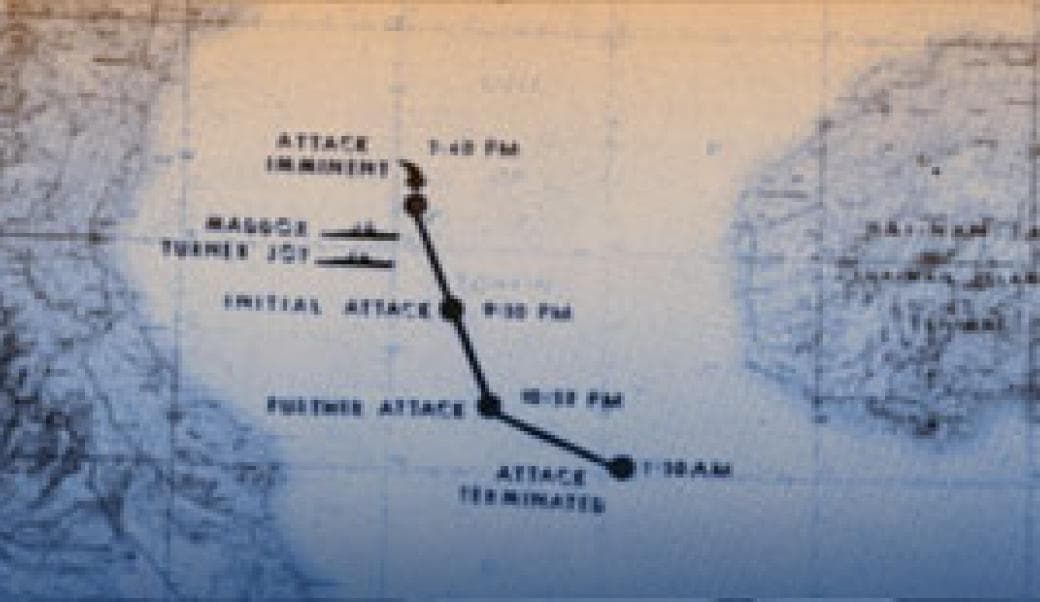
Declassified NSA documents from 2005 revealed that the second Gulf of Tonkin attack on August 4, 1964 never happened. NSA analysts 'made SIGINT fit the claim' of a North Vietnamese attack, deliberately presenting only information supporting the attack narrative to President Johnson. Congress passed the Gulf of Tonkin Resolution based on this fabricated evidence, escalating to full-scale war.
“The SIGINT reporting appears to have been presented in such a manner as to preclude responsible decision makers from having the complete and objective narrative of events.”
From “crazy” to confirmed
The Claim Is Made
This is the moment they called it crazy.
On August 4, 1964, the United States Navy reported that North Vietnamese torpedo boats had attacked the USS Maddox in the Gulf of Tonkin. Two days later, President Lyndon Johnson told Congress and the American public that a second attack had occurred. Congress swiftly passed the Gulf of Tonkin Resolution, effectively handing Johnson a blank check for military escalation in Vietnam.
What followed was sustained bombing campaigns and the deployment of ground troops that would kill over 58,000 Americans and millions of Vietnamese over the next decade. The war would tear apart the nation, spark massive protests, and fundamentally shift American politics for generations. Yet the attack that justified all of this—the second attack on August 4—almost certainly never happened.
At the time, the official story seemed airtight. The NSA, Navy commanders, and the President all confirmed the attack. Skeptical journalists and politicians were dismissed as naive or unpatriotic. The few analysts who privately questioned the evidence were overruled. For decades, the American public accepted the narrative because there was no reason to doubt it. The government had spoken.
Doubts began surfacing in the 1970s and 1980s, as declassified documents suggested the second attack might not have occurred. Journalists and historians questioned the radar data and radio intercepts that supposedly proved the attack. But the official position remained largely unchanged: the attack probably happened, though details were murky.
In 2005, that changed. The NSA released newly that revealed the full scope of what had happened in August 1964. The second attack never occurred. More damning was the documentary evidence of how the intelligence community had handled the facts. NSA analysts had deliberately presented only information supporting the attack narrative to President Johnson, while suppressing or contextualizing evidence that contradicted it. One internal memo noted that analysts had "made SIGINT fit the claim" rather than letting the evidence speak for itself.
Get the 5 biggest receipts every week, straight to your inbox — plus an exclusive PDF: The Top 10 Conspiracy Theories Proven True in 2025-2026. No spam. No agenda. Just the papers they couldn't hide.
You just read "The NSA deliberately skewed intelligence to fabricate a seco…". We send ones like this every week.
No one's said anything yet. Be the first to drop your take.
Confirmed: They Were Right
The truth comes out. Officially documented.
Confirmed: They Were Right
The truth comes out. Officially documented.
The radar operators who allegedly spotted the second attack were uncertain about what they saw. Radio intercepts suggesting a North Vietnamese attack were ambiguous, later reinterpreted by the same analysts who had initially promoted them. Rough seas that night made a torpedo attack technically unlikely. None of this was adequately conveyed up the chain of command. Instead, decision-makers received a curated version of reality designed to support a predetermined conclusion.
This wasn't incompetence or honest disagreement about ambiguous data. The NSA's own records showed that analysts knew they were shaping the intelligence to fit a political narrative. Johnson wanted justification for escalation, and the intelligence community provided it—not by discovering attack evidence, but by manufacturing the appearance of evidence.
What makes the Gulf of Tonkin significant isn't merely that one attack didn't happen. It's that the mechanisms of deception were documented in detail by the government's own records. It shows how institutional pressures, political expectations, and compartmented information can lead intelligent people to knowingly distort intelligence. It demonstrates that when the public is lied to about the justifications for war, the documents often prove it—but only years or decades later, after the consequences are irreversible. This is why declassification matters, and why skepticism about official narratives, when informed by evidence, isn't cynicism. It's vigilance.
Unlikely leak
Only 7.9% chance this would come out. It did.
Conspirators
~500Large op
Secret kept
41.3 years
Time to 95% exposure
500+ years