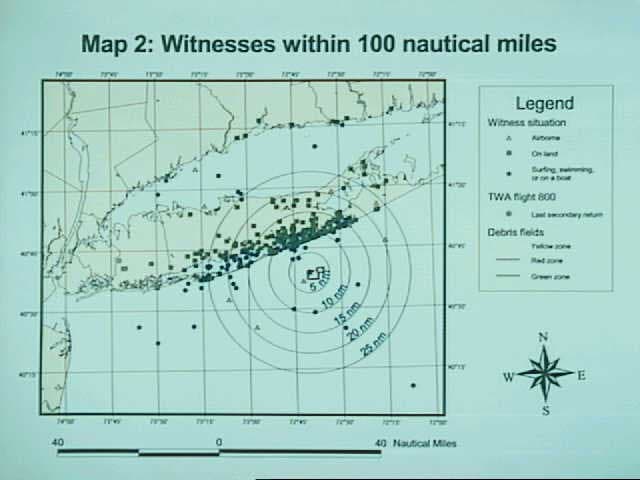
When TWA Flight 800 exploded off Long Island on July 17, 1996, killing 230 people, over 250 eyewitnesses reported seeing a streak of light rise from the surface before the explosion. NTSB whistleblower Hank Hughes testified under whistleblower protection about FBI interference in the investigation, including catching an FBI agent hammering evidence. A 2022 lawsuit by 15 victim families alleges a US Navy missile test caused the crash.
“I caught an FBI agent hammering on a piece of wreckage in an attempt to flatten it. The FBI interfered with and controlled the investigation from the beginning.”
From “crazy” to confirmed
The Claim Is Made
This is the moment they called it crazy.
On July 17, 1996, TWA Flight 800 disintegrated over the Atlantic Ocean near Long Island, New York, killing all 230 people aboard. What happened next—both in the sky and on the ground—remains one of the most contested aviation disasters in American history.
Immediately after the explosion, something peculiar emerged from witness accounts. Over 250 people on the ground reported seeing a bright streak of light rise from the ocean surface toward the aircraft before the blast occurred. These weren't casual observers—many were experienced mariners, military personnel, and others trained to recognize unusual phenomena. The consistency of their accounts created an obvious question: had something struck the plane from below?
The National Transportation Safety Board took the lead on the investigation, as federal law requires for civilian aviation accidents. The NTSB's initial direction seemed promising for those who believed the eyewitness accounts. But then the Federal Bureau of Investigation inserted itself into the process, citing national security concerns. What followed, according to testimony and documentation, was a subtle but significant shift in how evidence was handled and what conclusions were drawn.
The official conclusion, released after four years of investigation, attributed the crash to a fuel tank explosion in the center tank of the Boeing 747. While mechanical failure remained possible, this explanation sat uneasily with the eyewitness testimony that had been so prominent in the early days of the investigation.
In 1999, NTSB investigator Hank Hughes testified before the Senate Judiciary Committee under whistleblower protection. His account was striking: he described witnessing an FBI agent actually hammering evidence. More broadly, Hughes testified about what he characterized as FBI interference in the investigation's direction and conclusions. He wasn't alone in raising concerns—other NTSB staff members had also expressed doubts about how the investigation proceeded once became heavily involved.
Get the 5 biggest receipts every week, straight to your inbox — plus an exclusive PDF: The Top 10 Conspiracy Theories Proven True in 2025-2026. No spam. No agenda. Just the papers they couldn't hide.
You just read "Over 250 eyewitnesses saw a streak of light hit TWA Flight 8…". We send ones like this every week.
No one's said anything yet. Be the first to drop your take.
Hughes's testimony created a documentary record of internal skepticism about the official narrative, though it didn't immediately overturn any conclusions. The NTSB maintained its fuel tank theory, and that remained the official position for decades.
Then in 2022, fifteen families of victims filed a lawsuit alleging that a U.S. Navy missile test had caused the crash. This action represented more than grief-driven speculation—it was a formal legal challenge based on accumulated evidence and witness testimony that had never been adequately addressed in the official investigation.
The TWA Flight 800 case matters because it sits at the intersection of legitimate questions about government transparency and institutional credibility. When an independent agency investigating a tragedy suddenly finds itself subordinate to another government body, when whistleblowers must seek special protection to testify about what they witnessed, when over 250 eyewitnesses are eventually dismissed in favor of a mechanical explanation—these circumstances demand scrutiny.
What's disputed here isn't whether something unusual happened on July 17, 1996. Rather, it's whether the investigation that followed was truly independent, whether all evidence received equal consideration, and whether the public ever received a complete accounting of what investigators actually found. These questions matter not because they guarantee any particular answer, but because the process by which we arrive at truth—especially in high-profile incidents—shapes public trust in institutions that claim to serve the public interest.
Unlikely leak
Only 5.8% chance this would come out. It did.
Conspirators
~500Large op
Secret kept
29.8 years
Time to 95% exposure
500+ years