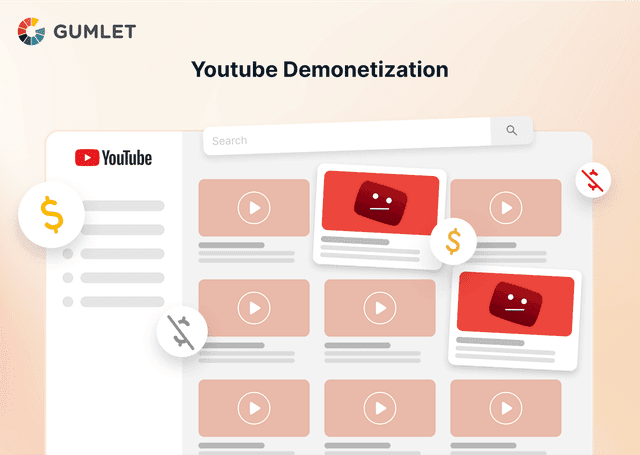
YouTube's demonetization system disproportionately impacts political content creators by cutting their revenue without removing their content — creating a financial censorship mechanism. YouTube blocked conservative commentator Steven Crowder from making money while admitting his videos 'did not violate Community Guidelines.' The platform's vague 'advertiser-friendly' policies give YouTube arbitrary power to defund creators discussing political topics, war, or controversial subjects. The system creates self-censorship: creators avoid covering certain topics to protect their income. This represents a new form of censorship — not banning speech, but making it financially unsustainable.
“YouTube isn't banning political speech — they're doing something more insidious. They're demonetizing creators whose views they don't like, making it financially impossible to produce independent political content while maintaining the illusion of free speech.”
What they said vs. what the evidence shows
“Our advertising policies are designed to protect advertisers and ensure their brands appear alongside appropriate content. Demonetization is not censorship — creators can still publish their content freely.”
— YouTube Spokesperson · Jun 2019
SourceFrom “crazy” to confirmed
The Claim Is Made
This is the moment they called it crazy.
YouTube's demonetization of conservative commentator Steven Crowder's channel in 2019 offered a rare glimpse into how digital platforms can suppress content without technically banning it. The platform removed ads from Crowder's videos while explicitly stating they "did not violate Community Guidelines" — a contradiction that raised uncomfortable questions about how online speech is actually policed in the modern era.
For years, content creators suspected YouTube was using its monetization system as a selective tool. When a video gets demonetized, the creator loses ad revenue but the content remains visible. It's removal without removal, punishment without accountability. Crowder's case provided documented evidence that this suspicion had merit.
YouTube's official position was that demonetization decisions were based on advertiser-friendly content policies. The platform claimed these policies protected brands from appearing next to controversial material. But here's where the logic breaks down: if content violates no community guidelines, why is it unsuitable for advertisers? YouTube never adequately answered this question.
The mechanism works like financial strangulation in slow motion. A creator covering political topics, military conflicts, or social controversies might see monetization stripped from their videos. They haven't been censored in the traditional sense — their audience can still find them. But the economic incentive to produce that content vanishes. Some creators abandon sensitive topics altogether. Others simply leave the platform.
This creates what might be called "soft censorship" or "financial censorship." It's not a ban. It's worse in some ways because it's invisible to casual observers. The content exists. The creator can technically still post. But they can't sustain themselves doing so.
Get the 5 biggest receipts every week, straight to your inbox — plus an exclusive PDF: The Top 10 Conspiracy Theories Proven True in 2025-2026. No spam. No agenda. Just the papers they couldn't hide.
You just read "YouTube uses demonetization as a financial censorship tool t…". We send ones like this every week.
No one's said anything yet. Be the first to drop your take.
The Cornell Chronicle's examination of YouTube's demonetization strategy acknowledged this fundamental problem. The vague guidelines about "advertiser-friendly" content give YouTube enormous discretionary power. What counts as controversial? Who decides? YouTube's own employees might disagree on individual cases, yet creators have little recourse to appeal these decisions meaningfully.
The system also creates a chilling effect across the platform. When creators see colleagues lose revenue for covering certain topics, they self-censor. They avoid discussing politics, avoid covering wars, avoid controversy altogether. They stick to safe content that won't trigger algorithmic or human review. YouTube doesn't need to ban these discussions. The financial pressure does the work.
What makes this partially verified rather than fully confirmed is that YouTube has never explicitly admitted to using demonetization as a content suppression tool. The company frames it as advertiser protection. But the pattern suggests otherwise. The disproportionate impact on political content, the vague standards, the lack of transparent appeals — these point to a system functioning as censorship whether intentional or not.
This matters because digital platforms now function as the primary public square. When companies can make speech financially unsustainable without formally banning it, they've discovered a form of power that exists in a legal gray area. Traditional free speech protections don't address it. Governments haven't regulated it. And the companies themselves profit from the ambiguity.
As more creators migrate to platforms like YouTube, their livelihoods depend on these companies' policies. That dependency creates vulnerability. The Crowder case proved the vulnerability is real, even if YouTube will never formally admit what its own actions revealed.
Beat the odds
This had a 0.4% chance of leaking — someone talked anyway.
Conspirators
~100Network
Secret kept
9.2 years
Time to 95% exposure
500+ years