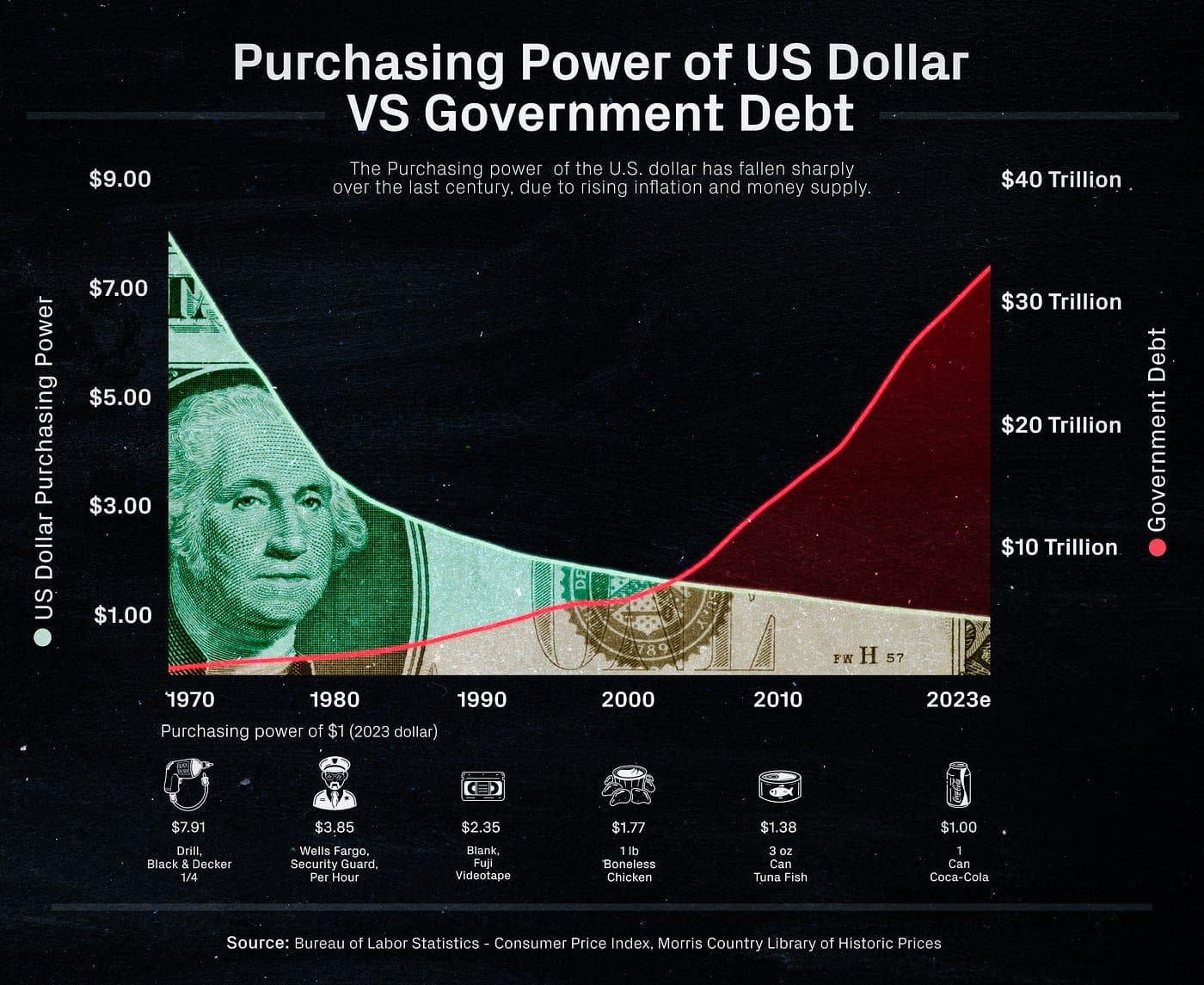
Since the Federal Reserve's creation in 1913, the U.S. dollar has lost approximately 96% of its purchasing power. The Fed's 2% inflation target means your savings lose half their value every 36 years by design. During 2020-2021, the Fed printed $4.6 trillion -- more than in its entire previous history. Consumer prices surged. Meanwhile, asset-owning wealthy Americans saw their net worth increase by trillions as printed money flowed into stocks and real estate rather than the real economy. Savers were punished while borrowers were rewarded.
“Central banks deliberately destroy the value of savings through money printing and inflation targeting. The system is designed to force people into risky investments and debt.”
From “crazy” to confirmed
The Claim Is Made
This is the moment they called it crazy.
Your grandfather's dollar could buy what it takes twenty-five dollars to purchase today. This isn't anecdotal nostalgia—it's documented financial reality that many dismissed as conspiracy theorizing until the numbers became impossible to ignore.
The claim that the U.S. dollar has lost roughly 96% of its purchasing power since the Federal Reserve's establishment in 1913 has circulated in financial circles for decades. Critics pointed to this statistic as evidence that the Fed's monetary policies were systematically eroding ordinary Americans' savings. Mainstream economists and Federal Reserve officials largely dismissed such concerns as oversimplifications of complex economic theory, insisting that moderate inflation was necessary for economic growth and employment.
The mathematics, however, tell a different story. According to Federal Reserve historical data, a basket of goods that cost one dollar in 1913 would cost approximately twenty-five dollars by 2013. Adjust further for inflation through 2024, and that purchasing power loss approaches 96%. This isn't projection or theory—it's historical pricing data that the Federal Reserve itself maintains.
The Fed's own monetary policy framework provides crucial context. Since the 1990s, the Federal Reserve has explicitly targeted a 2% annual inflation rate. While presented as moderate and manageable, compound mathematics reveal the implications: at 2% annual inflation, the purchasing power of the dollar theoretically halves every thirty-six years. Over a human lifetime, this represents a substantial erosion of savings.
The claim gained particular credibility following 2020-2021 monetary decisions. Federal Reserve records show that the institution printed 4.6 trillion dollars during this period—more currency than had been created in its entire previous 107-year history. This dramatic expansion directly preceded a significant surge in consumer prices across housing, food, and energy sectors.
What followed illustrated a crucial asymmetry that validates the underlying claim. Data from the Federal Reserve's own wealth surveys shows that asset-owning Americans—those holding stocks, real estate, and bonds—experienced trillions in net worth increases as printed money flowed into financial markets. Meanwhile, Americans dependent on savings accounts and fixed incomes watched their purchasing power decline measurably. The policy that weakened the dollar simultaneously rewarded existing wealth holders and penalized savers.
The Nixon Shock of 1971 provides historical perspective. When President Nixon ended the convertibility of U.S. dollars to gold, it unmoored the currency from any physical backing. From that point forward, the Fed's ability to expand the money supply faced no physical constraint—only policy choices. This context transforms the 96% figure from mere economic curiosity into a documented consequence of specific institutional decisions.
None of this requires assuming malice or coordinated conspiracy. The mechanisms are transparent and publicly documented. The Federal Reserve publishes its inflation targets. The Treasury reports money supply data. Historical price indices are publicly available.
What changed isn't whether the claim was true, but rather whether observers were paying attention. When people began experiencing the consequences directly—unable to afford housing, watching savings diminish, seeing asset prices climb beyond reach—suddenly the "conspiracy theory" became conventional wisdom.
This is precisely why this claim matters for public trust. When institutional explanations contradict lived experience, and when publicly available data ultimately proves the skeptics right, confidence in official narratives erodes. The question becomes not whether the dollar lost purchasing power, but why the institutions responsible resisted acknowledging it until the evidence became undeniable.
Get the 5 biggest receipts every week, straight to your inbox — plus an exclusive PDF: The Top 10 Conspiracy Theories Proven True in 2025-2026. No spam. No agenda. Just the papers they couldn't hide.
You just read "The U.S. dollar has lost 96% of its purchasing power since t…". We send ones like this every week.
No one's said anything yet. Be the first to drop your take.