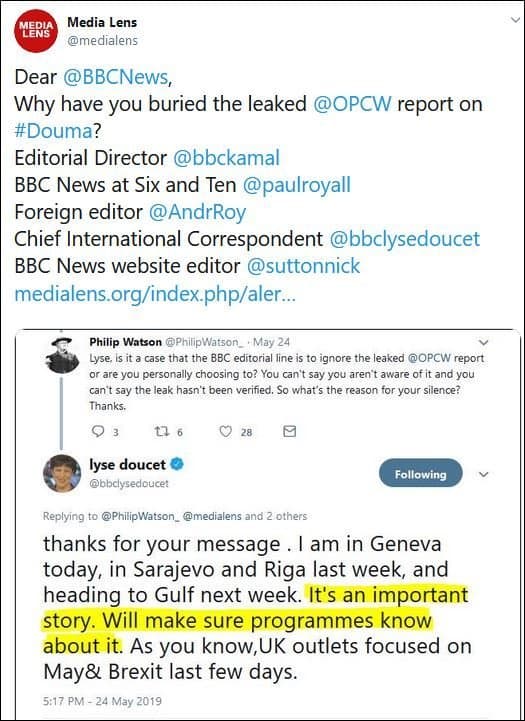
After the alleged April 2018 chemical attack in Douma, Syria, the US, France, and UK launched missile strikes on Syrian targets within a week. OPCW inspectors later leaked internal documents via WikiLeaks showing that key evidence was suppressed: a leaked engineering report indicated the chlorine cylinders were unlikely to have been air-dropped, toxicology findings were inconsistent with chlorine exposure, and a whistleblower panel concluded 'key information about chemical analyses, ballistics studies, and witness testimonies was suppressed to favor a preordained conclusion.' The OPCW's own executives privately praised the whistleblower's integrity.
“The OPCW's final report on Douma misrepresents the facts discovered on the ground. Key information was suppressed to support a preordained conclusion that would justify military action.”
What they said vs. what the evidence shows
From “crazy” to confirmed
The Claim Is Made
This is the moment they called it crazy.
When three Western nations launched over 100 missiles at Syria in April 2018, they were acting on a singular conviction: that the Assad government had conducted a chemical weapons attack on the suburb of Douma four days earlier. The strikes came with remarkable speed, authorized by President Trump, Prime Minister Macron, and PM May before any independent investigation could be completed. The justification seemed ironclad—chemical weapons had been used, civilians had died, and international law demanded a response.
What followed over the next two years told a starkly different story about how evidence gets handled at the highest levels of international organizations.
The Organisation for the Prohibition of Chemical Weapons, or OPCW, was tasked with investigating what happened in Douma. As the UN's designated chemical weapons watchdog, its credibility was essential to the legitimacy of those missile strikes. The organization's preliminary reports appeared to support the narrative that Syrian government forces had deployed chlorine gas against civilians.
But in late 2019, whistleblowers within the OPCW began coming forward. More significantly, internal documents leaked to WikiLeaks revealed a troubling pattern: critical findings that contradicted the official conclusion had been systematically removed from the final report.
An engineering assessment, conducted by the OPCW's own ballistics experts, concluded that the chlorine cylinders found at the attack sites were unlikely to have been air-dropped—the method that would implicate government forces. This analysis was excluded from the final report. Toxicology data showing symptoms inconsistent with chlorine exposure was similarly suppressed. The leaked documents showed that witness testimonies and chemical analyses that pointed toward alternative explanations were deliberately omitted.
A panel established to review the whistleblower complaints found that "key information about chemical analyses, ballistics studies, and witness testimonies was suppressed to favor a preordained conclusion." The panel noted that executives at the OPCW had privately acknowledged the integrity of the whistleblowers while publicly maintaining the official narrative.
The organization's leadership defended its methodology but did not substantially rebut the specific claims about suppressed evidence. Instead, they emphasized the complexity of the investigation and questioned the motives of those raising concerns. Critics argued this amounted to dismissing inconvenient findings rather than addressing them directly.
The significance of this case extends far beyond Syria. It demonstrates how institutional pressure, political expectations, and careerism can compromise even organizations designed to operate with scientific objectivity. The OPCW's credibility, which underpins international enforcement of chemical weapons prohibitions, was fundamentally damaged by the revelation that its investigation had been tailored to reach a predetermined conclusion.
This matters because nations rely on organizations like the OPCW to provide impartial technical assessments that inform military decisions affecting millions of lives. When such organizations suppress contradictory evidence—whether from institutional pressure or other motives—the foundations of international law weaken. Public trust in these institutions depends on transparent handling of evidence, even when findings are inconvenient.
The Douma case remains contentious, with legitimate disagreements about what actually occurred. But the question of whether an international investigative body suppressed its own experts' findings is no longer in dispute.
Get the 5 biggest receipts every week, straight to your inbox — plus an exclusive PDF: The Top 10 Conspiracy Theories Proven True in 2025-2026. No spam. No agenda. Just the papers they couldn't hide.
You just read "OPCW whistleblowers revealed the organization suppressed evi…". We send ones like this every week.
No one's said anything yet. Be the first to drop your take.