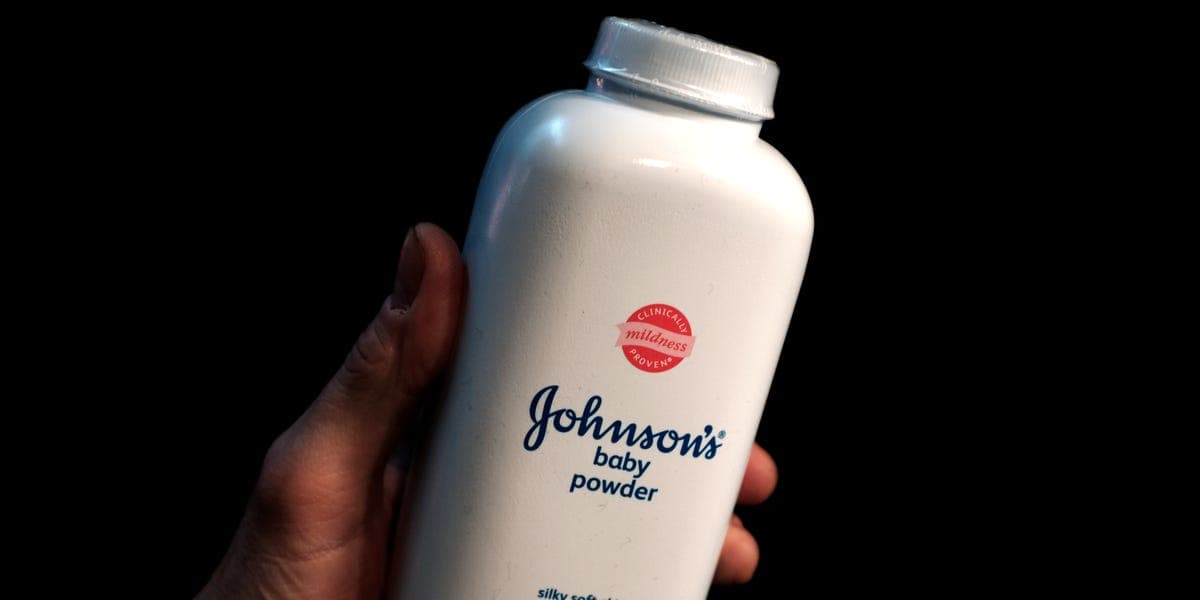
A Reuters investigation in December 2018 revealed that from at least 1971 to the early 2000s, Johnson & Johnson's talc and finished powders tested positive for asbestos. Traces were first detected in the late 1950s. J&J didn't tell the FDA that at least three tests from 1972 to 1975 found asbestos — one at levels reported as 'rather high.' Company executives, mine managers, scientists, doctors, and lawyers all knew about the contamination. They also successfully influenced regulators' plans to limit asbestos in cosmetic talc. J&J stock dropped 10% on the news — its worst loss in two decades.
“Johnson & Johnson's baby powder contains asbestos and they've known about it for decades. They covered up test results showing contamination and influenced regulators to avoid restrictions.”
From “crazy” to confirmed
The Claim Is Made
This is the moment they called it crazy.
For decades, Johnson & Johnson told the world that its baby powder was safe. Mothers trusted the company's assurances enough to dust it on their infants' skin. What the company didn't say was that its own scientists had found asbestos in the product—and that executives, lawyers, and doctors had made a calculated decision to keep that information quiet.
The claim that J&J knew about asbestos contamination in its talc products wasn't new. Consumer advocates and researchers had raised concerns for years. But the company consistently denied any knowledge of the problem, dismissing suggestions that asbestos had ever contaminated their baby powder. Regulators largely accepted this narrative, and for good reason—J&J was one of the world's most trusted corporations, with a squeaky-clean public image built on decades of marketing itself as a family-friendly brand.
In December 2018, Reuters published an investigation that shattered this carefully maintained facade. The reporting revealed something that had been buried in company archives: J&J's own testing from at least 1971 onward repeatedly detected asbestos in their talc and powders. One test from the early 1970s showed contamination levels described internally as "rather high." The company had documentation going back even further—to the late 1950s—showing traces of asbestos. Yet J&J never disclosed these findings to the FDA or to the public.
What made the revelation even more damning was the scope of who knew. This wasn't a case of miscommunication or isolated negligence. Company executives, mine managers, scientists, doctors, and lawyers all had knowledge of the contamination. They didn't just know—they acted on that knowledge. J&J successfully lobbied regulators to prevent them from implementing stricter limits on asbestos in cosmetic talc products. The company had essentially weaponized its corporate influence to keep regulations weak while its own products tested positive for a known carcinogen.
Get the 5 biggest receipts every week, straight to your inbox — plus an exclusive PDF: The Top 10 Conspiracy Theories Proven True in 2025-2026. No spam. No agenda. Just the papers they couldn't hide.
You just read "J&J knew for decades that their baby powder contained asbest…". We send ones like this every week.
No one's said anything yet. Be the first to drop your take.
Confirmed: They Were Right
The truth comes out. Officially documented.
Confirmed: They Were Right
The truth comes out. Officially documented.
The evidence was overwhelming because it came from J&J's own internal documents. These weren't allegations or circumstantial inferences—they were test results, memos, and records that the company itself had generated and kept. The Reuters investigation had accessed this documentation, meaning there was no ambiguity about what the company knew and when it knew it.
The market's reaction was swift. J&J's stock dropped 10 percent on the news, marking its worst day in two decades. The company faced thousands of lawsuits from people who had developed mesothelioma and ovarian cancer after years of using the powder. Many of those lawsuits would ultimately result in significant settlements and judgments against the corporation.
This case matters not because it reveals a single corporate wrongdoing, but because it exposes the machinery behind sustained deception. For over forty years, a major corporation prioritized profits over safety while maintaining a public image of trustworthiness. That image was so powerful that even as the evidence accumulated, most people believed the company's denials.
What happened with J&J's baby powder should prompt a fundamental question about corporate accountability: if one of America's most respected companies could conceal this for decades, what else are we not being told? It's a question that still reverberates today.
Beat the odds
This had a 0% chance of leaking — someone talked anyway.
Conspirators
~100Network
Secret kept
1.2 years
Time to 95% exposure
500+ years