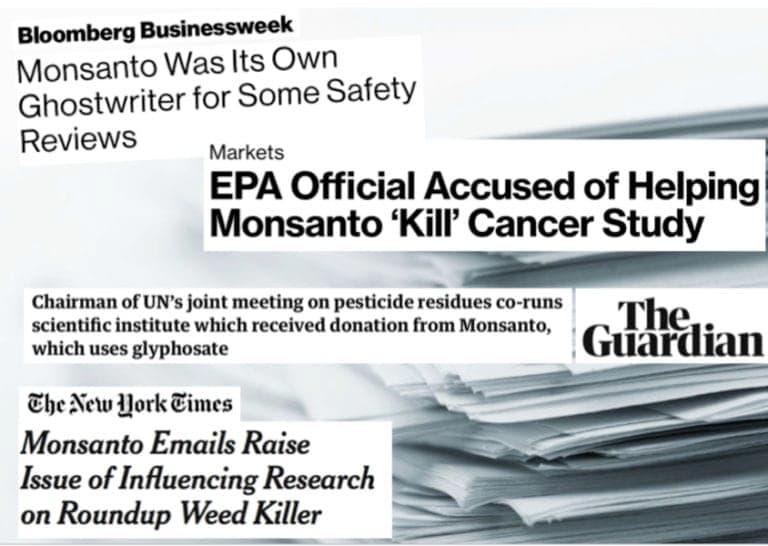
The 'Monsanto Papers' revealed that Monsanto's own toxicologist wrote in 2003: 'you cannot say that Roundup is not a carcinogen.' The company ghostwrote studies with academics as frontmen, launched coordinated attacks on IARC after its 'probable carcinogen' classification, and an EPA official boasted he could 'kill' an investigation and 'should get a medal.' A key safety study was retracted for 'serious ethical concerns.' Bayer (which acquired Monsanto) has paid over $10 billion in settlements.
“You cannot say that Roundup is not a carcinogen. We have not done the necessary testing on the formulation to make that statement.”
From “crazy” to confirmed
The Claim Is Made
This is the moment they called it crazy.
When Monsanto's internal documents surfaced in litigation, they revealed a company that knew something crucial about its flagship product but chose a different path: fight the scientists, not the science.
For decades, Monsanto maintained that glyphosate—the active ingredient in Roundup—was safe. The company's public stance was unequivocal. Regulators listened. Farmers sprayed billions of gallons. And the International Agency for Research on Cancer (IARC), a division of the World Health Organization, classified glyphosate as "probably carcinogenic to humans" in 2015. Monsanto dismissed this conclusion as outlier science, driven by anti-chemical ideology rather than evidence.
The company's own documents told a different story. In 2003, Monsanto's toxicologist wrote plainly: "you cannot say that Roundup is not a carcinogen." This wasn't from a whistleblower or leaked memo—it emerged from the company's own files during legal discovery. The gap between what Monsanto knew internally and what it claimed publicly had a specific name in the documents: ghostwriting.
didn't conduct all of its safety research alone. Instead, the company collaborated with academics and researchers, providing the funding and the conclusions, while having scientists put their names on studies as lead authors. These ghostwritten papers then circulated through regulatory channels and scientific literature with the appearance of independent research. When IARC classified as probably ic, Monsanto's response was coordinated and aggressive. Internal communications revealed a deliberate campaign to attack and undermine IARC scientists. The company funded criticism, cultivated relationships with regulatory officials, and worked to discredit the organization's methods.
Get the 5 biggest receipts every week, straight to your inbox — plus an exclusive PDF: The Top 10 Conspiracy Theories Proven True in 2025-2026. No spam. No agenda. Just the papers they couldn't hide.
You just read "Monsanto ghostwrote safety studies, attacked WHO cancer scie…". We send ones like this every week.
No one's said anything yet. Be the first to drop your take.
Confirmed: They Were Right
The truth comes out. Officially documented.
Confirmed: They Were Right
The truth comes out. Officially documented.
Perhaps most damning was the involvement of an EPA official. According to the documents, a senior EPA staffer promised to "kill" the glyphosate investigation and boasted that he "should get a medal" for his work protecting the company's interests. This wasn't speculation—it was documented in communications between Monsanto and its allies within the regulatory apparatus that was supposed to oversee the company independently.
One key safety study became so ethically compromised that it was retracted. The retraction cited "serious ethical concerns," a rare and damaging outcome in scientific literature. These weren't minor oversights. They were systematic efforts to shape the regulatory environment through influence, ghostwriting, and access to officials who appeared to prioritize corporate interests over public health.
Monsanto initially dismissed the allegations as routine corporate behavior taken out of context. The company argued that all of its research met regulatory standards and that its communications with government agencies were appropriate. Bayer, which acquired Monsanto in 2018, initially defended these practices as common industry practice.
The financial reckoning suggested otherwise. Bayer has paid over $10 billion in settlements to resolve thousands of lawsuits from people alleging that Roundup exposure caused cancer. That sum represents one of the largest corporate liability settlements in history. It's difficult to reconcile a truly safe product with a $10 billion settlement.
What matters most here isn't just that Monsanto misled the public or that an EPA official appeared corrupted. It's that the mechanisms we rely on to protect public health—regulatory agencies, scientific peer review, and corporate accountability—were all shown to be permeable to corporate influence. Trust in these institutions doesn't recover quickly from revelations like these. It shouldn't.
Beat the odds
This had a 1.9% chance of leaking — someone talked anyway.
Conspirators
~300Network
Secret kept
15.6 years
Time to 95% exposure
500+ years