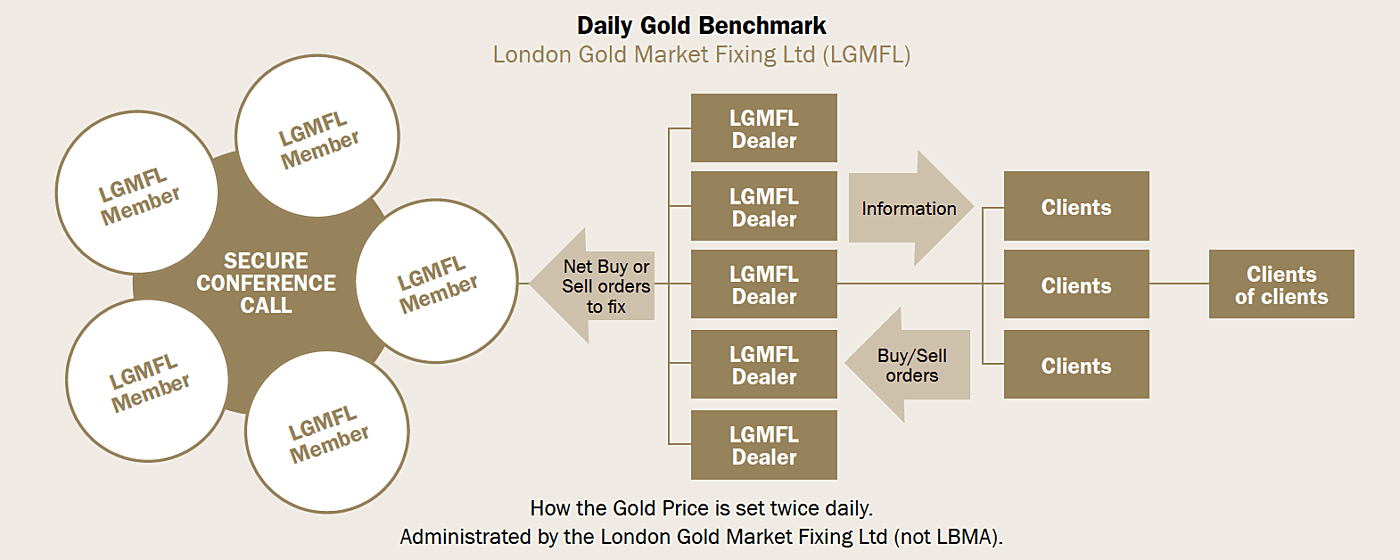
For decades, the daily gold price was set by just five banks on a private phone call -- a process ripe for abuse. Researchers found 'unusual trading patterns' consistent with manipulation around the 3 PM London fix since at least 2004. In 2014, Barclays was fined for a trader who manipulated the fix to avoid a $3.9 million client payout. Deutsche Bank paid $60 million and the five fix-setting banks paid $152 million in total settlements. The century-old fixing process was replaced in 2015.
“The daily London Gold Fix is being manipulated by the small group of banks that control the price-setting process, suppressing gold prices for their own benefit.”
From “crazy” to confirmed
The Claim Is Made
This is the moment they called it crazy.
Every afternoon at 3 PM in London, five of the world's largest banks would pick up their phones for a private call. On this call, they would collectively decide the price of gold for the entire planet. For over a century, this process went unquestioned. Then researchers started asking: what if they were lying?
The London Gold Fix, as it was formally known, determined the official daily price of gold that influenced everything from jewelry manufacturing to central bank reserves. Barclays, Deutsche Bank, HSBC, Scotiabank, and The Bank of Nova Scotia held this enormous power in their hands, literally speaking. The five institutions would discuss supply and demand, then agree on a price. No regulators were listening. No independent auditors were present.
When academic researchers began analyzing trading patterns around the 3 PM fix, they noticed something peculiar. Between 2004 and 2014, unusual trading patterns appeared consistently in the minutes surrounding the official price-setting call. These patterns suggested someone knew what the fix would be before it was publicly announced—or worse, that someone was actively manipulating it to move the price in their favor.
The banking industry largely dismissed these findings. This was how business had been conducted for over a hundred years, they argued. These institutions had reputations to protect. Manipulation would be illegal market abuse.
But in 2014, regulators proved the skeptics right. Barclays admitted that one of its traders, Daniel Plunkett, had repeatedly manipulated the gold fix to avoid a $3.9 million client payout. He would place trades in the seconds before or after the 3 PM fix, moving prices in a direction that would benefit his position. Barclays paid a settlement without admitting broader wrongdoing, but the damage was done. If one trader at one bank had done this, had others?
Get the 5 biggest receipts every week, straight to your inbox — plus an exclusive PDF: The Top 10 Conspiracy Theories Proven True in 2025-2026. No spam. No agenda. Just the papers they couldn't hide.
You just read "The London Gold Fix was manipulated for over a decade by the…". We send ones like this every week.
No one's said anything yet. Be the first to drop your take.
Confirmed: They Were Right
The truth comes out. Officially documented.
Confirmed: They Were Right
The truth comes out. Officially documented.
Within months, Deutsche Bank faced scrutiny and paid $60 million in fines related to gold-fixing manipulation. The investigation widened. By the time settlements were finalized, all five banks that set the fix had collectively paid $152 million to resolve manipulation allegations. The century-old system, once considered an institution beyond reproach, was exposed as structurally compromised.
The evidence was damning but straightforward: traders at multiple banks had used their access to the fixing process to move markets in their favor. The lack of transparency, combined with the concentrated power held by just five institutions, had created a system almost designed for abuse. When regulators finally examined the data closely, the patterns that researchers had identified became undeniable.
By 2015, the London Gold Fix was replaced with an electronic system operated by an independent administrator. The old phone call method was abandoned entirely.
What this episode reveals extends far beyond gold markets. For decades, one of the world's most important commodity prices was set by a system that relied entirely on the honesty of a handful of bankers—with zero public oversight. The conspiracies weren't invented by outsiders; they were executed by insiders. The lesson isn't that we should trust financial institutions less. It's that we should trust systems more: transparent ones with independent verification, where power is distributed rather than concentrated in five private phone calls.
Beat the odds
This had a 0.2% chance of leaking — someone talked anyway.
Conspirators
~50Network
Secret kept
10.4 years
Time to 95% exposure
500+ years