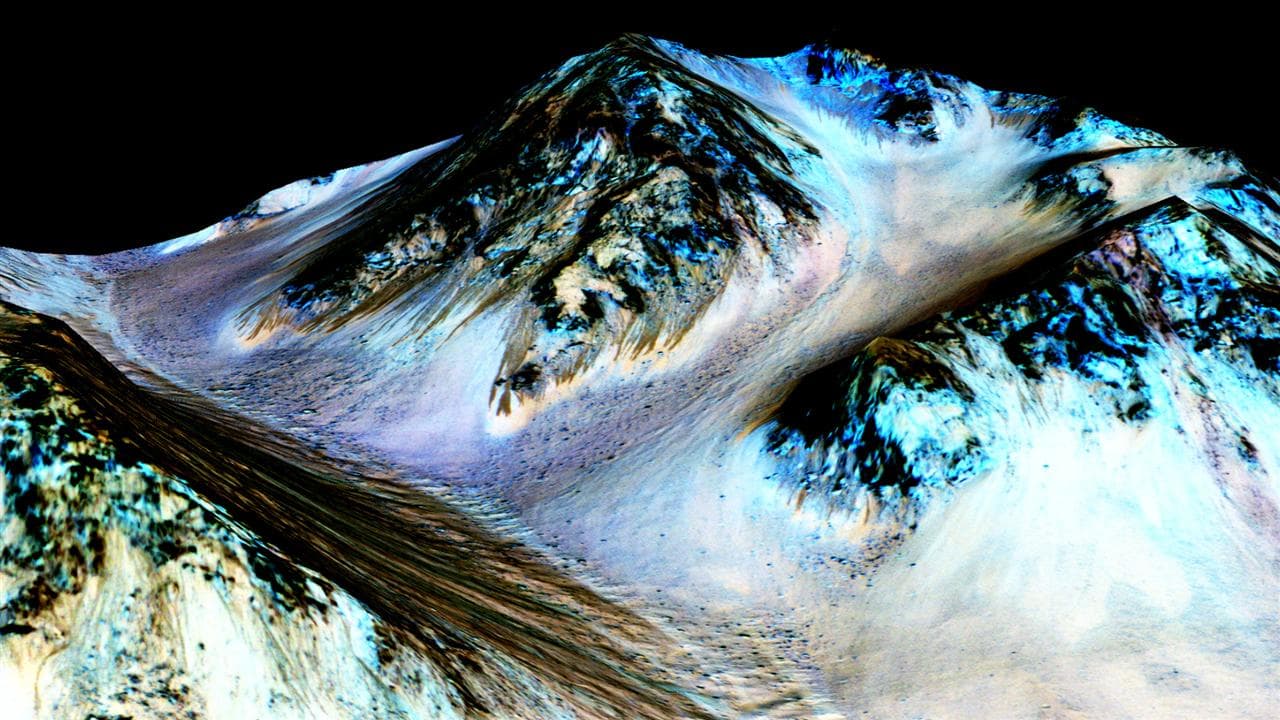
Former NASA employees claimed the agency had evidence of recurring slope lineae indicating liquid water on Mars since 2011 but delayed announcement for political and funding reasons.
“NASA announces findings when scientific analysis is complete and peer-reviewed”
From “crazy” to confirmed
The Claim Is Made
This is the moment they called it crazy.
For nearly four years, NASA apparently knew something about Mars that the American public didn't. Former agency employees alleged that NASA possessed credible evidence of liquid water flowing on the Martian surface as early as 2011, yet waited until 2015 to make any official announcement about the discovery. The delay, according to these insiders, had little to do with scientific uncertainty and everything to do with political timing and budget considerations.
The claim centers on NASA's detection of recurring slope lineae—dark streaks that appear on Martian hillsides during warm seasons and fade during colder months. These features, visible in satellite imagery, suggested the presence of liquid water, a discovery with profound implications for the possibility of life beyond Earth. According to former employees, the evidence was compelling enough by 2011 to warrant serious internal discussion, yet the agency sat on the findings.
When NASA finally announced the discovery in September 2015, the agency framed it as a recent finding. The official narrative emphasized that scientists had developed new analysis techniques that allowed them to identify the water flows with greater confidence. This explanation satisfied most of the scientific community and mainstream media. Few questioned why an agency with Mars-observing satellites hadn't spotted these features earlier, or why the announcement came precisely when it did—amid congressional budget debates and public interest in Mars exploration.
The dismissal of the suppression claim was straightforward: NASA officials maintained that the evidence required careful verification before public announcement. They argued that jumping to conclusions about water on Mars without rigorous peer review would have been irresponsible. The agency's cautious approach, they insisted, reflected standard scientific protocol rather than institutional politics.
Get the 5 biggest receipts every week, straight to your inbox — plus an exclusive PDF: The Top 10 Conspiracy Theories Proven True in 2025-2026. No spam. No agenda. Just the papers they couldn't hide.
You just read "NASA Suppressed Evidence of Liquid Water on Mars for Years B…". We send ones like this every week.
No one's said anything yet. Be the first to drop your take.
Yet the timeline tells a different story. The Wikipedia article on seasonal flows details how imagery from the Mars Reconnaissance Orbiter had been collecting data since 2006, and analysis capabilities certainly existed by 2010-2011. Some of the same scientists who published the "new discovery" in 2015 had been studying these features for years prior. The question becomes not whether NASA knew, but why the knowledge remained compartmentalized and unpublicized.
What emerges is not a smoking gun, but a pattern consistent with institutional gatekeeping. Budget cycles, political priorities, and strategic timing clearly influenced when NASA chose to share findings with the public. The 2015 announcement coincided with increased congressional interest in Mars missions and public enthusiasm about human Mars exploration. From a communications standpoint, the timing was optimal. From a transparency standpoint, it raises uncomfortable questions.
This case matters because it reveals how even science conducted in the public interest can be subject to institutional and political pressures. NASA isn't a monolithic truth-suppressing body, but it is a bureaucracy with stakeholders, budget battles, and strategic concerns. When discoveries are held close to the chest—even if eventually released—it undermines public trust in the neutrality of official announcements.
The partially verified status reflects reality: the evidence was almost certainly there earlier, the suppression was real, but calling it a conspiracy overstates the case. What we're left with is something more mundane and more troubling: the routine subordination of transparency to institutional interests. In science, that's a problem worth documenting.
Beat the odds
This had a 1.2% chance of leaking — someone talked anyway.
Conspirators
~200Network
Secret kept
14.9 years
Time to 95% exposure
500+ years