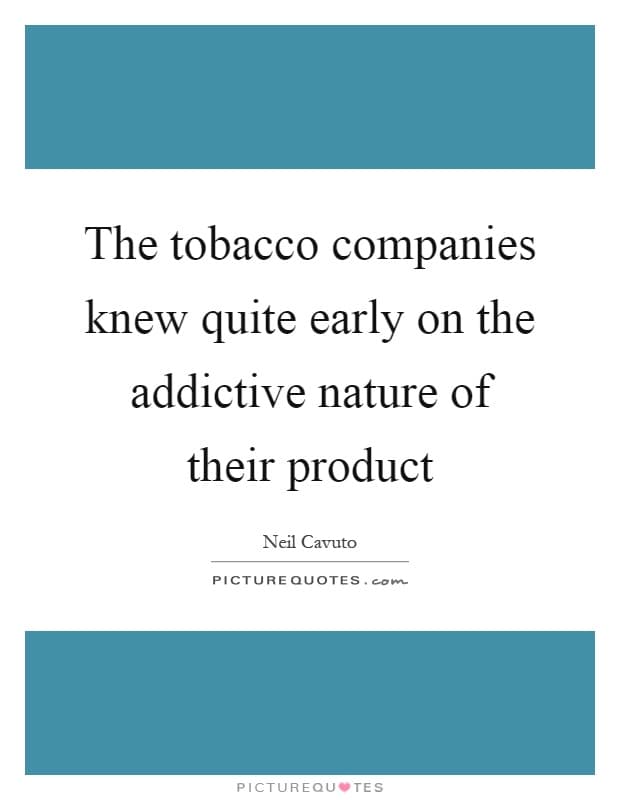
Internal documents revealed tobacco executives knew nicotine was addictive by the 1960s while publicly denying it for decades. Company memos discussed addiction and manipulation of nicotine levels.
“Cigarettes are not addictive and nicotine is not a drug”
From “crazy” to confirmed
The Claim Is Made
This is the moment they called it crazy.
In 1994, several tobacco company executives sat before Congress and raised their right hands. Under oath, they denied that nicotine was addictive. It was a pivotal moment in American history, broadcast live to millions, with the CEOs of major tobacco corporations stating flatly that they believed their product was not habit-forming.
For decades before that testimony, however, company scientists had reached a very different conclusion in private.
The tobacco industry's public position was remarkably consistent from the 1950s onward: nicotine addiction was unproven. Executives issued statements claiming the science was inconclusive. Trade groups funded research designed to cast doubt on addiction claims. Marketing campaigns suggested that smoking was simply a matter of personal choice. The industry's position was so unified and so publicly stated that it became accepted wisdom in some circles — or at least created enough confusion to undermine regulatory efforts.
But internal memos told a different story.
When documents emerged during litigation that led to the Tobacco Master Settlement Agreement, they revealed that major tobacco companies had understood nicotine's addictive properties since at least the 1960s. Company scientists wrote reports acknowledging addiction. Executives discussed ways to manipulate nicotine levels in cigarettes to maintain consumer dependence. One internal Philip Morris document from 1972 stated plainly that "nicotine is addictive." These weren't tentative findings or preliminary hypotheses — they were confident assertions made behind closed doors.
The gap between what these companies knew and what they said publicly wasn't a matter of evolving science. It was a calculated deception spanning multiple decades and crossing multiple administrations. While the tobacco industry publicly funded doubt about addiction's existence, their own scientists had already confirmed it.
The settlement agreements that emerged in the late 1990s forced the disclosure of millions of internal documents. Researchers, journalists, and legal teams systematically reviewed these records and found a consistent pattern: knowledge of addiction that was never shared with consumers or regulators. The companies had conducted their own research, understood the results, and then spent considerable resources obscuring those results from the public.
This case became textbook evidence of how corporations can weaponize uncertainty. The tobacco industry demonstrated that you don't need to prove your product is safe — you just need to create reasonable doubt about claims that it's dangerous. By funding alternative research and maintaining a unified public message that contradicted their private findings, they extended the timeline before regulatory action could be taken.
The significance extends beyond tobacco. The patterns documented here — internal knowledge suppressed publicly, corporate funding used to manufacture doubt, executives denying what documents prove they knew — became a template studied by researchers examining other industries. When similar patterns emerged in discussions of climate change, lead paint, and fossil fuels, many pointed back to the tobacco industry's playbook.
What made this claim verifiable was the forced disclosure of documents. The companies couldn't maintain their denials once their own words became public record. It serves as a reminder that some of the most important truths about public health aren't revealed through scientific journals or corporate transparency. They emerge when institutional power finally catches up to institutional deception.
Get the 5 biggest receipts every week, straight to your inbox — plus an exclusive PDF: The Top 10 Conspiracy Theories Proven True in 2025-2026. No spam. No agenda. Just the papers they couldn't hide.
You just read "Tobacco companies knew nicotine was addictive decades before…". We send ones like this every week.
No one's said anything yet. Be the first to drop your take.