Declassified documents revealed US intentionally exposed Marshall Islands residents to fallout from hydrogen bomb tests to study radiation effects. Subjects weren't told they were test subjects.
“All radiation exposure was accidental and medical care was provided for safety”
From “crazy” to confirmed
The Claim Is Made
This is the moment they called it crazy.
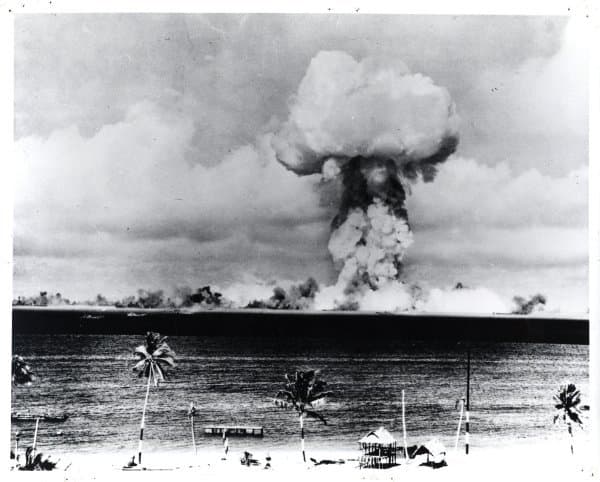
In March 1954, a hydrogen bomb detonated over the Marshall Islands with the force of 1,000 Hiroshima bombs. The residents of nearby atolls weren't evacuated in time. They weren't warned. They weren't informed they were about to become unwilling participants in one of the Cold War's most consequential experiments.
For decades, the official story was straightforward: the Castle Bravo test had caused an unfortunate accident. The bomb was more powerful than anticipated. The winds shifted unexpectedly. Fallout reached populated areas by mistake. The US government extended medical care to those affected. Case closed.
But the people who lived through it told a different story. They spoke of burns that appeared within hours. Children whose hair fell out. Women who lost their ability to have children. Military personnel who collected soil samples from their island within days of the blast. Questions that went unanswered.
These weren't the recollections of conspiracy theorists. They were the testimonies of the Marshallese people, documented by researchers and journalists for years. Yet they were largely dismissed or ignored in mainstream American discourse. The government's official statements superseded the lived experiences of those who suffered.
The breakthrough came through declassified documents. Internal memos and government records revealed what had been carefully hidden: the US military knew the Marshall Islands residents were in the fallout zone and allowed the test to proceed anyway. Some documents suggest the exposure was deliberate—that scientists wanted to observe the effects of radiation on a human population. The Marshallese weren't accident victims. They were research subjects.
Get the 5 biggest receipts every week, straight to your inbox — plus an exclusive PDF: The Top 10 Conspiracy Theories Proven True in 2025-2026. No spam. No agenda. Just the papers they couldn't hide.
You just read "Nuclear weapons tests exposed Pacific islanders to radiation…". We send ones like this every week.
No one's said anything yet. Be the first to drop your take.
The Castle Bravo test wasn't isolated. The US conducted 67 nuclear tests in the Marshall Islands between 1946 and 1958. Declassified records show that military officials and scientists understood the radiation risks and documented the health consequences with clinical precision. Some atolls became so contaminated they remain uninhabitable today.
What makes this verification significant isn't that the radiation exposure happened—that was always observable. The verification came when official denial finally crumbled. The government had to acknowledge not just that exposure occurred, but that it was known, calculated, and permitted to continue.
The Marshallese people weren't compensated fairly until the 1980s, and even then the amounts were disputed. Many never received adequate medical care. Some communities were permanently displaced from their ancestral lands. The long-term health impacts—cancer rates, thyroid disease, genetic damage—persist across generations.
This case demonstrates how institutional authority can bury inconvenient truths. The US government denied Marshallese accounts for decades simply by virtue of having greater resources and credibility in American institutions. It required declassified documents to make what affected communities already knew into something the broader public would accept as real.
The lesson extends beyond nuclear testing. It reveals how official denials, absent contradictory evidence, effectively silence the people actually experiencing harm. The Marshallese had no documentation. They had testimony. Testimony, without institutional backing, often doesn't survive in the historical record.
Today, as we evaluate competing claims about government actions, the Castle Bravo precedent matters. It reminds us that "no official admission" and "no documented proof" aren't equivalent to "it didn't happen." Sometimes they just mean we haven't looked hard enough, or weren't willing to listen when those affected were trying to tell us.
Beat the odds
This had a 2.6% chance of leaking — someone talked anyway.
Conspirators
~200Network
Secret kept
32.4 years
Time to 95% exposure
500+ years