In 2014, Sage Publications retracted 60 articles after discovering authors created fake reviewer accounts to review their own papers. Springer retracted 64, BioMed Central 43. A single researcher, Hyung-In Moon, reviewed his own papers using fabricated identities. Some journals accepted papers generated by SCIgen, a program producing gibberish. The peer review system incentivizes speed over rigor and lacks transparency.
“The peer review system is broken. Scientists are reviewing their own papers under fake identities, journals accept computer-generated nonsense, and the process is easily manipulated.”
From “crazy” to confirmed
The Claim Is Made
This is the moment they called it crazy.
Confirmed: They Were Right
The truth comes out. Officially documented.
Confirmed: They Were Right
The truth comes out. Officially documented.
The machinery that validates scientific research—peer review—depends on a simple assumption: that reviewers are who they claim to be. In 2014, that assumption collapsed when major academic publishers discovered something that should have been impossible: authors were reviewing their own papers under fake identities.
The scope became clear quickly. Sage Publications retracted 60 articles. Springer removed 64 more. BioMed Central took down 43. These weren't isolated incidents from fringe journals. These were established publishers with reputations built over decades, suddenly admitting their quality control had failed spectacularly.
One researcher, Hyung-In Moon, exemplified just how broken the system had become. He didn't just slip a fake review past an editor once. He created fabricated reviewer accounts and used them repeatedly to approve his own work. This wasn't a subtle manipulation—it was industrial-scale fraud conducted in plain sight.
The discovery raised an uncomfortable question: how did this happen? The answer reveals why the peer review system itself was vulnerable. Publishers and journals operate under pressure to publish quickly and maintain productivity metrics. Reviewers often remain anonymous, creating an environment where verification is minimal. When an author provides suggested reviewers, many editors accept those names without thorough vetting. The system assumes good faith but builds in almost no mechanisms to enforce it.
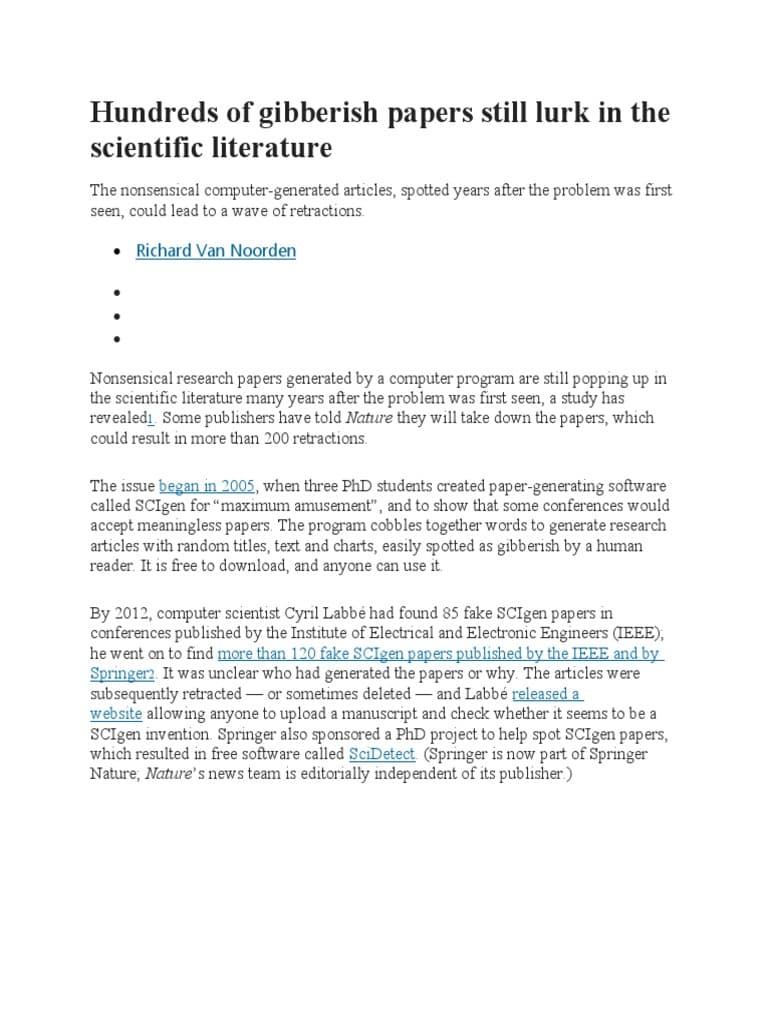
The problem extended beyond deliberate fraud. Some journals accepted papers generated by SCIgen, a computer program designed specifically to produce meaningless academic gibberish. These weren't papers that slipped through due to minor errors or overlooked details. They were complete nonsense—syntactically correct but scientifically empty—that passed editorial review.
When these retractions made headlines, the response from the scientific community was one of acknowledgment mixed with defensiveness. Yes, problems existed, institutions said. But they were isolated. The system was self-correcting. Reforms would follow. Some changes did occur: publishers implemented better reviewer verification, journals became more careful about suggested reviewers, and awareness increased about the risks of rapid publication cycles.
Yet the retractions also exposed something deeper. The peer review system, treated as a pillar of scientific integrity, had been operating with remarkably little oversight. There was no central database of reviewers. No standardized verification. No consistent consequences for manipulation. Journals handled problems individually, quietly, without coordination—meaning that researchers caught committing fraud at one publisher could simply submit to another.
What makes this verification matter isn't just academic embarrassment. Scientific findings shape medical practice, inform policy decisions, and guide where research funding flows. When papers circulate based on fake reviews rather than genuine scrutiny, patients might receive treatments based on flawed evidence. Policy makers might implement solutions built on fraudulent research. The damage compounds quietly, through citations and inclusion in literature reviews.
The retractions proved that what sounded like a conspiracy theory—that the scientific establishment's quality control was fundamentally broken—was actually documented reality. It wasn't a shadowy plot. It was negligence built into how the system operated. The peer review crisis forced an uncomfortable reckoning: the mechanisms we trust to certify knowledge had serious vulnerabilities, and no one was consistently preventing their exploitation.
Get the 5 biggest receipts every week, straight to your inbox — plus an exclusive PDF: The Top 10 Conspiracy Theories Proven True in 2025-2026. No spam. No agenda. Just the papers they couldn't hide.
You just read "Hundreds of scientific papers retracted for fake peer review…". We send ones like this every week.
No one's said anything yet. Be the first to drop your take.