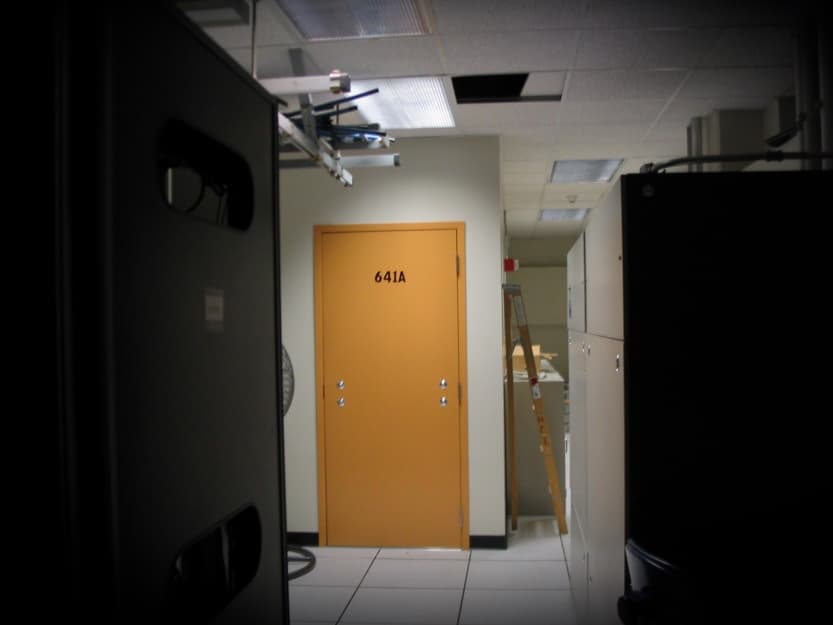
Mark Klein, an AT&T technician for 22 years, discovered Room 641A at AT&T's San Francisco facility — a secret room where optical splitters created exact copies of all internet traffic passing through AT&T's backbone and redirected it to the NSA. The room contained a Narus STA 6400, capable of intercepting and analyzing internet communications at very high speeds. Klein went public in 2006 after reading about Bush's warrantless wiretapping program. The EFF filed Hepting v. AT&T, but Congress passed retroactive immunity for telecoms in 2008.
“AT&T built a secret room where the NSA copies all internet traffic flowing through their network. Every email, every web page, every phone call — they're copying everything.”
From “crazy” to confirmed
The Claim Is Made
This is the moment they called it crazy.
When Mark Klein walked into Room 641A at AT&T's San Francisco switching center in 2003, he saw something that would haunt him for the rest of his life: optical splitters siphoning copies of every email, phone call, and web search passing through AT&T's network backbone directly to the National Security Agency. Klein had spent 22 years as a technician at AT&T. He knew what he was looking at.
What Klein discovered was a systematic, warrantless mass surveillance operation running in plain sight. The equipment in that room—a Narus STA 6400 packet analyzer—could intercept and analyze internet communications at speeds measured in gigabits per second. It was sophisticated. It was real. And it was operating without court orders or public knowledge.
The official story, when Klein tried to raise concerns internally, was dismissive. AT&T executives and lawyers told him he didn't understand what he was seeing. Government officials, when the program eventually became public knowledge in 2006 after the New York Times reported on Bush administration wiretapping, denied the specific allegations. The very existence of Room 641A was classified. There was no formal acknowledgment. There was no transparency. There was only silence and denial.
But Klein had documentation. He had taken notes. He had sketches of the room and its architecture. In 2006, after reading about the Bush administration's warrantless surveillance program, Klein went public with what he knew. The Electronic Frontier Foundation filed a lawsuit on behalf of AT&T customers—Hepting v. AT&T—seeking damages for the illegal surveillance.
Get the 5 biggest receipts every week, straight to your inbox — plus an exclusive PDF: The Top 10 Conspiracy Theories Proven True in 2025-2026. No spam. No agenda. Just the papers they couldn't hide.
You just read "AT&T technician exposed Room 641A: a secret NSA facility spl…". We send ones like this every week.
No one's said anything yet. Be the first to drop your take.
Confirmed: They Were Right
The truth comes out. Officially documented.
Confirmed: They Were Right
The truth comes out. Officially documented.
The case never reached a verdict. Instead, Congress intervened. In 2008, lawmakers passed the FISA Amendments Act, which granted telecommunications companies retroactive immunity for their cooperation with NSA surveillance programs. The lawsuit was dismissed. AT&T faced no consequences. The company that had allowed the government to spy on millions of Americans without warrants was protected by law.
Yet Klein's claims were ultimately vindicated. The evidence emerged not through the court system but through Edward Snowden's revelations in 2013, which confirmed that Room 641A was indeed part of a massive NSA surveillance apparatus called UPSTREAM. Snowden's documents showed that the NSA had been collecting internet communications in bulk for over a decade—exactly what Klein had tried to warn the world about seven years earlier.
Today, Room 641A stands as a case study in how institutions fail when confronted with uncomfortable truths. A whistleblower with direct knowledge was ignored. A company prioritized government contracts over customer privacy. Congress chose corporate immunity over accountability. And the American public had no idea that their most intimate digital communications were being intercepted and analyzed without their consent or knowledge.
What matters now is recognizing the pattern. Klein was right, and the system made it nearly impossible for his truth to matter in real time. That's the real story here: not just that the NSA was spying, but that the mechanisms designed to hold power accountable—courts, Congress, corporate responsibility—failed. The only reason we know what happened is because another whistleblower came forward five years later. We should ask ourselves what else is happening in secret rooms we don't know about.
Beat the odds
This had a 0% chance of leaking — someone talked anyway.
Conspirators
~150Network
Secret kept
0.5 years
Time to 95% exposure
500+ years