This receipt is still in the Pro early-access window — public in 23h.
Upgrade to Pro for 24-48h early access on every new drop + weekly newsletter + category alerts.
Upgrade — $9.99/mo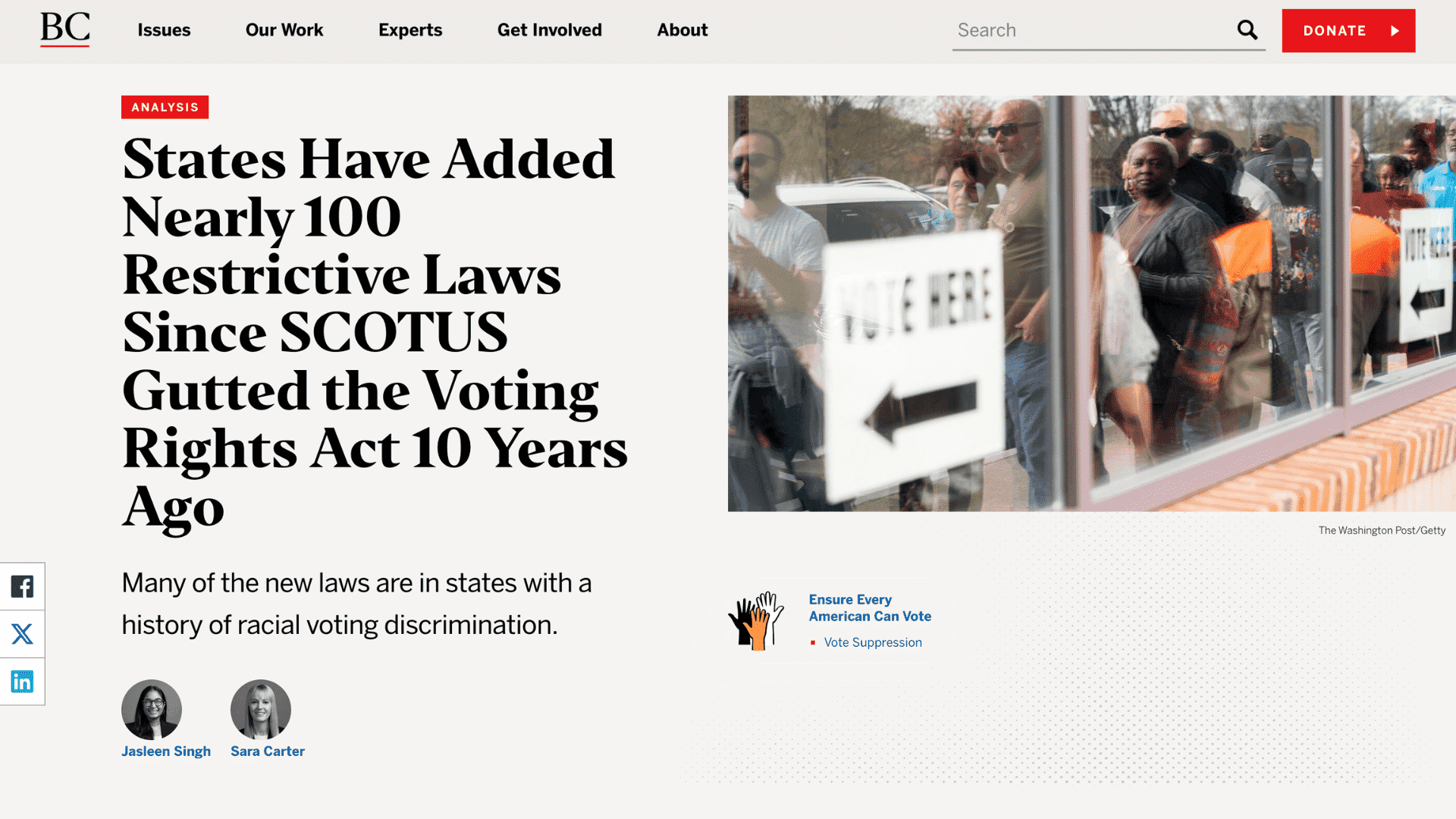
On April 29, 2026, the Supreme Court ruled 6-3 in Louisiana v. Callais that Louisiana's map with two majority-Black districts was an unconstitutional racial gerrymander, with Justice Kagan's dissent warning the ruling left Section 2 of the Voting Rights Act 'all but a dead letter.' In May the Court bypassed its own 32-day waiting period to give the decision immediate effect, letting Louisiana redraw down to a single majority-Black district before the 2026 elections.
“On April 29, 2026, the Supreme Court ruled 6-3 in Louisiana v. Callais that Louisiana's map with two majority-Black districts was an unconstitutional racial gerrymander, with Justice Kagan's dissent warning the ruling left Section 2 of the Voting Rights Act 'all but a dead letter.' In May the Court bypassed its own 32-day waiting period to give the decision immediate effect, letting Louisiana redraw down to a single majority-Black district before the 2026 elections.”
For decades, Section 2 of the Voting Rights Act was the legal backstop against racial gerrymandering. On April 29, 2026, a 6-3 Supreme Court majority turned it into something close to a dead letter — and then moved fast to make sure the consequences hit before the next election.
In Louisiana v. Callais (No. 24-109), the Court struck down a congressional map Louisiana's own legislature had adopted in 2024. That map created two majority-Black districts, drawn only after two lower courts found the state's previous single-district map likely violated Section 2 of the VRA. Justice Samuel Alito, writing for the majority and joined by Roberts, Thomas, Gorsuch, Kavanaugh, and Barrett, held that the second majority-Black district was an unconstitutional racial gerrymander.
Justice Elena Kagan, joined by Sotomayor and Jackson, dissented sharply, arguing the decision rendered Section 2 'all but a dead letter' and trapped states in an impossible bind: drawing a district to comply with the VRA now risks being struck down as a racial gerrymander. Justice Jackson warned the outcome carried 'a strong political undercurrent.'
The most striking part came after. On May 5, 2026, the Court agreed to immediately finalize its opinion, bypassing the standard 32-day waiting period so Louisiana could redraw its map ahead of the 2026 elections. Black voters defending the 2024 map asked the Court to reverse the expedited order — it refused, without explanation, the next morning. The replacement map is expected to contain just one majority-Black district.
Get the 5 biggest receipts every week, straight to your inbox — plus an exclusive PDF: The Top 10 Conspiracy Theories Proven True in 2025-2026. No spam. No agenda. Just the papers they couldn't hide.
You just read "SCOTUS Gutted the Voting Rights Act 6-3 — Then Fast-Tracked …". We send ones like this every week.
No one's said anything yet. Be the first to drop your take.
The Court never formally declared Section 2 unconstitutional. It didn't have to. By treating VRA-compliant maps as suspect racial gerrymanders — and rushing the ruling into effect — it achieved much the same result, reshaping who holds power before voters ever weighed in.
Beat the odds
This had a 0% chance of leaking — someone talked anyway.
Conspirators
~50Network
Secret kept
2.4 years
Time to 95% exposure
500+ years