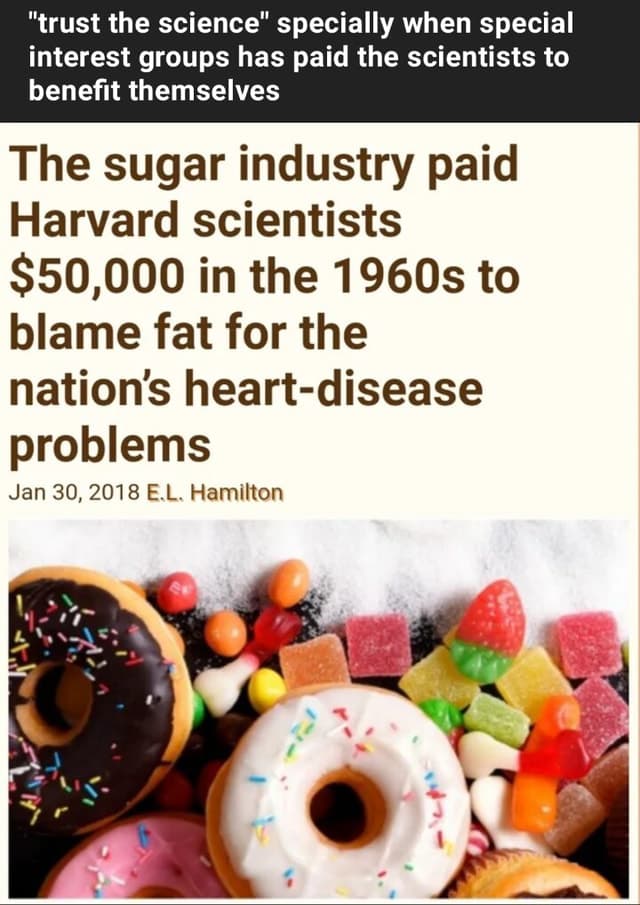
In the 1960s, sugar executive John Hickson devised a plan to shift blame for heart disease from sugar to saturated fat. The industry paid Harvard nutritionists for a 1967 New England Journal of Medicine review that dismissed sugar as a risk while vilifying fat. UCSF researcher Cristin Kearns found letters showing one scientist writing to his funder that 'every time the Iowa group publishes a paper we have to rework a section in rebuttal.' The review applied different evidence standards: dismissing sugar studies while accepting weaker fat studies. This corrupted study shaped global nutrition policy for 50 years.
“The sugar industry secretly funded Harvard research that blamed fat for heart disease. They paid scientists to produce predetermined conclusions that misled the public for five decades.”
From “crazy” to confirmed
The Claim Is Made
This is the moment they called it crazy.
When you were told to cut fat from your diet and reach for sugar-free alternatives instead, you were following advice shaped by one of the most consequential acts of scientific manipulation in modern history. For half a century, the sugar industry successfully rewrote the nutritional science that governments and doctors relied on to guide public health policy.
The story begins in 1964 when John Hickson, a sugar industry executive, recognized an existential threat to his product. Scientists were increasingly linking sugar consumption to heart disease, the leading cause of death in America. Rather than accept this inconvenient finding, Hickson devised a plan: pay respected scientists to produce authoritative research blaming fat—not sugar—for the epidemic of heart disease.
Harvard University's nutrition department became the chosen vehicle. Hickson contacted D. Mark Hegsted and Robert McGandy, prestigious nutritionists at the university, offering funding for a review paper. The price tag was approximately $6,500—roughly $50,000 in today's money. What the industry got in return was a 1967 New England Journal of Medicine review that would influence dietary guidelines for generations.
The review's conclusions were precisely what the sugar industry needed: sugar posed no meaningful risk to heart health, while saturated fat was the true villain. Published in one of the world's most prestigious medical journals, the paper carried the weight of Harvard's reputation and the appearance of scientific objectivity. Nutrition authorities, policymakers, and doctors cited it as definitive evidence.
For decades, this arrangement remained hidden. The industry had successfully rewritten the scientific record, and nobody outside a small circle knew it had happened. Then in 2016, researcher Cristin Kearns at the University of California, San Francisco, uncovered the evidence. Working through archives, Kearns found internal sugar industry documents and correspondence that revealed the entire scheme.
Get the 5 biggest receipts every week, straight to your inbox — plus an exclusive PDF: The Top 10 Conspiracy Theories Proven True in 2025-2026. No spam. No agenda. Just the papers they couldn't hide.
You just read "The sugar industry paid Harvard scientists to publish a frau…". We send ones like this every week.
No one's said anything yet. Be the first to drop your take.
Confirmed: They Were Right
The truth comes out. Officially documented.
Confirmed: They Were Right
The truth comes out. Officially documented.
The documents were damning. Internal letters showed scientists discussing how to neutralize competing research. One Harvard researcher wrote to his industry funder: "every time the Iowa group publishes a paper we have to rework a section in rebuttal." The review applied starkly different standards of evidence—dismissing sugar studies as inconclusive while accepting weaker studies implicating fat. This wasn't science. It was choreographed persuasion disguised as scholarship.
What makes this scandal particularly significant is its durability. The corrupted 1967 review became the foundation for dietary guidelines that persisted well into the 21st century. Generations of Americans were advised to reduce fat intake while increasing carbohydrate consumption. Paradoxically, obesity and diabetes rates soared during exactly the period when Americans followed this fat-reducing guidance most closely.
The sugar industry's gamble ultimately paid off. By the time the truth emerged, the damage to public health had already been done, and the preferred narrative had become so deeply embedded in nutritional orthodoxy that changing it proved remarkably difficult.
This case matters because it exposes a fundamental vulnerability in how we produce knowledge. Scientific credibility is fragile, easily borrowed by those with enough resources and institutional access. When financial incentives corrupt the peer-review process and prestigious journals, the entire system becomes suspect. We cannot know which other findings remain influenced by undisclosed conflicts of interest, still hidden in archives waiting for future researchers to uncover them. Trust in science depends on transparency—something the sugar industry deliberately withheld.