Senate investigation revealed HSBC processed billions in drug money and violated sanctions. Bank executives knew about the money laundering but failed to stop it for profits.
“HSBC has robust anti-money laundering controls and complies with all international banking regulations”
From “crazy” to confirmed
The Claim Is Made
This is the moment they called it crazy.
It's a figure so large it becomes almost meaningless: $881 billion. That's roughly the GDP of Sweden. But that number represents something far darker—the amount of money HSBC, one of the world's largest banks, knowingly processed for drug cartels and organizations designated as terrorist threats. The bank didn't accidentally stumble into this role. Evidence shows executives understood exactly what was happening and chose profit over compliance.
The initial claims came from whistleblowers and journalists investigating HSBC's activities in Mexico and other high-risk jurisdictions during the 2000s. These sources alleged that HSBC's vast network had become a preferred conduit for criminal organizations moving illicit proceeds across borders. The bank, they suggested, had systematically dismantled compliance procedures to facilitate these flows. The allegations seemed extraordinary enough that many dismissed them as exaggeration or misunderstanding of complex banking operations.
HSBC's official position minimized the controversy. Bank leadership and PR representatives characterized any money laundering as isolated lapses by low-level employees who circumvented established safeguards. They emphasized that banking institutions process trillions in transactions annually and some improper activity was statistically inevitable. The bank pointed to its compliance staff and internal controls as evidence that the system worked as intended. This narrative proved convenient for regulators and policymakers alike—it allowed them to accept an explanation that didn't implicate senior management.
Then came the Senate investigation. In 2012, the U.S. Senate's Permanent Subcommittee on Investigations published a scathing report that transformed allegation into documented fact. The investigation revealed that HSBC had processed at least $881 billion in suspicious transactions. The bank's own files showed that executives in the Americas region had flagged $680 million as potentially drug-related, yet these transactions continued anyway. Mexican subsidiaries moved bulk cash from major drug trafficking regions with virtually no scrutiny. The bank's weak anti-money laundering controls in high-risk jurisdictions weren't accidental—they were the result of deliberate decisions to prioritize business volume over compliance.
The Senate produced internal HSBC documents proving that senior management knew about these flows and chose inaction. Bank executives received reports detailing suspicious patterns, yet hiring and staffing in compliance departments remained inadequate. The bank even decided to exit certain markets and close correspondent accounts, not because they wanted to stop facilitating crime, but because they didn't want to pay for proper compliance monitoring. This wasn't negligence; it was calculation.
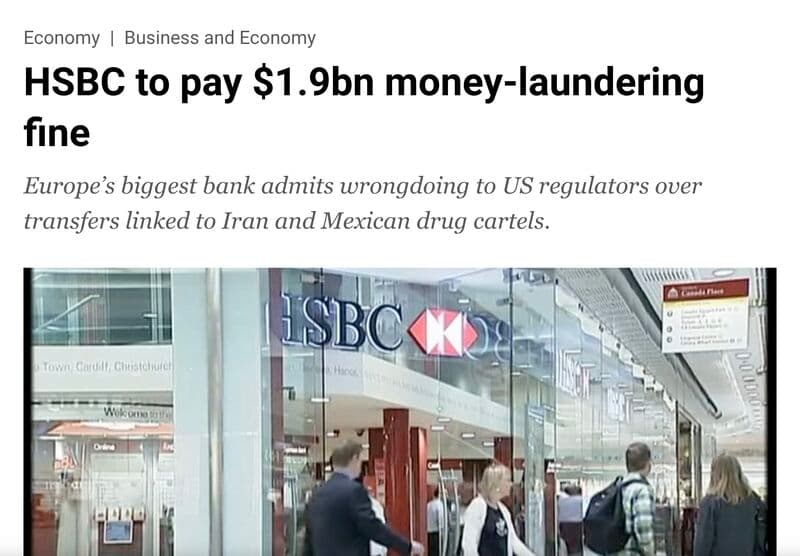
The consequences, when finally applied, proved modest. HSBC paid a $1.9 billion settlement—significant in absolute terms but a rounding error compared to the $881 billion laundered. No executives faced criminal prosecution. The bank agreed to an external monitor for five years, then moved on.
This case matters because it exposes how global financial architecture can be weaponized by criminal organizations and how institutions nominally designed to prevent this can instead enable it. When a bank with HSBC's resources and reputation processes nearly a trillion in suspicious funds, it suggests either incompetence at scale or something closer to complicity. The settlement and monitoring arrangement signal that even the most egregious violations result in business continuing largely unchanged. For those who believed HSBC's version of events, the Senate investigation provided a decisive answer. For everyone else, it raised harder questions about whether the banking system itself operates according to different rules.
Get the 5 biggest receipts every week, straight to your inbox — plus an exclusive PDF: The Top 10 Conspiracy Theories Proven True in 2025-2026. No spam. No agenda. Just the papers they couldn't hide.
You just read "HSBC Laundered $881 Billion for Drug Cartels and Terrorist O…". We send ones like this every week.
No one's said anything yet. Be the first to drop your take.