In 2016, a leak of 11.5 million documents from Mossack Fonseca revealed how world leaders, billionaires, and criminals used shell companies to hide wealth. The leak exposed 12 current or former heads of state, 128 politicians, and major banks that helped create more than 214,000 offshore entities. The journalist who broke the story, Daphne Caruana Galizia, was assassinated by a car bomb in Malta in 2017.
“The global elite use a massive network of offshore shell companies and tax havens to hide trillions in wealth from taxation and public scrutiny.”
From “crazy” to confirmed
The Claim Is Made
This is the moment they called it crazy.
When 11.5 million confidential documents landed in the hands of journalists in 2015, they contained something world leaders had worked hard to keep hidden: proof that dozens of sitting politicians and heads of state were actively concealing vast wealth in offshore shell companies. The International Consortium of Investigative Journalists (ICIJ) spent months analyzing the Mossack Fonseca law firm's internal files before releasing the Panama Papers in April 2016. What followed was one of the largest financial exposés in modern history.
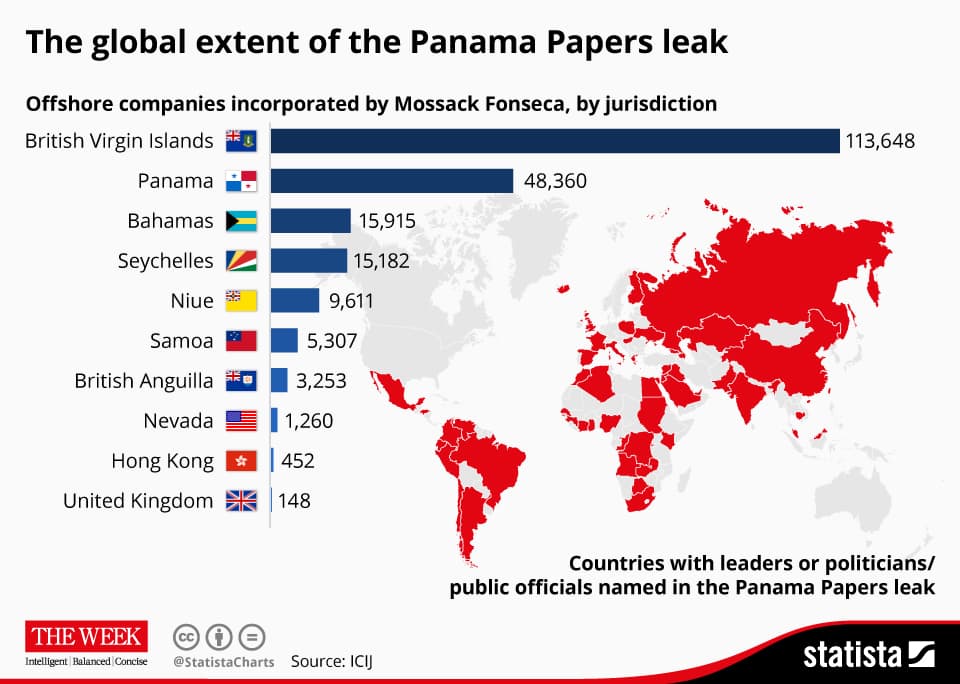
The claims were straightforward and damning: twelve current or former heads of state, 128 politicians from around the world, and major international banks had facilitated the creation of more than 214,000 offshore entities designed to hide money from tax authorities and regulators. The network spanned from London to Hong Kong, from Malta to the British Virgin Islands. These weren't theoretical possibilities or suspicious patterns—they were documented transactions and ownership records from one of the world's most prolific creators of shell companies.
The initial responses from accused parties followed a predictable script. Most denied wrongdoing, claiming that offshore accounts were legal tax planning strategies. Some argued that their names appeared in the documents but that they had no direct involvement or knowledge of the arrangements. A few governments launched token investigations that quietly faded from public attention. The prevailing attitude from politicians was that the Panama Papers represented old news—most transactions predated 2016—and that scrutiny amounted to an invasion of privacy.
But the evidence proved otherwise. The ICIJ's investigation, conducted with partner news organizations worldwide, didn't rely on speculation or inference. Journalists had actual documentation: incorporation papers, bank transfers, email correspondence between Mossack Fonseca employees and clients, and ownership structures clearly linking politicians to shell companies. The documents showed how wealthy individuals and their enablers had engineered systems to move money across borders while obscuring its origin and ownership. One former Icelandic Prime Minister, Sigmundur Davíð Gunnlaugsson, resigned within days of the papers' release after public pressure. Other officials faced criminal investigations.
Get the 5 biggest receipts every week, straight to your inbox — plus an exclusive PDF: The Top 10 Conspiracy Theories Proven True in 2025-2026. No spam. No agenda. Just the papers they couldn't hide.
You just read "Panama Papers exposed 12 world leaders and 140+ politicians …". We send ones like this every week.
No one's said anything yet. Be the first to drop your take.
Confirmed: They Were Right
The truth comes out. Officially documented.
Confirmed: They Were Right
The truth comes out. Officially documented.
The verification wasn't instantaneous, but it was thorough. Financial regulators, journalists, and investigative bodies worldwide confirmed the documents' authenticity. Banks acknowledged their role in the schemes. By 2017, the Panama Papers had sparked genuine consequences: countries tightened offshore reporting requirements, financial institutions implemented stricter compliance procedures, and international frameworks for tracking beneficial ownership strengthened.
Yet the story carries a darker note. Daphne Caruana Galizia, the Maltese journalist who played a crucial role in breaking the Panama Papers story locally, was assassinated by a car bomb in October 2017. Her death wasn't an isolated tragedy—it reflected the real costs of exposing financial corruption at the highest levels.
The Panama Papers matter because they shattered a fundamental myth: that the wealthy operate within systems governed by rules everyone else must follow. The leak proved that for those with sufficient resources and access to specialized financial infrastructure, different rules apply. It demonstrated that major institutions—banks, law firms, governments—actively enabled this two-tiered system. The question that lingers isn't whether this happened—the documents prove it did—but how much remains hidden in the systems we still haven't examined.
Beat the odds
This had a 0% chance of leaking — someone talked anyway.
Conspirators
~50Network
Secret kept
0.5 years
Time to 95% exposure
500+ years