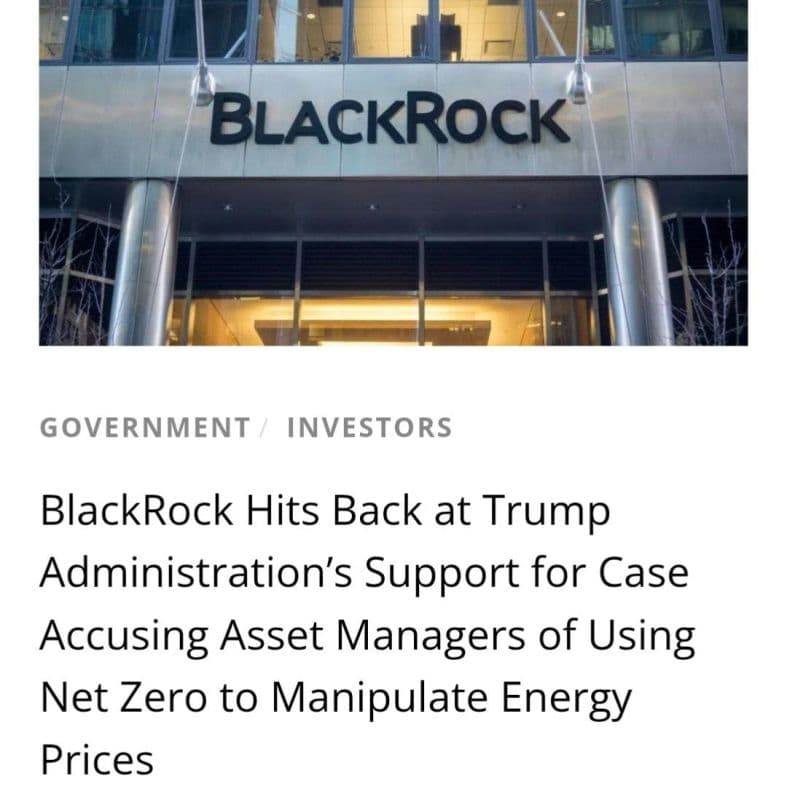
TX AG: anticompetitive conspiracy via shareholder influence in competing coal companies. May 2025: FTC/DOJ filed statement. First challenge to passive investment concentration.
“'They own everything' is now a federal lawsuit backed by DOJ.”
What they said vs. what the evidence shows
“Without merit.”
— BlackRock · Nov 2023
SourceFrom “crazy” to confirmed
The Claim Is Made
This is the moment they called it crazy.
When Texas Attorney General Ken Paxton filed suit against BlackRock in 2025, he made a specific allegation that mainstream finance had long dismissed as conspiracy thinking: that the world's largest asset manager was using its shareholder influence to suppress competition in the energy sector. The claim seemed audacious. BlackRock, after all, has spent years promoting Environmental, Social, and Governance (ESG) investing principles. How could a firm championing climate consciousness simultaneously be accused of manipulating coal markets?
The mechanics of Paxton's complaint centered on a pattern. BlackRock, which manages nearly $10 trillion in global assets, holds significant stakes in multiple competing coal companies. The lawsuit argued this created perverse incentives: rather than allow competition to flourish and drive prices down for consumers, BlackRock could allegedly coordinate shareholder votes and board appointments to suppress output across the sector. The result, Texas argued, amounted to an anticompetitive conspiracy that artificially inflated energy costs.
Wall Street initially treated the lawsuit as a political stunt. Financial regulators and mainstream analysts suggested Paxton was confusing legitimate shareholder activism with illegal market manipulation. The Federal Trade Commission and Department of Justice, agencies tasked with enforcing antitrust law, had historically ignored passive investment concentration. Their position was clear: fund managers investing across competing firms in the same sector wasn't inherently illegal, and certainly not a federal priority.
Get the 5 biggest receipts every week, straight to your inbox — plus an exclusive PDF: The Top 10 Conspiracy Theories Proven True in 2025-2026. No spam. No agenda. Just the papers they couldn't hide.
You just read "Texas sued BlackRock for energy manipulation - FTC and DOJ b…". We send ones like this every week.
No one's said anything yet. Be the first to drop your take.
Source: Texas sued BlackRock for energy manipulation - FTC and DOJ backed the case
That consensus fractured in May 2025.
The FTC and DOJ, in a stunning reversal, filed a statement backing Texas's legal theory. The agencies didn't necessarily endorse every claim in Paxton's complaint, but they validated his core concern: passive investment concentration—when a single firm owns meaningful stakes in multiple competitors—can function as an anticompetitive mechanism. Their filing acknowledged what critics had argued for years: the financial architecture of modern capitalism had created blind spots in antitrust enforcement.
What changed? The record became harder to ignore. Academic research documenting the correlation between passive investor concentration and reduced competition had accumulated. Internal communications from major asset managers revealed discussions about coordinating shareholder activism across portfolio companies. Most damaging, energy market data showed price behaviors inconsistent with truly competitive markets during periods of high passive investor overlap.
This case represents something larger than BlackRock's alleged conduct. It signals a turning point in how regulators understand financial power in the 21st century. For decades, the investment industry successfully argued that passive indexing was purely passive—managers simply tracked market benchmarks without wielding real power. The Texas lawsuit, now backed by federal enforcement agencies, challenges that convenient fiction.
The implications ripple across sectors. If BlackRock can be held accountable for anticompetitive shareholder coordination, similar theories could apply to pharmaceutical companies, telecommunications firms, and technology platforms where passive investors hold concentrated stakes. Asset managers suddenly face scrutiny they've avoided.
This matters because public trust in financial institutions depends partly on believing markets work fairly. When Americans discovered their energy bills reflected not genuine competition but coordinated suppression by the world's largest investor, confidence eroded. The FTC and DOJ's May 2025 statement suggested they'd reached the same conclusion: passive investors, despite their marketing, wield active power. And that power, unchecked, poses real risks to competitive markets and consumer welfare.
Beat the odds
This had a 0% chance of leaking — someone talked anyway.
Conspirators
~50Network
Secret kept
2.5 years
Time to 95% exposure
500+ years