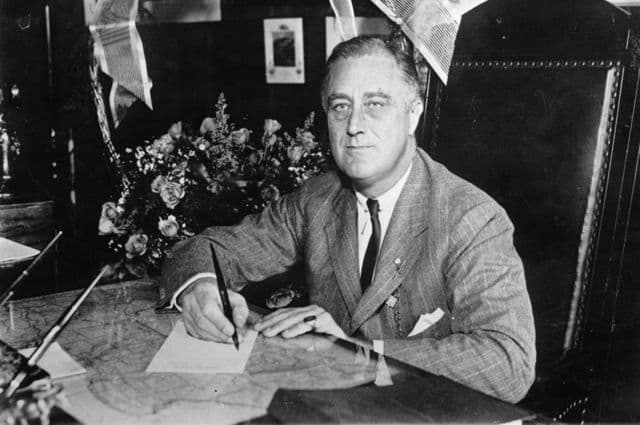
In 1933, a group of wealthy industrialists and Wall Street financiers — linked to JP Morgan, DuPont, and other major corporations — conspired to overthrow President Franklin D. Roosevelt and install a fascist dictatorship. Marine Corps Major General Smedley Butler, whom they tried to recruit to lead the coup, instead exposed the entire plot to Congress.
“Major General Smedley Butler testified before the McCormack-Dickstein Committee in November 1934 that representatives of a group of wealthy industrialists approached him to lead a coup against President Roosevelt, using a private army of 500,000 veterans.”
What they said vs. what the evidence shows
“A plot without plotters.”
— Time Magazine, Time Inc. · Dec 1934
SourceFrom “crazy” to confirmed
The Claim Is Made
This is the moment they called it crazy.
In the summer of 1933, as Franklin D. Roosevelt's New Deal policies threatened the fortunes of America's wealthiest industrialists, a group of Wall Street power brokers hatched a plan that sounds like fiction — but was confirmed by a congressional investigation.
The conspirators — linked to JP Morgan, DuPont, Remington Arms, and other major corporations — approached Major General Smedley Butler, one of the most decorated Marines in American history, with a proposal: lead a private army of 500,000 veterans in a march on Washington to overthrow Roosevelt and install a fascist government modeled after Mussolini's Italy.
What the plotters didn't anticipate was that Butler was no puppet. Instead of joining the conspiracy, he reported everything to the McCormack-Dickstein Committee (a precursor to the House Un-American Activities Committee). In explosive testimony in November 1934, Butler named names and laid out the entire scheme.
Despite Butler's testimony and corroborating evidence, no one was ever prosecuted. The mainstream press largely dismissed the affair. Time magazine called it a "plot without plotters." The committee's final report confirmed that a plot had indeed existed but named no conspirators, and Congress took no action.
Get the 5 biggest receipts every week, straight to your inbox — plus an exclusive PDF: The Top 10 Conspiracy Theories Proven True in 2025-2026. No spam. No agenda. Just the papers they couldn't hide.
You just read "Wall Street executives plotted a military coup against Presi…". We send ones like this every week.
No one's said anything yet. Be the first to drop your take.
Confirmed: They Were Right
The truth comes out. Officially documented.
Confirmed: They Were Right
The truth comes out. Officially documented.
The McCormack-Dickstein Committee's own final report acknowledged: "There is no question that these attempts were discussed, were planned, and might have been placed in execution." Declassified records and Butler's sworn testimony remain in the congressional record. Historians have since confirmed the plot's authenticity, with Jules Archer's 1973 book and subsequent archival research providing extensive documentation.
The Business Plot remains one of the most dramatic examples of a proven conspiracy that was buried by the very institutions meant to investigate it. The people who called it crazy were proven wrong — by Congress itself.
Beat the odds
This had a 0.3% chance of leaking — someone talked anyway.
Conspirators
~500Large op
Secret kept
1.4 years
Time to 95% exposure
500+ years