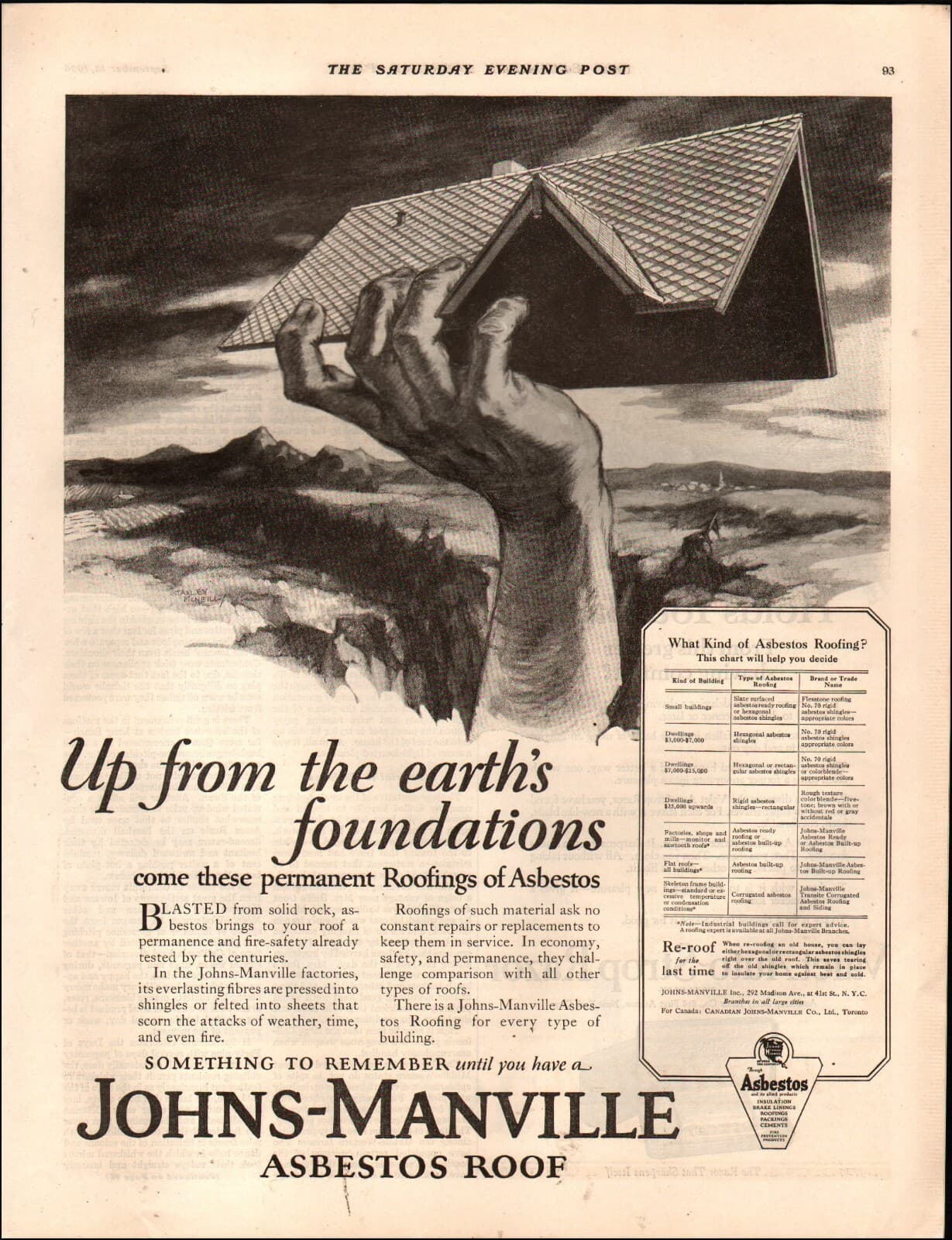
Company executives knew asbestos caused lung cancer since the 1930s but concealed medical evidence from workers. Internal memos revealed deliberate suppression of health studies.
“There is no conclusive evidence that asbestos exposure causes cancer in our workers”
From “crazy” to confirmed
The Claim Is Made
This is the moment they called it crazy.
For decades, Johns Manville Corporation was one of America's largest manufacturers of asbestos products. The company built its reputation on insulation materials, roofing supplies, and industrial products that seemed essential to post-war construction. What workers didn't know could kill them—and the company made sure they wouldn't find out.
Starting in the 1930s, Johns Manville's own medical researchers documented that asbestos exposure caused severe lung disease and cancer. Company doctors examined workers, ran tests, and filed reports confirming the deadly nature of the mineral fibers their employees breathed every day. This wasn't speculation or preliminary data. These were concrete findings from the corporation's own health programs. Yet the information stayed locked behind corporate doors.
For over 40 years, the company actively suppressed this evidence. Workers were never told they faced mortal danger. No warnings were posted. No safety measures were implemented beyond what was minimally required by law. Men and women continued inhaling asbestos fibers, many eventually developing mesothelioma, asbestosis, and lung cancer, never knowing the hazard was understood and preventable.
The official response from Johns Manville and the broader industry was consistent denial. Company spokespeople claimed the health risks of asbestos were unclear. They said more research was needed. They suggested that any illnesses among workers were coincidental or caused by smoking, not their products. Industry groups funded sympathetic research and lobbied against stricter regulations. This narrative held for years, supported by a convenient fog of manufactured uncertainty.
The truth emerged through internal corporate documents. Memos, medical reports, and correspondence between executives revealed the deliberate nature of the cover-up. These weren't instances of negligence or oversight. Company leadership knew the dangers and made calculated decisions to conceal them. One particularly damning aspect was the company's practice of not informing workers who showed signs of asbestos disease during medical examinations. Employees with visible lung damage were simply told nothing was wrong.
Research published through peer-reviewed sources and investigative journalism exposed the systematic manipulation of evidence. The company had actively suppressed the publication of negative findings in medical literature. They discouraged independent researchers from studying asbestos hazards. When internal scientists recommended stronger safety protocols, they were overruled by executives prioritizing profit over worker health.
The consequences were catastrophic. Thousands of Johns Manville employees developed terminal illnesses directly linked to workplace exposure. Many died never knowing that their employer possessed proof of the danger years before symptoms appeared. Families lost breadwinners. Communities saw clusters of asbestos-related deaths. The human cost was immeasurable.
Why does this matter now? The Johns Manville case wasn't an isolated incident—it became a template. It demonstrated how corporations could suppress inconvenient health information, manipulate science, and prioritize shareholders over workers for decades. The company eventually filed for bankruptcy in 1982, partially to limit litigation, establishing a trust fund for victims. But by then, the damage was irreversible.
This case fundamentally undermines the assumption that markets and regulators adequately protect public health. It shows that documented evidence of danger means nothing if powerful institutions choose silence. It reminds us why independent verification, transparency requirements, and strict liability exist. And it illustrates a persistent problem: those who profit from a product have powerful incentives to bury evidence that might threaten those profits.
The Johns Manville asbestos cover-up wasn't a conspiracy theory that paranoid workers invented. It was a documented corporate strategy. That distinction matters tremendously for how we evaluate claims about institutional honesty today.
Get the 5 biggest receipts every week, straight to your inbox — plus an exclusive PDF: The Top 10 Conspiracy Theories Proven True in 2025-2026. No spam. No agenda. Just the papers they couldn't hide.
You just read "Johns Manville Hid Asbestos Cancer Evidence from Workers for…". We send ones like this every week.
No one's said anything yet. Be the first to drop your take.