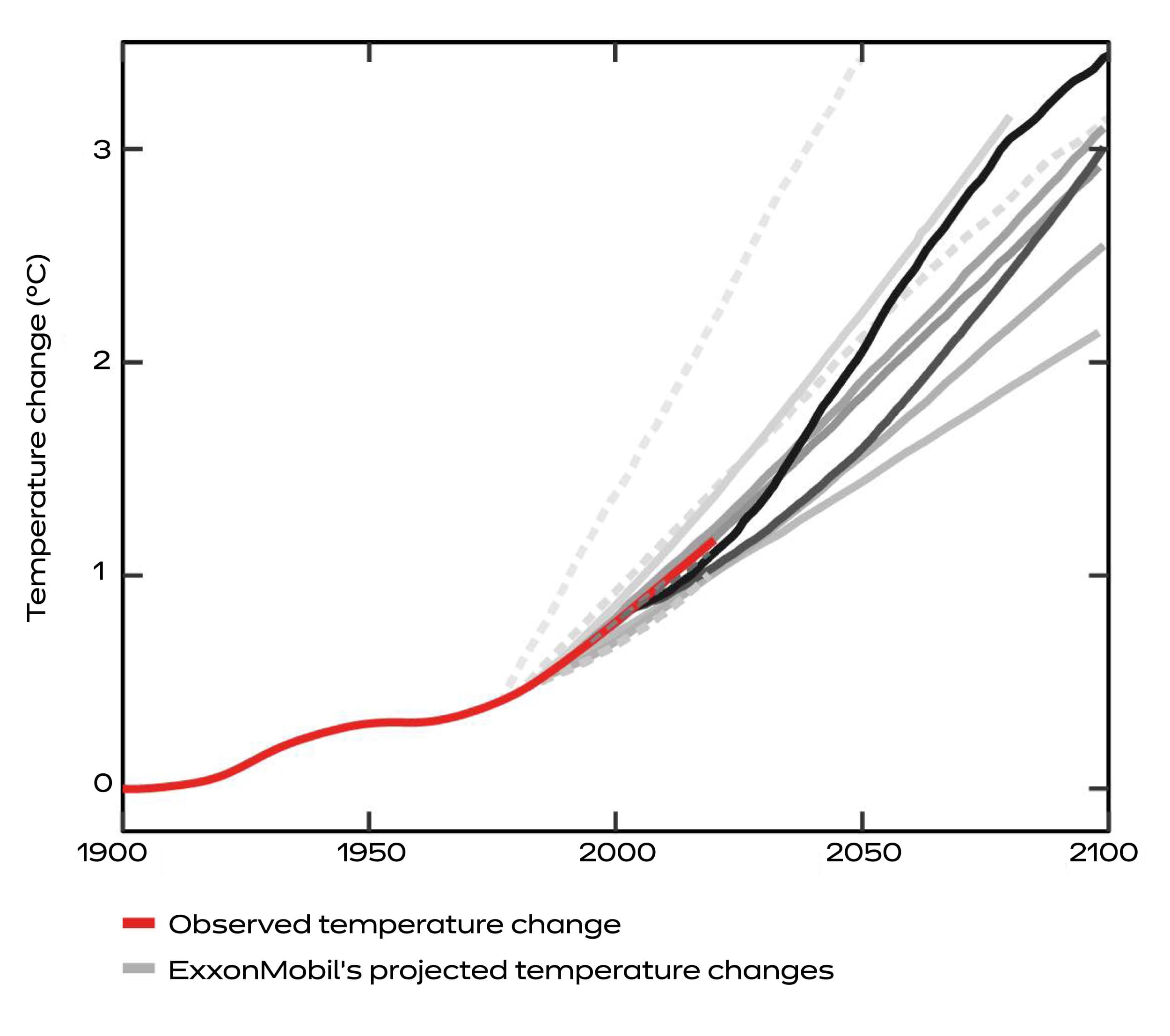
Leaked internal Exxon documents from the 1970s-80s show company scientists correctly predicted climate change effects decades before Exxon publicly denied global warming science.
“The scientific evidence for climate change remains inconclusive and requires further study before any policy decisions”
From “crazy” to confirmed
The Claim Is Made
This is the moment they called it crazy.
In the late 1970s, Exxon's own scientists were running computer models that predicted global warming with striking accuracy. The company's internal projections, developed by researchers like James Black, showed that burning fossil fuels would raise atmospheric CO2 levels and warm the planet—conclusions that align remarkably well with modern climate science. Yet for decades afterward, Exxon publicly questioned whether climate change was real at all.
This disconnect between what Exxon knew internally and what it told the public became undeniable after Inside Climate News obtained and reviewed internal company documents, memos, and meeting notes spanning from 1977 through the mid-1980s. The investigation revealed that Exxon had been monitoring climate research closely, funding its own studies, and drawing clear conclusions about the dangers of continued fossil fuel consumption.
At the time, Exxon's acknowledgment of climate risks was hardly fringe thinking. The scientific consensus around human-caused global warming was solidifying. The company simply recognized this reality earlier than most and invested in understanding what it meant for their business. One internal memo stated plainly that if climate projections proved accurate, the implications would be "of great importance to the future of the company."
But something shifted. Through the 1980s and beyond, Exxon's public position began to diverge sharply from its internal scientific findings. The company would later become known for funding climate skepticism, supporting think tanks that questioned warming science, and downplaying the urgency of climate action. Industry documents suggest this wasn't due to new scientific evidence contradicting their earlier work—it was a deliberate strategic choice.
Get the 5 biggest receipts every week, straight to your inbox — plus an exclusive PDF: The Top 10 Conspiracy Theories Proven True in 2025-2026. No spam. No agenda. Just the papers they couldn't hide.
You just read "Exxon's Internal Climate Scientists Accurately Predicted Glo…". We send ones like this every week.
No one's said anything yet. Be the first to drop your take.
The evidence for this claim is substantial and documented. Inside Climate News's investigation, published in 2015, drew from decades of archived Exxon materials. The reporters found internal presentations where Exxon scientists presented climate projections to company leadership. They discovered that the company tracked CO2 emission scenarios and understood feedback loops in the climate system. Crucially, the scientists' early predictions have held up well against actual climate observations decades later.
What makes this case particularly significant is that it reveals a knowing gap between private understanding and public messaging. Exxon wasn't ignorant of climate science. The company couldn't claim it was caught off guard by a scientific consensus that emerged later. Instead, the evidence shows executives and scientists understood the stakes, discussed them in boardrooms, and then made a business decision to cast doubt on the very science they had validated internally.
This matters because it speaks to institutional accountability and public trust. Citizens, policymakers, and investors make decisions based on information they're given. When a major corporation privately acknowledges risks while publicly sowing doubt about those same risks, it distorts the public understanding of reality. It delays action that might have prevented or mitigated harm.
The Exxon case also raises broader questions about what other institutions may know privately but won't admit publicly. It demonstrates that being on the right side of science, internally, doesn't mean being on the right side of history if you're simultaneously working to undermine that science externally.
Beat the odds
This had a 0.8% chance of leaking — someone talked anyway.
Conspirators
~200Network
Secret kept
10.7 years
Time to 95% exposure
500+ years