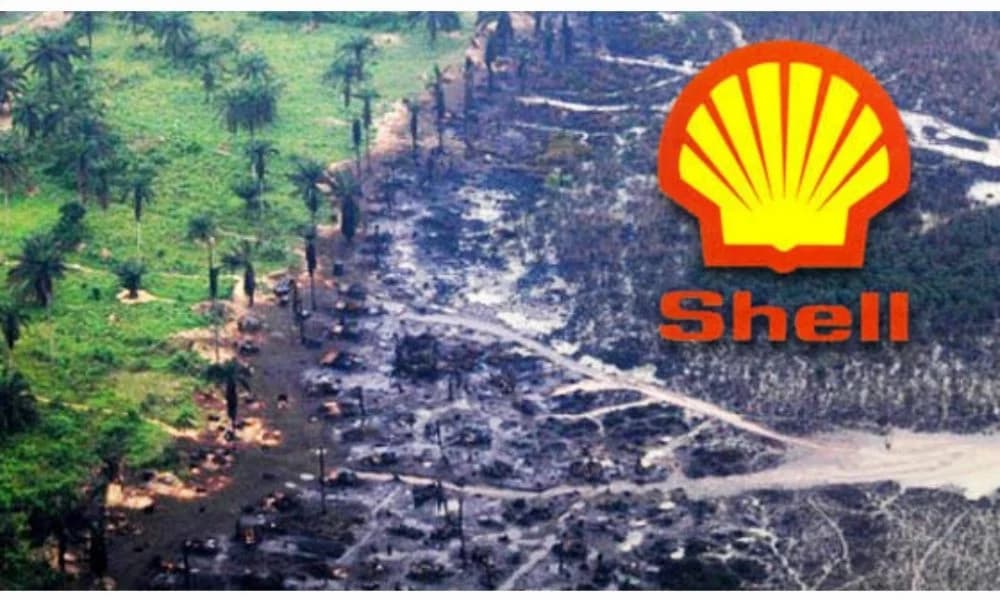
Leaked Shell documents revealed the company was aware of extensive pipeline leaks and environmental destruction in Nigeria's Niger Delta but publicly blamed sabotage. Internal reports documented ecosystem damage.
“Oil spills in Nigeria are primarily caused by criminal sabotage and illegal refining operations”
From “crazy” to confirmed
The Claim Is Made
This is the moment they called it crazy.
For decades, Shell Oil operated in Nigeria's Niger Delta with minimal public scrutiny. The company extracted billions in crude while the region's environment deteriorated around them. What remained unclear for years was whether Shell knew the damage was happening, or whether they were simply negligent operators in a chaotic region.
The company's public position was consistent and straightforward: sabotage by local militants and criminal gangs was responsible for the oil spills plaguing the Niger Delta. Shell blamed theft and pipeline vandalism for the environmental catastrophe unfolding across one of Africa's most ecologically sensitive regions. This narrative allowed the corporation to position itself as a victim of circumstances beyond its control, rather than as a polluter.
Local communities and environmental groups disputed this account, but their voices carried little weight against Shell's corporate messaging and government relationships. The official story held: yes, there were spills, but they weren't Shell's fault. The company maintained this position throughout the 1990s and 2000s as oil slicks fouled waterways and poisoned farmland.
Then WikiLeaks released the cables. Among the thousands of diplomatic communications made public starting in 2010 were internal Shell documents and correspondence that painted a very different picture. These weren't allegations or environmental assessments conducted by critics. These were Shell's own internal reports acknowledging pipeline leaks, equipment failures, and systematic environmental damage that the company knew about in real time.
The cables revealed that Shell engineers had documented extensive corrosion, aging infrastructure, and predictable failure points throughout their Nigerian operations. The company was aware that their pipelines were degrading and would inevitably leak. Internal communications showed Shell understood the environmental consequences of these failures—contaminated soil, poisoned water, destroyed ecosystems. Yet publicly, the corporation continued attributing spills primarily to sabotage.
Get the 5 biggest receipts every week, straight to your inbox — plus an exclusive PDF: The Top 10 Conspiracy Theories Proven True in 2025-2026. No spam. No agenda. Just the papers they couldn't hide.
You just read "Shell Oil Knew About Nigerian Oil Spill Environmental Damage". We send ones like this every week.
No one's said anything yet. Be the first to drop your take.
This wasn't a case of discovering something that happened in the distant past. The leaked documents covered operations from the 1980s through the 2000s, meaning Shell maintained this deceptive narrative for two decades while possessing contrary evidence. The documents didn't suggest the company was unaware of the damage. They suggested Shell knew exactly what was happening and chose to manage its public image rather than address the problem.
The environmental toll was staggering. The Niger Delta, home to roughly 30 million people, experienced oil spills at rates far exceeding those in other oil-producing regions worldwide. Farmland became unusable. Fishing communities lost their livelihoods. The ecosystem suffered damage that experts said would require generations to recover.
What makes this case significant isn't just that a corporation lied. It's that Shell's false narrative was accepted by governments, media outlets, and international institutions because the alternative—holding a major oil company accountable—required confronting powerful economic interests. The leaked documents didn't change Shell's fundamental business practices in Nigeria overnight. They simply made it harder to maintain the pretense of ignorance.
This case illustrates how institutional knowledge and public knowledge operate in separate spheres. Companies can document internal truths while promoting external falsehoods, and those falsehoods can persist as long as the incentives for questioning them remain weak. The WikiLeaks revelations proved the claim wasn't just plausible—it was documented fact. Shell knew.
Beat the odds
This had a 1.2% chance of leaking — someone talked anyway.
Conspirators
~200Network
Secret kept
15.4 years
Time to 95% exposure
500+ years